
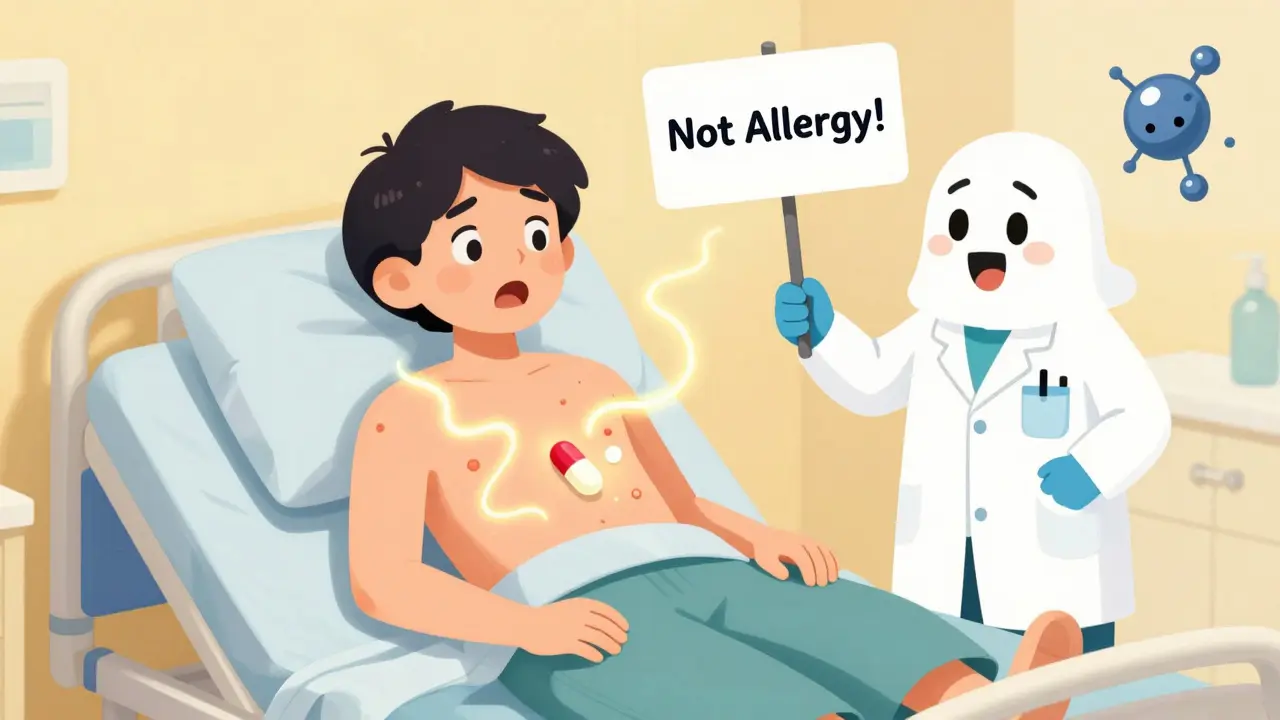
Many people who take opioids for pain end up with one very common complaint: intense itching. It’s not just annoying - it can make patients think they’re having a dangerous allergic reaction. But here’s the truth: itching from opioids is rarely a true allergy. In fact, most of the time, it’s just a side effect - and knowing the difference could mean the difference between staying on effective pain relief or being stuck with weaker, less reliable options.
Itching Isn’t an Allergy - Most of the Time
When you take morphine or codeine and break out in itchy skin, it’s not because your immune system is attacking the drug. It’s because the opioid is directly triggering mast cells in your skin to dump histamine - a chemical that causes redness, flushing, and yes, that relentless itch. This is called a pseudoallergic reaction. It mimics an allergy but doesn’t involve antibodies or immune memory. Think of it like a false alarm. Your body reacts, but it’s not because you’re allergic - it’s because the drug is chemically irritating your cells. Studies show that 70% to 80% of people who say they’re "allergic to opioids" are actually experiencing this kind of reaction. A 2022 study from the University of Michigan looked at over 1,200 patients who reported opioid allergies. Nearly 9 out of 10 of them described only itching, nausea, or dizziness - all classic side effects, not true allergies.What Does a Real Opioid Allergy Look Like?
True opioid allergies are rare - affecting only 0.1% to 0.3% of people who take them. They involve your immune system recognizing the drug as a threat and mounting a full-blown response. This isn’t just itching. It’s hives that spread quickly, swelling of the lips or throat (angioedema), trouble breathing, a sudden drop in blood pressure, or even anaphylaxis. These reactions usually happen within minutes to an hour after taking the drug, especially the first time. One case reported by Mayo Clinic involved a 44-year-old woman who went into anaphylaxis five minutes after her first morphine dose. Her blood pressure crashed to 70 mmHg, her oxygen levels dropped, and she needed epinephrine and ICU care. That’s a true allergy. And if you’ve had something like that, you need to avoid that opioid - and possibly others like it - for life.Why the Confusion Matters
Labeling someone as "allergic to opioids" just because they got itchy can have serious consequences. Pain management becomes harder. Doctors may avoid prescribing powerful painkillers, even when they’re the best option. Patients end up with weaker drugs, longer recovery times, or even unnecessary surgery because they can’t get adequate pain control. The cost? In the U.S., mislabeling opioid "allergies" adds about $1,200 per patient in extra healthcare costs - mostly from switching to more expensive or less effective alternatives. Multiply that across millions of patients, and you’re looking at $24 billion to $36 billion a year. And here’s the kicker: 90% of people labeled allergic to opioids can safely take another opioid after proper evaluation. That’s not a guess - it’s from a 2022 study by Dr. Elina Jerschow and her team at the American College of Allergy, Asthma & Immunology.
Which Opioids Cause the Most Itching?
Not all opioids are created equal when it comes to itching. Morphine is the worst offender. It releases 3 to 4 times more histamine than an equivalent dose of hydromorphone. Codeine is similar. Both have a chemical structure that easily triggers mast cells. Fentanyl, on the other hand? Almost none. Methadone? Very little. Why? Their chemical makeup doesn’t irritate mast cells the same way. That’s why switching from morphine to fentanyl or methadone often stops the itching cold - even if the patient was told they’re "allergic to all opioids." Here’s a quick comparison:| Opioid | Itching Risk | Histamine Release | Notes |
|---|---|---|---|
| Morphine | High (30-40%) | Very High | Classic trigger; avoid if itching is severe |
| Codeine | High (25-35%) | High | Often used in combination meds; same risk as morphine |
| Oxycodone | Moderate (15-25%) | Moderate | Less histamine than morphine, but still causes itching |
| Fentanyl | Low (5-10%) | Very Low | Safe alternative; patch form works well |
| Methadone | Low (5-10%) | Very Low | Long-acting; needs careful dosing |
| Hydromorphone | Low (5-15%) | Low | Strong pain relief with minimal itching |
What Should You Do If You Get Itchy?
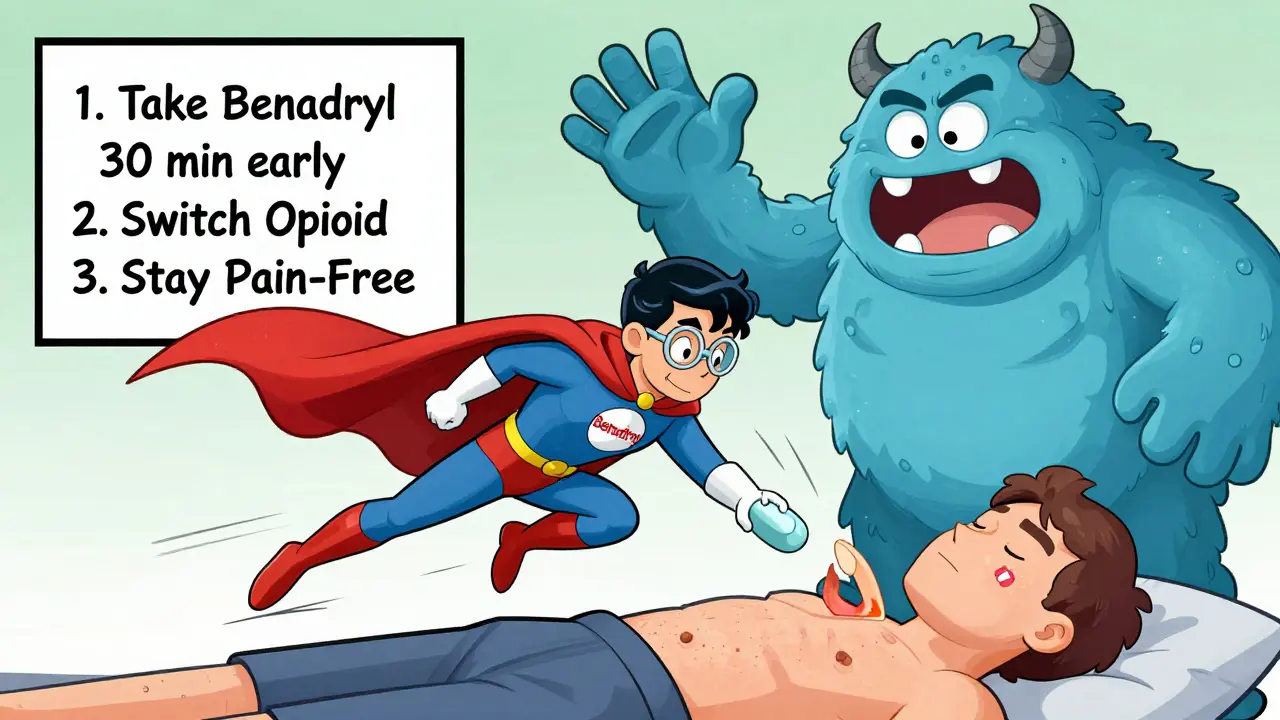
If you’re on opioids and start itching, don’t panic. Don’t stop the medication. Don’t assume you’re allergic. Talk to your doctor. Here’s what actually works:- Take an antihistamine like diphenhydramine (Benadryl) 25-50 mg about 30 minutes before your next opioid dose. This blocks histamine and stops the itch in 80-90% of cases.
- Ask your doctor to reduce the opioid dose by 25-50%. Pseudoallergic reactions are dose-dependent - lower the dose, lower the itch.
- Switch to a different opioid. Fentanyl or methadone are often the best choices. You don’t need to avoid all opioids - just the ones that trigger histamine.
- If you’re in palliative care, ask about nalfurafine. It’s a new anti-itch drug approved in Japan and in late-stage trials in the U.S. It targets the spinal itch pathway directly, without affecting pain relief.
When to Be Concerned
You need urgent care if you have:- Swelling of the face, lips, tongue, or throat
- Wheezing or trouble breathing
- Dizziness, fainting, or a sudden drop in blood pressure
- Hives that spread fast or turn into blisters
What About Skin Tests?
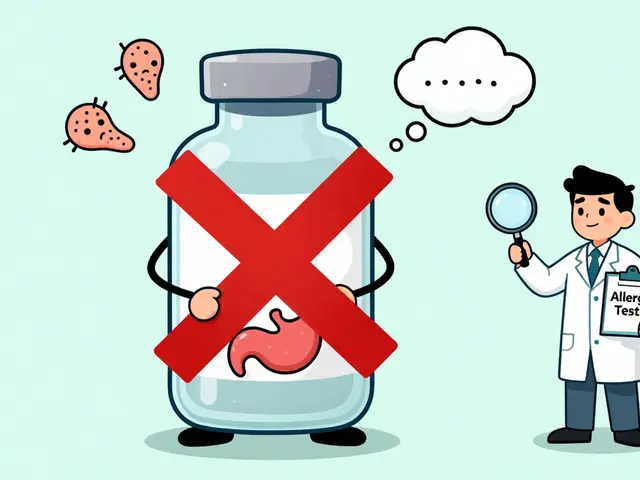
Some clinics offer skin testing for opioid allergies. But here’s the problem: they’re not very reliable. Studies show up to 30% of people get false positives - meaning they’re told they’re allergic when they’re not. The American Pain Society doesn’t recommend routine skin testing unless you’ve had a life-threatening reaction. Instead, the best test is a supervised trial. If your doctor suspects a pseudoallergy, they might give you a low dose of a different opioid - like fentanyl - while you’re on antihistamines. If you don’t react, you’re not allergic. Simple. Safe. Effective.What Patients Are Saying
Reddit threads on r/painmanagement are full of stories like this:"I was told I was allergic to all opioids because I got itchy on morphine. I tried fentanyl patch with Benadryl - no itching, no problem. Now I’m pain-free. Why wasn’t anyone told this?" - u/PainWarrior2022On the flip side, someone who truly had anaphylaxis writes:
"One dose of morphine and I couldn’t breathe. I nearly died. I don’t take any opioids now. I’m labeled allergic - and I’m glad I am." - u/TrueAllergySurvivorBoth are valid. But they’re not the same thing.
The Bottom Line
Itching from opioids is common. It’s usually not an allergy. It’s a side effect - and one that’s easy to manage. Don’t let a simple itch stop you from getting the pain relief you need. Talk to your doctor. Try an antihistamine. Consider switching opioids. Don’t accept "you’re allergic to all opioids" as an answer. And if you’ve ever had a true allergic reaction - swelling, breathing trouble, collapse - then yes, avoid those drugs. But make sure your records are clear. Your life might depend on it.Is itching from opioids a sign of an allergy?
No, itching from opioids is usually not an allergy. It’s a pseudoallergic reaction caused by direct histamine release from mast cells. True allergies involve immune system activation and cause symptoms like swelling, trouble breathing, or anaphylaxis - not just itchiness.
Can I still take opioids if I get itchy?
Yes. Most people who get itchy on morphine or codeine can safely take other opioids like fentanyl or methadone, especially if they take an antihistamine like diphenhydramine beforehand. Switching opioids often eliminates the itching without losing pain control.
Which opioid causes the least itching?
Fentanyl and methadone cause the least itching. They have chemical structures that don’t trigger histamine release the way morphine and codeine do. Studies show only 5-10% of patients on fentanyl or methadone experience itching, compared to 30-40% on morphine.
Should I get tested for an opioid allergy?
Only if you’ve had a severe reaction like anaphylaxis. Skin tests for opioids are unreliable and often give false positives. The best way to test is a supervised trial with a different opioid under medical supervision while using antihistamines.
Can I use Benadryl to stop opioid itching?
Yes. Taking diphenhydramine (Benadryl) 25-50 mg 30 minutes before your opioid dose reduces itching in 80-90% of cases. It’s safe, cheap, and widely available. Many hospitals use this as standard practice for patients who get itchy on morphine.

Darren Torpey
March 4, 2026 AT 16:50Tobias Mösl
March 4, 2026 AT 18:48tatiana verdesoto
March 5, 2026 AT 15:23Justin Rodriguez
March 6, 2026 AT 15:28Ethan Zeeb
March 7, 2026 AT 12:14Siri Elena
March 8, 2026 AT 21:14Mariah Carle
March 9, 2026 AT 20:46Milad Jawabra
March 11, 2026 AT 16:38Jessica Chaloux
March 12, 2026 AT 02:49Tildi Fletes
March 12, 2026 AT 06:05Pankaj Gupta
March 13, 2026 AT 17:52Alex Brad
March 13, 2026 AT 21:27Lebogang kekana
March 14, 2026 AT 09:13Chris Beckman
March 15, 2026 AT 11:57Megan Nayak
March 17, 2026 AT 11:31