

Steroid Eye Exam Reminder Calculator
Eye Exam Calculator
Find your next recommended eye exam based on your steroid usage.
Recommended Eye Exam Schedule
Enter your steroid usage details above to see your personalized eye exam schedule.
When you’re taking steroids for asthma, eczema, rheumatoid arthritis, or another chronic condition, your main focus is usually managing the disease-not your eyes. But if you’ve been on steroids for months or longer, your vision might be changing without you realizing it. Blurry vision, halos around lights, faded colors, trouble reading-these aren’t just signs of aging. They could be early signs of steroid-induced cataracts, a preventable and treatable side effect that many patients don’t know about until it’s too late.
What Exactly Are Steroid-Induced Cataracts?
Cataracts are cloudy areas that form in the lens of your eye, blocking light and making vision fuzzy. Most people think of cataracts as something that happens slowly with age. But steroid-induced cataracts are different. They form faster, in as little as 2-4 weeks, and they show up in a very specific spot: the back of the lens, just behind the pupil. This is called a posterior subcapsular cataract, or PSC.Why does this matter? Because this part of the lens is directly in the path of light entering your eye. Even a tiny cloud here can cause major vision problems. Unlike age-related cataracts that start at the edges and creep inward, PSCs begin right where you need clear vision-making them especially disruptive for reading, driving at night, or seeing in bright sunlight.
The science behind it is complex, but here’s the simple version: steroids change the way proteins in your lens behave. Normally, these proteins stay neatly arranged to let light pass through clearly. Steroids cause them to clump together like scrambled eggs. These clumps scatter light instead of letting it focus on your retina. And because your lens has no blood supply, it can’t repair itself. Once the damage starts, it builds up over time.
Who’s at Risk?
It’s not just about how much steroid you take-it’s how long, how often, and how it’s delivered. Topical eye drops, inhaled steroids for asthma, and oral pills all carry risk. But here’s the surprising part: topical steroids (eye drops or ointments) are the most likely to cause cataracts. A 2024 study in Saudi Arabia found that people using steroid eye drops had over three times the risk compared to those taking them orally or by inhalation.Patients on long-term treatment are most vulnerable:
- Those taking more than 2,000 mg of beclomethasone (a common inhaled steroid) over time
- Anyone using steroids for more than 4 months
- Children on chronic steroid therapy for conditions like nephrotic syndrome or severe eczema
- People with diabetes or uveitis-these conditions already stress the eye, and steroids make it worse
Even if you’re taking steroids as prescribed, you’re not immune. About 8.9% of long-term users develop these cataracts. And because the symptoms creep in slowly, many don’t notice until their vision is already significantly affected.
What Do Steroid-Induced Cataracts Feel Like?
If you’re on steroids and your vision has changed lately, pay attention to these signs:- Blurry vision-especially when reading or doing close work (reported in 92% of cases)
- Glare and halos around headlights, streetlights, or bright windows (83% of patients)
- Faded or washed-out colors-red looks dull, white seems yellowish
- Double vision in one eye (not both)
- Difficulty seeing at night-even with good street lighting
- Reduced peripheral vision-like looking through a tunnel
These symptoms often get worse in bright light. That’s why many patients say they can’t drive at night anymore, or they avoid going outside on sunny days. One patient described it as “seeing through frosted glass”-everything is soft, blurry, and lacks contrast. Text on a page doesn’t pop like it used to. Colors lose their punch.
Unlike age-related cataracts, which develop over years, steroid-induced ones can go from barely noticeable to severely impairing vision in just 6-12 months. That’s why waiting to see your eye doctor until you’re struggling to read the TV remote is too late.
How Are They Diagnosed?
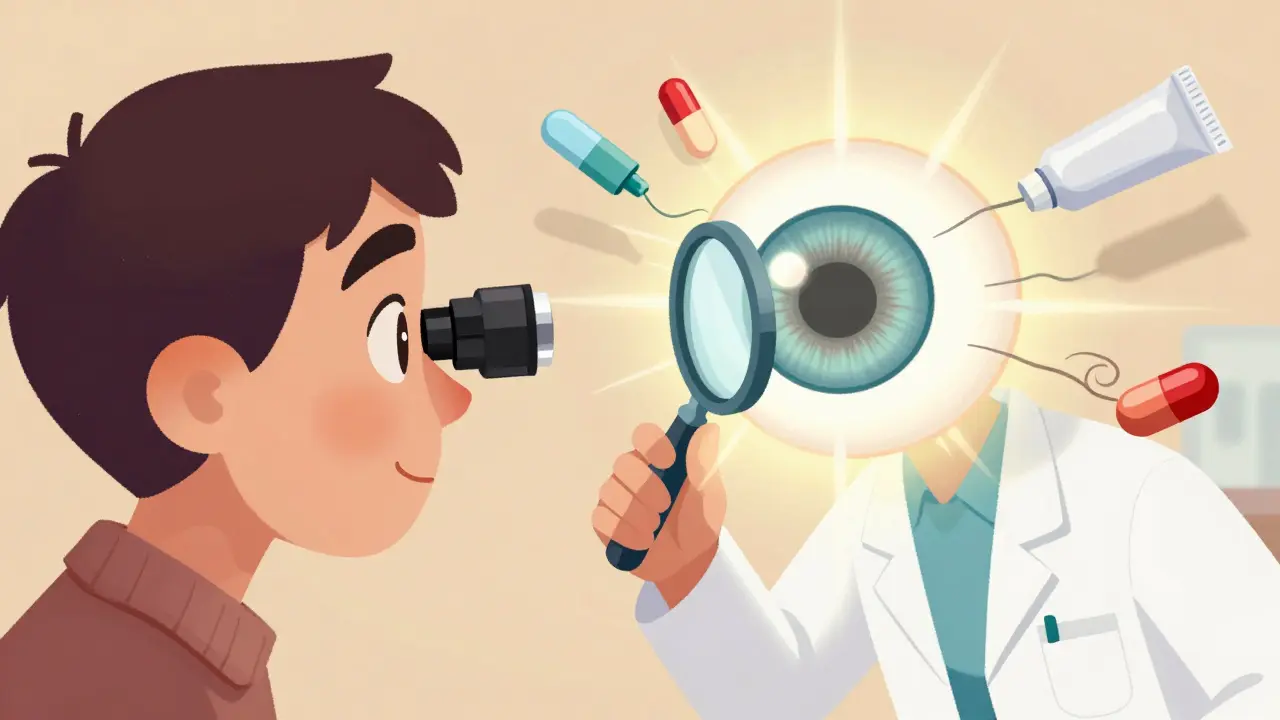
Your eye doctor doesn’t need fancy tests to spot these. A simple slit-lamp exam-where they shine a bright, thin beam into your eye and look through a microscope-is usually enough. Early PSCs look like tiny, pearl-like opacities on the back surface of the lens. Often, these show up before you even notice symptoms.That’s why regular eye checks are critical. If you’re on long-term steroids (more than 2 weeks), your doctor should have already recommended a baseline eye exam. After that, you need follow-ups every 3-6 months. If you’re using high-dose steroids or have other risk factors like diabetes, every 3 months is better.
Many patients don’t realize their eye doctor needs to know about every steroid they’re taking-not just eye drops, but inhalers, creams, injections, and pills. Even a low-dose nasal spray can contribute over time. Keep a list of all medications and bring it to every eye appointment.
Can You Reverse Them Without Surgery?
Unfortunately, no. Once the protein clumps form in the lens, they don’t go away. There’s no eye drop, supplement, or diet that can clear them. Antioxidants like vitamin C or E have been studied, but there’s no proven benefit yet. Some researchers are looking into new protective compounds, but nothing is ready for use.The only way to restore clear vision is surgery. That’s the hard truth. But here’s the good news: cataract surgery is one of the safest and most successful operations in all of medicine. Over 92% of patients see a major improvement in vision after the procedure.
The surgery itself is quick-usually under 20 minutes. The cloudy lens is removed and replaced with a clear artificial lens, called an IOL. Most people notice better vision within a day or two. Colors look brighter, glare fades, and reading becomes easy again.
But there’s a catch: if you still need steroids after surgery, your new lens isn’t immune. You’ll still be at risk for new cataracts forming, or other complications like increased eye pressure (steroid-induced glaucoma). That means you’ll need ongoing monitoring-even after surgery.
What If You Can’t Stop Taking Steroids?
This is the toughest part for many patients. If you have asthma, lupus, or Crohn’s disease, stopping steroids might mean your condition flares up. That’s why doctors don’t just say “quit the meds.” They weigh the risks.Here’s what a good care team does:
- They try to reduce your steroid dose to the lowest effective level
- They look for alternative treatments-like biologics for autoimmune diseases-that don’t cause cataracts
- They coordinate between your rheumatologist, pulmonologist, or dermatologist and your eye doctor
Studies show that when specialists communicate, patients have 37% less vision loss. That’s huge. Don’t let your eye doctor be the only one who knows about your steroid use. Make sure your prescribing doctor knows your vision is changing.
What Happens After Surgery?
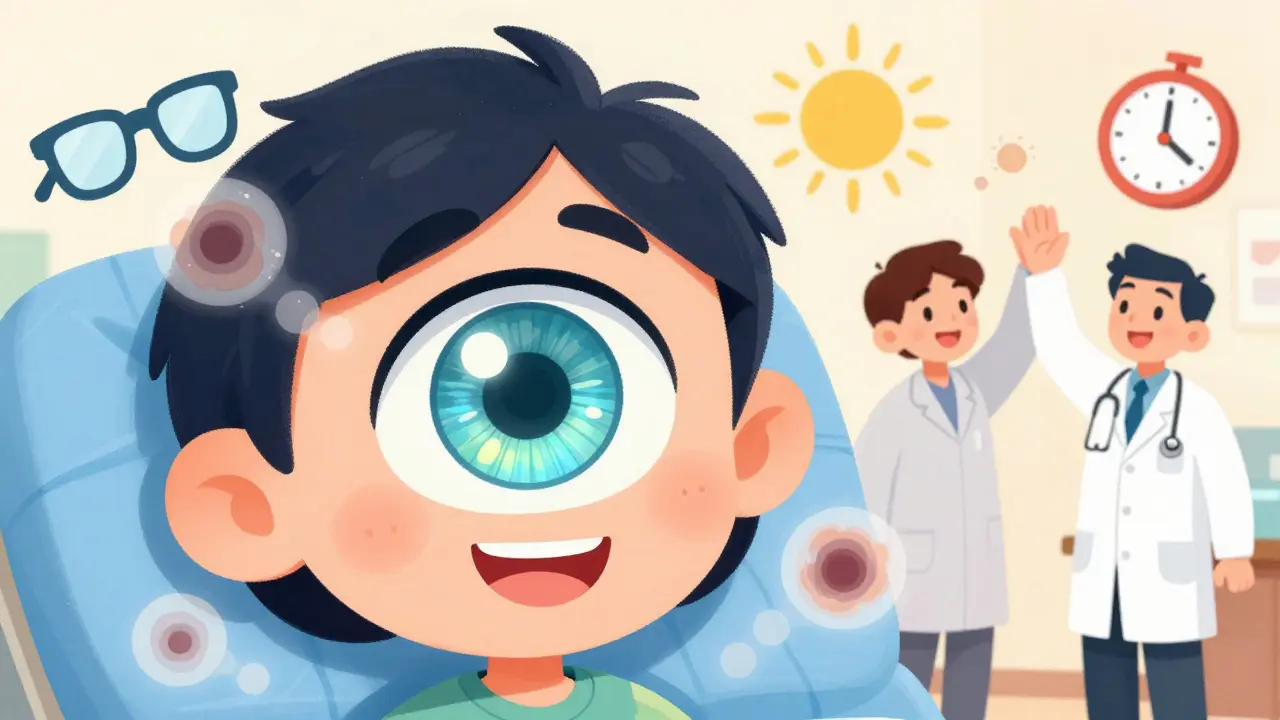
Most patients feel like they’ve gotten their vision back. But recovery isn’t always smooth. If you’re still on steroids, your eye might swell more than usual. You’ll likely need stronger anti-inflammatory eye drops after surgery. And you’ll need to come back for checkups more often.Some patients develop a condition called posterior capsule opacification (PCO)-sometimes called a “secondary cataract.” It’s not a new cataract, just a cloudy membrane behind the new lens. It’s easy to fix with a quick laser treatment that takes 5 minutes and needs no recovery time.
Overall, outcomes are excellent. Most people don’t need glasses for distance after surgery, and many can read without reading glasses, depending on the type of lens implanted.
How to Protect Your Vision
If you’re on steroids, here’s your action plan:- Get a baseline eye exam before starting long-term steroid therapy
- Stick to a 3-6 month eye check schedule-don’t skip them
- Tell every doctor you see that you’re on steroids-eye doctors need to know, but so do your primary care and specialists
- Use the lowest dose possible for the shortest time
- Watch for symptoms-if your vision changes, don’t wait. Book an appointment immediately
- Ask about alternatives-are there non-steroid options for your condition?
Many patients feel guilty about asking to reduce their steroids. But your vision matters. If your eyesight is fading, it’s not a sign you’re doing something wrong-it’s a sign your treatment plan needs adjusting. A good doctor will work with you to find the balance between controlling your disease and protecting your sight.
Final Thoughts
Steroid-induced cataracts aren’t rare. They’re predictable. And they’re preventable-if you know what to look for. The biggest risk isn’t the steroid itself-it’s silence. Silence from patients who don’t realize their blurry vision is linked to their medication. Silence from doctors who don’t ask about eye health.You don’t have to accept faded colors, nighttime glare, or blurry text as part of life on steroids. Vision loss from these cataracts is almost always reversible. But only if you act early. Stay informed. Stay vigilant. And don’t let a simple eye exam slide off your calendar. Your future self will thank you.
Can steroid eye drops cause cataracts?
Yes. Topical steroid eye drops carry the highest risk of causing posterior subcapsular cataracts, even more than oral or inhaled steroids. Studies show users of steroid eye drops have over three times the risk compared to other forms. This is why doctors monitor eye pressure and lens clarity closely in patients using these drops for more than a few weeks.
How long does it take for steroids to cause cataracts?
Cataracts can begin forming in as little as 2-4 weeks of steroid use, especially with high doses or eye drops. But noticeable vision changes usually appear after 3-6 months. By 4 months of continuous use, the risk increases significantly. That’s why regular eye exams every 3-6 months are essential for anyone on long-term steroids.
Are steroid-induced cataracts reversible without surgery?
No. Once the lens proteins clump together due to steroid exposure, the cloudiness cannot be reversed with drops, supplements, or lifestyle changes. The only proven way to restore clear vision is cataract surgery, where the cloudy lens is replaced with an artificial one. Early detection doesn’t prevent the cataract-but it allows you to plan surgery before vision becomes dangerously impaired.
Can I still use steroids after cataract surgery?
Yes, but with caution. Your new artificial lens is not immune to steroid damage. You can still develop new clouding or increased eye pressure after surgery. That’s why ongoing monitoring is critical. Your eye doctor will likely prescribe stronger anti-inflammatory drops after surgery and schedule more frequent checkups if you continue steroid therapy.
Do all steroids cause cataracts?
Not all, but most do. Any corticosteroid-whether it’s prednisone, dexamethasone, beclomethasone, fluticasone, or hydrocortisone-can potentially cause cataracts with prolonged use. The risk is higher with stronger steroids and longer duration. Even low-dose nasal sprays or skin creams can contribute over time. The key factor is cumulative exposure, not the specific type.
Should I stop taking steroids if I develop cataracts?
Never stop steroids on your own. Abruptly stopping can cause serious health problems, like adrenal crisis or disease flare-ups. Instead, talk to your prescribing doctor and your eye doctor together. They may be able to lower your dose, switch to a different medication, or adjust your treatment plan to protect your vision without risking your overall health.


Doreen Pachificus
January 4, 2026 AT 07:19Been on inhaled steroids for asthma for 5 years and just noticed how much harder it is to read street signs at night. Thought I needed new glasses. Turns out, maybe not.
Thanks for laying this out so clearly.
Charlotte N
January 4, 2026 AT 21:02i had no idea eye drops were the worst??
my dermatologist gave me hydrocortisone cream for my eczema and never said a word about eyes
now i’m scared to use anything
Uzoamaka Nwankpa
January 6, 2026 AT 15:19My mom had cataract surgery last year and still uses prednisone for her lupus. Her doctor told her the new lens won’t get cloudy but she’s got to come back every 3 months. I didn’t even know this was a thing until now. Scary.
Oluwapelumi Yakubu
January 8, 2026 AT 05:55Listen here, my brothers and sisters - steroids are the silent thief of clarity. Not the kind that makes you jacked, but the kind that steals your sunset, your text messages, your ability to read the damn microwave timer without squinting.
It’s not magic, it’s molecular mayhem. Proteins in your lens? They’re not just clumping - they’re throwing a rave in your eyeball while you’re asleep. And you? You’re just trying to find your car keys.
Don’t wait for the world to go frosted. Get that slit-lamp exam like it’s your job. Because honestly? It might be.
Abhishek Mondal
January 8, 2026 AT 23:50Actually, the real issue here isn't steroid-induced cataracts - it's the pharmaceutical-industrial complex's systematic erasure of patient autonomy under the guise of 'treatment protocols.'
Did you know that the 2024 Saudi study was funded by an IOL manufacturer? The posterior subcapsular cataract narrative is engineered to drive surgical revenue. There are natural antioxidants - lutein, zeaxanthin, astaxanthin - that have shown promise in vitro, but they're suppressed because they're not patentable.
And why is everyone so quick to accept surgery? The lens isn't a disposable camera. You're replacing a biological marvel with a plastic disc. And then they tell you it's 'safe.' Safe for whom? Not for your soul.
Catherine HARDY
January 9, 2026 AT 22:58Wait - so if I’m on steroid nasal spray for allergies… and I get cataracts… and then I get surgery… and then I’m still on the spray… does that mean the hospital is secretly in cahoots with the drug companies?
They know this will happen. They know. They just don’t tell you. It’s all about the money. I’ve been watching documentaries. This isn’t medicine. It’s a slow-motion scam.
And what if the new lens is bugged? What if they’re tracking your eye movements? I’ve heard things…
Allen Ye
January 11, 2026 AT 03:29There’s something deeply existential about losing your vision to a medication meant to save you.
We treat the body like a machine - fix the asthma, fix the eczema, fix the arthritis - but we forget that the eye is not a component you can swap out. It’s a window to the world that has been shaped by centuries of evolution, and now we’re clouding it with synthetic molecules that don’t belong.
And yet, we’re told to be grateful for the medicine. But gratitude doesn’t restore the vibrancy of a red stoplight. It doesn’t bring back the crispness of a child’s face in a photo. It doesn’t make the stars visible again.
Maybe the real question isn’t how to treat steroid-induced cataracts - it’s whether we should be prescribing them at all. We’ve optimized for survival, but what about quality? What about the quiet, ordinary beauty of seeing clearly? That’s not a side effect - it’s the point of living.
And if we’re willing to trade that for a few more years of controlled inflammation, then we’ve already lost something far more valuable than sight.
Maybe we need to stop thinking of medicine as a tool for control, and start thinking of it as a conversation with the body - one where we listen before we intervene.
It’s not just about cataracts. It’s about how we define health in an age of chemical dominance.
And if you’re still on steroids? Please - don’t just get an eye exam. Ask your doctor if there’s another way. Not because it’s safer - but because you deserve to see the world as it is, not as a foggy memory of what it used to be.
Chris Cantey
January 12, 2026 AT 23:14I’ve been on prednisone for 7 years. I don’t see halos anymore. I just… don’t care. I’m tired. The meds keep me alive. My vision? It’s secondary.
Maybe that’s the real tragedy - we stop fighting for the small things when we’re just trying to survive.
Terri Gladden
January 14, 2026 AT 01:55OMG I JUST REALIZED MY BLURRY VISION IS FROM MY SKIN CREAM??
I’VE BEEN USING THAT STEROID CREAM FOR 3 YEARS AND NOW I CAN’T READ MY PHONE??
MY DOCTOR NEVER TOLD ME!!
THIS IS A SCANDAL!!
WHY DOESN’T THE FDA DO SOMETHING??
MY LIFE IS RUINED!!
PLEASE HELP ME I’M CRYING RIGHT NOW
melissa cucic
January 15, 2026 AT 19:54While the clinical information presented is accurate and well-sourced, it is imperative to underscore the necessity of interdisciplinary communication between primary care providers, specialists, and ophthalmologists. The absence of standardized protocols for ophthalmic monitoring in patients on chronic corticosteroid regimens represents a significant gap in preventive medicine.
Furthermore, the psychological burden of vision loss - particularly when it is iatrogenic - warrants integration into patient education frameworks. Empowerment through knowledge is not merely beneficial; it is ethically obligatory.
Future guidelines should mandate baseline and interval ophthalmologic evaluations for all patients prescribed corticosteroids for durations exceeding four weeks, regardless of route of administration. This is not an optional precaution - it is a standard of care.
Vicki Yuan
January 17, 2026 AT 07:28If you're on steroids, don't wait until you can't read your child's school report to get your eyes checked. Go now. Seriously. It takes five minutes and could save your ability to see their face clearly for years to come.
And tell every doctor you see - even the dentist - because your vision matters more than you think.