
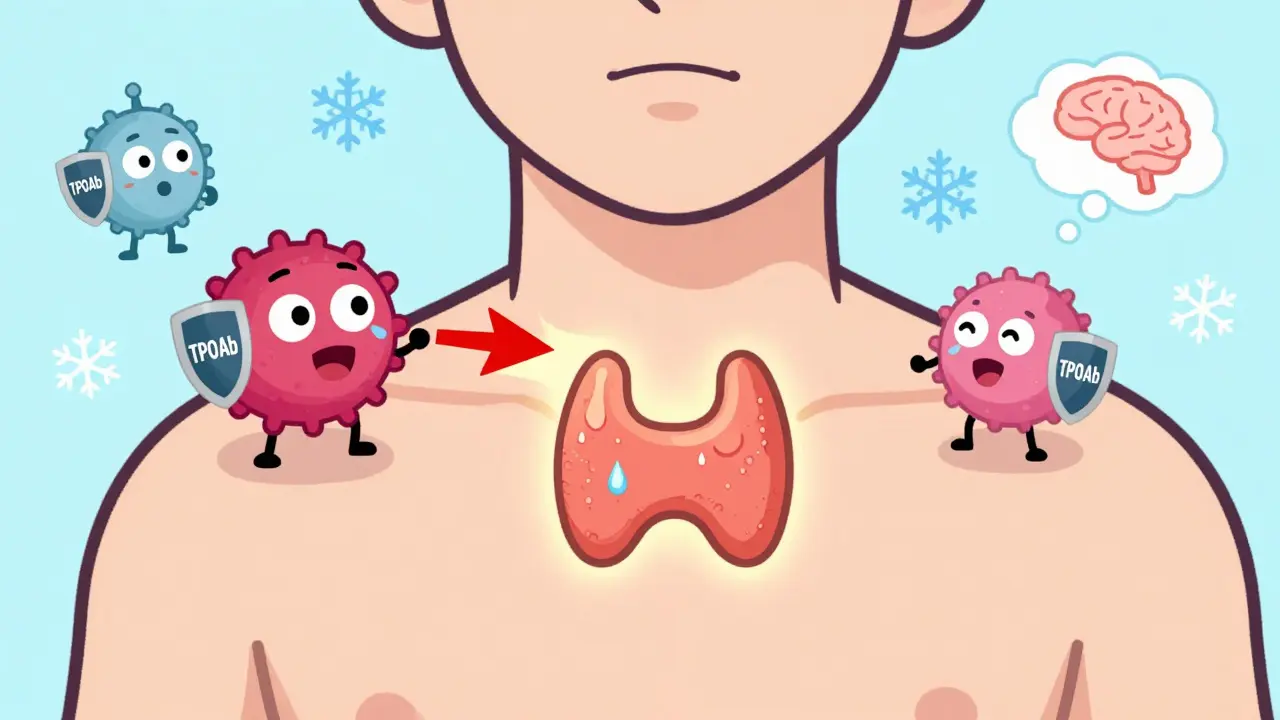
Hashimoto’s thyroiditis is the most common cause of hypothyroidism in places like the UK and the US where people get enough iodine in their diet. It’s not just a slow thyroid - it’s your immune system turning on your own thyroid gland. Imagine your body’s defense system, meant to fight off viruses and bacteria, mistakenly deciding your thyroid is the enemy. That’s Hashimoto’s. Over time, this attack damages the gland until it can’t make enough thyroid hormone. The result? Fatigue, weight gain, cold intolerance, brain fog, and mood swings - symptoms that often get dismissed as stress or aging.
What makes Hashimoto’s different from other causes of low thyroid function is that it’s autoimmune. That means blood tests for thyroid antibodies are key to confirming the diagnosis. The most common one is thyroid peroxidase antibody, or TPOAb. If your TPOAb is above 35 IU/mL, it’s a strong sign your immune system is actively targeting your thyroid. You don’t need to test these antibodies every year - once they’re high, they usually stay high. What matters more is how your thyroid is functioning right now, and that’s where TSH comes in.
Why TSH Is the Gold Standard for Monitoring
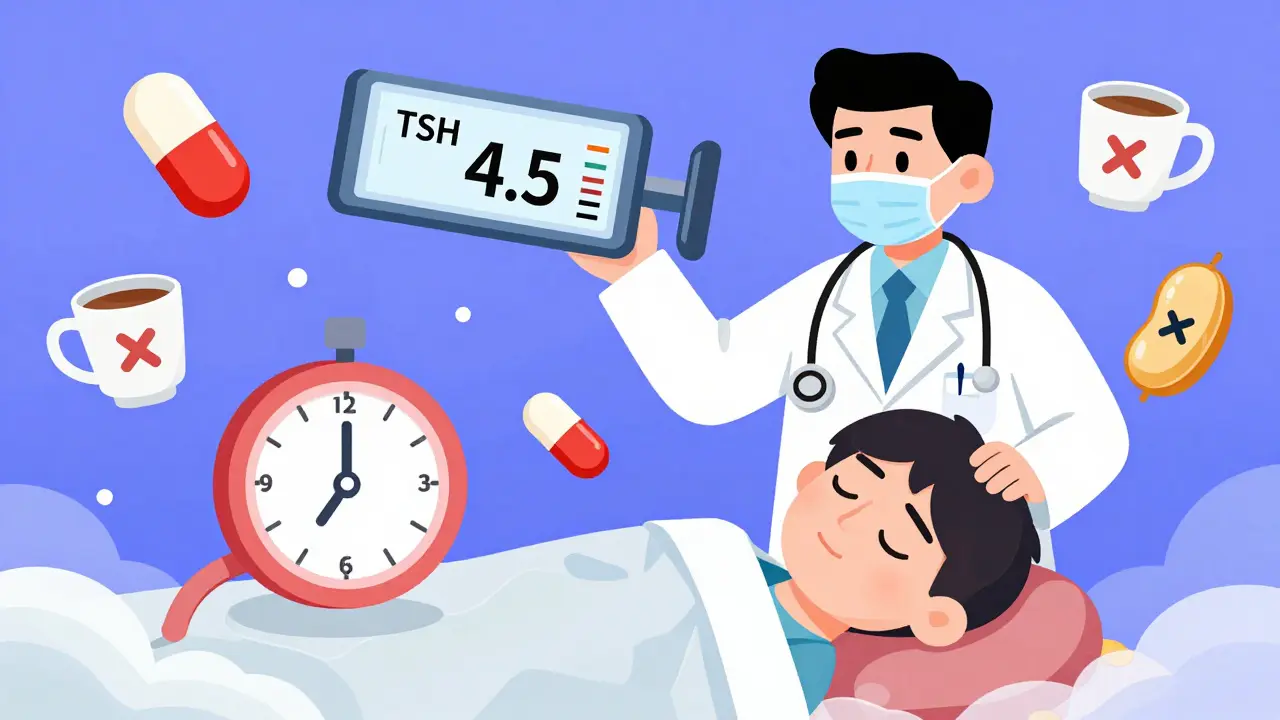
Thyroid-stimulating hormone (TSH) is the body’s way of telling your thyroid, "Hey, make more hormone." When your thyroid isn’t working well, your pituitary gland pumps out more TSH to try to kickstart it. So if your TSH is high - say, over 4.5 mIU/L - it’s a red flag that your thyroid is struggling. If you’re on levothyroxine (LT4), the goal is to bring TSH back into the normal range. Most guidelines say 0.4 to 4.0 mIU/L is the target for adults under 65. For older adults, a slightly higher TSH, up to 6.0 mIU/L, might be okay because very low TSH can raise the risk of heart problems or bone loss.
The reason TSH is so reliable is that it’s sensitive. Even small changes in thyroid hormone levels cause big shifts in TSH. That’s why doctors don’t routinely check free T4 or T3 once you’re on treatment. A 2016 Cleveland Clinic review said it plainly: "In primary hypothyroidism with no pituitary issues, TSH alone is sufficient for monitoring." You don’t need five tests when one tells you everything.
How Often Should You Get Tested?
When you first start levothyroxine, you won’t feel better overnight. It takes time for your body to adjust. That’s why most guidelines - from the AAFP, Mayo Clinic, and AACE - all agree: wait 6 to 8 weeks after starting or changing your dose before retesting TSH. Why? Because levothyroxine has a long half-life. It takes weeks for your blood levels to stabilize, and your pituitary gland needs that time to reset its sensitivity.
After that first test, if your TSH is still off, your doctor will adjust your dose - usually by 12.5 to 25 mcg - and wait another 6 to 8 weeks. This back-and-forth can be frustrating. Many people report feeling awful during this period: too much medication causes anxiety and palpitations; too little leaves you exhausted. But rushing to change doses too often doesn’t help. The science is clear: testing every 2 or 4 weeks won’t speed up results. You have to let your body catch up.
Once your TSH is steady and you feel fine, most experts recommend annual testing. Some clinics, especially in the UK, might check every 6 months at first, then switch to yearly. But if something changes - like you gain or lose more than 10% of your body weight, start a new medication, or become pregnant - you need to get tested sooner.
Special Cases: Pregnancy and Age
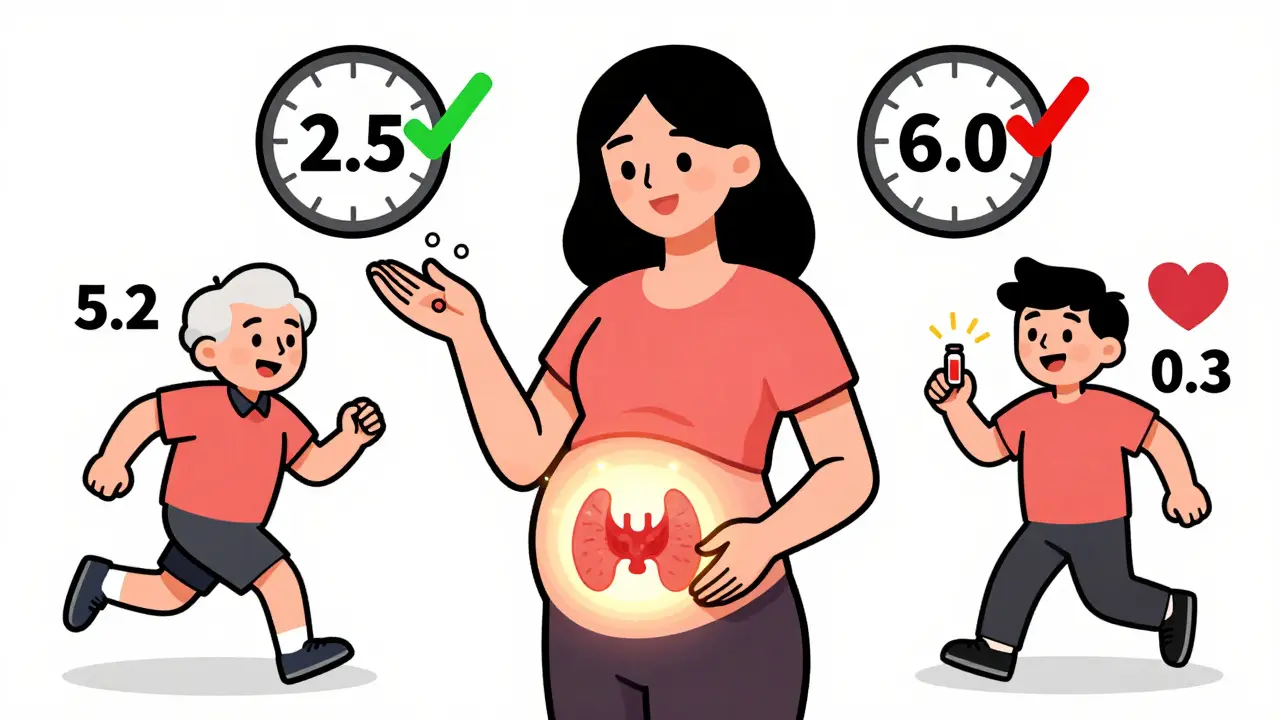
Pregnancy changes everything. Your body’s demand for thyroid hormone jumps, and untreated Hashimoto’s raises risks of miscarriage, preterm birth, and developmental issues in the baby. If you’re pregnant and have Hashimoto’s, your TSH target drops dramatically. The American Thyroid Association recommends keeping TSH below 2.5 mIU/L in the first trimester, and under 3.0 mIU/L for the rest of pregnancy. Testing should happen every 4 weeks during the first half of pregnancy, then every 6 to 8 weeks after that. Many women need to increase their levothyroxine dose by 25% to 50% during pregnancy - sometimes even more.
For older adults, especially over 65, the rules loosen a bit. A TSH of 4.5 to 6.0 isn’t automatically a problem if you feel fine. Aggressively lowering TSH in older people can lead to atrial fibrillation or bone fractures. The goal here isn’t to hit a perfect number - it’s to avoid symptoms. If you’re energetic, sleeping well, and not gaining weight, a TSH of 5.2 might be perfectly fine for you.
What About Symptoms?
Here’s where things get messy. Some people have normal TSH levels but still feel terrible. Fatigue, depression, dry skin, hair loss - these symptoms don’t always match TSH. That’s when doctors might consider adjusting the target. The Royal Australian College of General Practitioners suggests trying to get TSH into the lower half of normal (0.4-2.5 mIU/L) if symptoms persist. Some patients report feeling much better at 1.0 or 1.5, even if it’s still "in range." A 2023 study in JAMA Internal Medicine found that people with a certain gene variation (DIO2 polymorphism) had fewer symptoms when their TSH was kept between 0.4 and 2.0. This hints at a future where treatment is personalized - not just based on population averages, but on your genetics.
But don’t chase the lowest possible TSH. Suppressing TSH below 0.4 can cause heart rhythm issues or bone thinning. It’s a balance. Your doctor should listen to your symptoms, but not override lab evidence.
Medication and Lifestyle Factors
Levothyroxine is the standard treatment. Generic versions work just as well as brand-name Synthroid - but consistency matters. If you switch brands often, your TSH might fluctuate. That’s why the FDA tightened manufacturing standards in 2018: to reduce batch-to-batch differences.
Several things can interfere with absorption:
- Iron and calcium supplements - take them at least 4 hours apart from your thyroid pill
- Proton pump inhibitors (like omeprazole) - reduce stomach acid needed for absorption
- Estrogen (in birth control or HRT) - increases thyroid-binding proteins, which can lower free hormone levels
- High-fiber diets or soy products - can bind to levothyroxine in the gut
- Taking the pill with food, coffee, or grapefruit juice - always take it on an empty stomach, 30 to 60 minutes before eating
Even small changes like these can throw off your TSH. That’s why consistency in timing, diet, and supplements is just as important as the dose itself.
What About Antibody Tests and Alternative Therapies?
You might hear about diets, selenium, or iodine supplements "curing" Hashimoto’s. That’s misleading. While selenium might slightly reduce antibody levels in some studies, it doesn’t improve symptoms or prevent progression. Iodine? It can actually make Hashimoto’s worse in some people. No supplement can stop your immune system from attacking your thyroid.
And you don’t need to keep testing your antibodies. Once you’ve confirmed the diagnosis, repeating TPOAb or thyroglobulin antibody tests adds no value. They don’t predict disease progression or treatment response. Your TSH and how you feel are the only things that matter.
What’s Next?
The future of Hashimoto’s management is moving toward precision. Home TSH testing devices like ThyroChek were approved in 2021, making monitoring easier - though labs are still more accurate, especially at low TSH levels. Researchers are exploring whether adding T3 (triiodothyronine) to levothyroxine helps patients who still feel unwell. But a 2022 Cochrane review found no strong evidence for it. For now, levothyroxine alone, guided by TSH, remains the gold standard.
What’s clear? Hashimoto’s isn’t a one-size-fits-all condition. Your TSH target isn’t just a number on a lab report - it’s tied to your age, your pregnancy status, your genes, and your symptoms. The goal isn’t to hit a perfect lab value. It’s to feel like yourself again - without fatigue, without brain fog, without the constant chill.
Can Hashimoto’s thyroiditis be cured?
No, Hashimoto’s thyroiditis cannot be cured. It’s a lifelong autoimmune condition where the immune system attacks the thyroid gland. However, it can be effectively managed with levothyroxine therapy. Once thyroid hormone levels are restored and TSH is stabilized, most people live normal, symptom-free lives. The damage to the thyroid is permanent, but replacement therapy replaces what the gland can no longer produce.
Why does my doctor only check TSH and not T4 or T3?
In primary hypothyroidism caused by Hashimoto’s, TSH is the most sensitive and reliable indicator of thyroid hormone replacement adequacy. The pituitary gland responds quickly to small changes in thyroid hormone levels, making TSH a precise feedback signal. Routine T4 or T3 testing isn’t needed if TSH is stable and you’re feeling well. The Cleveland Clinic and American Thyroid Association both confirm that TSH alone is sufficient for monitoring in most cases.
How long does it take for levothyroxine to start working?
You may notice small improvements in energy and mood within 2 to 3 weeks, but full effects take 6 to 8 weeks. This is because levothyroxine has a long half-life (about 7 days), and your body needs time to reach steady-state levels. Your pituitary gland also needs time to adjust its TSH production. That’s why doctors wait 6 to 8 weeks before retesting - testing sooner won’t give accurate results.
Can I stop taking levothyroxine if I feel better?
No. Hashimoto’s causes permanent damage to the thyroid gland. Once it stops producing enough hormone, your body can’t restart that function. Stopping levothyroxine will cause your TSH to rise again, and symptoms like fatigue, weight gain, and depression will return. Lifelong treatment is necessary. Your dose may change over time due to weight, age, or other factors, but you’ll need to take it every day.
Why do some people still feel tired even with normal TSH?
Some people feel better when their TSH is in the lower half of the normal range (0.4-2.5 mIU/L), even if it’s still considered "normal." This is especially true for those with certain genetic variations, like the DIO2 polymorphism. Other factors - like low iron, vitamin D deficiency, sleep issues, or stress - can also mimic hypothyroid symptoms. If you’re still tired with normal TSH, your doctor should check for these other causes before assuming your dose is wrong.
Should I avoid gluten if I have Hashimoto’s?
There’s no strong evidence that a gluten-free diet improves Hashimoto’s for everyone. However, some people with Hashimoto’s also have celiac disease or non-celiac gluten sensitivity. If you have digestive symptoms, bloating, or unexplained fatigue, testing for celiac disease is reasonable. If you’re diagnosed with celiac, going gluten-free is essential. If not, eliminating gluten won’t likely change your thyroid function or antibody levels.



William James
February 26, 2026 AT 05:44Man, this post hit me right in the feels. I’ve been on levothyroxine for 8 years now, and honestly? The biggest thing no one talks about is how lonely it feels when your symptoms don’t match your labs. I had a TSH of 1.8 last year and still felt like I was dragging concrete boots through molasses. Took me 3 months to convince my doc to try bumping me to 1.2 - and guess what? I slept through the night for the first time in years. Not saying everyone needs that, but if you’re still tired with a ‘normal’ TSH… maybe you’re not crazy. Just underdosed.
Joanna Reyes
February 27, 2026 AT 06:02I appreciate how thorough this is, but I wish someone had told me earlier that consistency is more important than perfection. I used to take my pill with coffee because I was in a rush - and my TSH would spike every time. Then I started taking it at 6 a.m. with a full glass of water, waited 45 minutes, and never looked back. Also, iron and calcium? I keep them in a separate drawer labeled ‘Thyroid Traitors.’ I don’t even touch them within 4 hours of my pill. It’s not rocket science - it’s just discipline. And yeah, I know it’s annoying to wait 6-8 weeks between tests, but your pituitary isn’t on Zoom time. Let it breathe.
Dinesh Dawn
March 1, 2026 AT 03:01As someone from India, I just want to say - soy milk is everywhere here. I didn’t realize it was messing with my med until I cut it out. My TSH dropped from 5.1 to 2.9 in 2 months. Also, no one warned me about how much stress affects this. Meditation helped more than I thought it would. Not a cure, but a quieting of the noise. Thanks for the clear info.
Nick Hamby
March 2, 2026 AT 19:27It’s fascinating how TSH functions as a biological feedback loop - a physiological thermostat, if you will. The pituitary gland’s sensitivity to minute fluctuations in circulating thyroid hormone is one of the most elegant examples of homeostatic regulation in human physiology. That’s why we prioritize it. While it’s tempting to chase free T4 or T3 levels, doing so often leads to iatrogenic hyperthyroidism, particularly in older adults. The data is robust: TSH alone is sufficient for monitoring in primary hypothyroidism. The challenge lies not in the science, but in the human tendency to overcomplicate what is elegantly simple.
kirti juneja
March 3, 2026 AT 18:17OMG YES. I was on 100mcg for 3 years and felt like a zombie. Then my doc did this weird thing - lowered me to 88mcg - and I cried because I had energy. Like, real energy. Not ‘I drank 3 espressos’ energy. Actual, non-caffeine-dependent, walk-in-the-woods energy. Also, I stopped eating soy yogurt. And now I’m not a walking potato. 🙌
Haley Gumm
March 5, 2026 AT 04:22Okay, but why do people still think selenium cures Hashimoto’s? I’ve seen 3 people in my support group go broke on $80 bottles of it. It doesn’t stop the attack. It doesn’t regenerate your thyroid. It’s a Band-Aid on a gunshot wound. And gluten-free diets? Unless you have celiac, it’s just a placebo with extra grocery bills. We need less woo, more science. And yes, I’m still waiting for my doc to check my DIO2 gene. #NoMoreGuesswork
Gabrielle Conroy
March 5, 2026 AT 06:35YESSSSS!!! 🙌 I’ve been on levothyroxine since 2019 and my doc used to test me every 3 months. Then I read this exact post and asked for a change - now I’m annual. And guess what? My TSH hasn’t budged. Also - I take my pill on an empty stomach, no coffee, no breakfast, no lying. I even have a little alarm on my phone. It’s not glamorous, but it works. Also, if you’re pregnant? DO NOT SKIP THE TESTS. I had a miscarriage before I knew my TSH was 7.2. Now I’m a mom of 2. Thank you for this. 💕
Spenser Bickett
March 6, 2026 AT 18:17So let me get this straight… you’re telling me the entire medical establishment is just… right? TSH is all we need? No fancy biomarkers? No functional medicine magic? No ancestral diet to reverse autoimmunity? Wow. I guess I wasted $12,000 on a ‘thyroid reset’ retreat in Costa Rica. My bad. 😏
Christopher Wiedenhaupt
March 7, 2026 AT 12:52The data supporting TSH as the primary monitoring tool in primary hypothyroidism is well-established and supported by multiple clinical guidelines including those from the American Thyroid Association and the American Association of Clinical Endocrinologists. While individual symptomatology may vary, clinical decision-making should be anchored in evidence-based laboratory parameters rather than subjective perception alone. Consistency in medication timing and avoidance of dietary interferents remains a critical, albeit underemphasized, component of therapeutic success.
John Smith
March 8, 2026 AT 16:58My TSH is 5.2 and I feel fine. My doctor wants to ‘fix’ it. I told him I’m not a lab result. I’m a person who sleeps 8 hours, hikes on weekends, and doesn’t need a pill to tell me I’m alive. Why do we turn medicine into a numbers game? You don’t need to be ‘in range’ to be well. You just need to be you.
Natanya Green
March 8, 2026 AT 17:38WAIT - so you’re saying my 6-month-long panic attack, hair loss, and weight gain wasn’t ‘just stress’? I thought I was broken. I went to 7 therapists. I tried keto. I did yoga every day. I cried in the shower. And then I got my TSH tested… 8.9. I started levothyroxine. Within 3 weeks, I remembered what joy felt like. I’m not ‘cured’ - but I’m finally alive again. Thank you for writing this. I needed to hear someone say it out loud.