
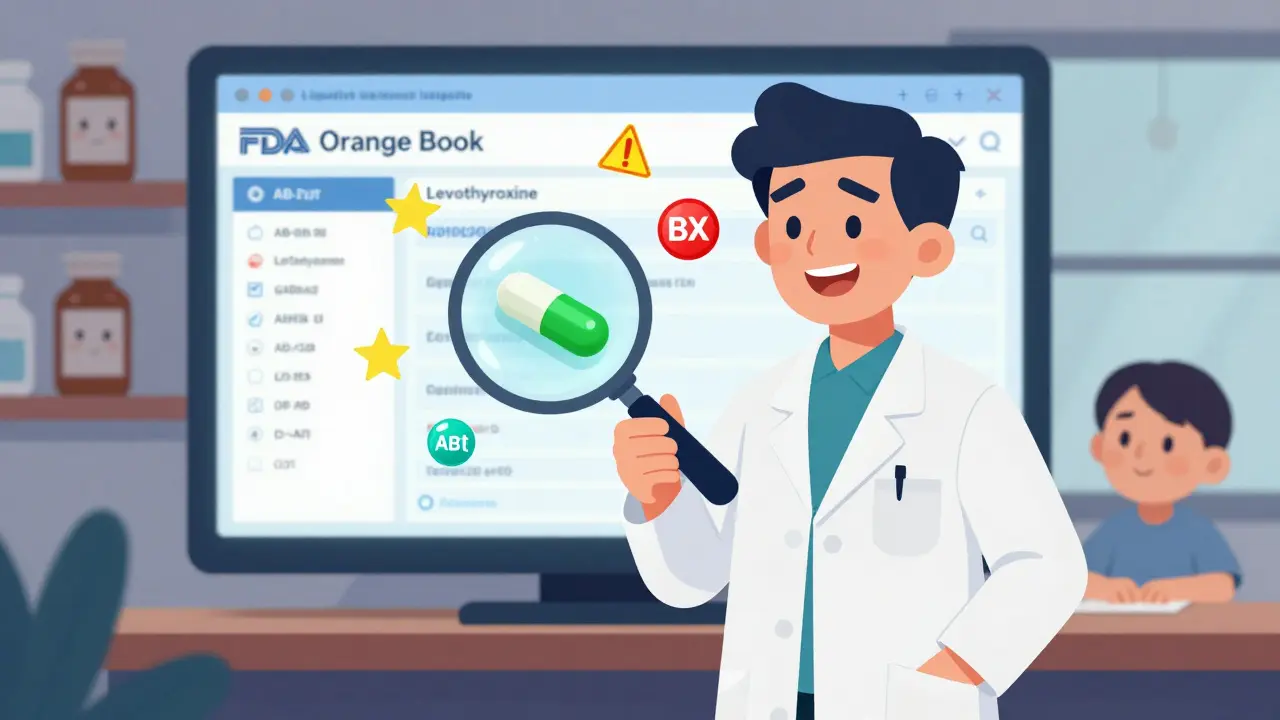
When a pharmacist fills a prescription for a generic drug, they don’t just pick any pill with the same name. They rely on one trusted source: the FDA’s Orange Book. This isn’t just a reference guide-it’s the legal backbone of generic drug substitution in the U.S. If you’re a pharmacist, a prescriber, or even a patient wondering why your generic isn’t automatically swapped in, understanding how to verify therapeutic equivalence through the Orange Book matters.
What Is the FDA Orange Book?
The official name is Approved Drug Products with Therapeutic Equivalence Evaluations, but everyone calls it the Orange Book. It’s published by the U.S. Food and Drug Administration (FDA) and updated daily. Since 1984, it’s been required by law under the Hatch-Waxman Act to list all approved prescription drugs and whether generics can legally be substituted for brand-name versions.
It doesn’t cover over-the-counter (OTC) drugs. It doesn’t list every single drug on the market. But for prescription medications, it’s the only source that tells you: Can this generic be swapped for that brand? The answer comes in the form of a two-letter code-like AB, AB1, or BX.
As of September 2023, the Orange Book includes over 16,000 approved drug products. Of those, more than 15,000 have therapeutic equivalence ratings. That means nearly every generic you’ve ever taken was approved based on data tracked here.
What Does "Therapeutic Equivalence" Really Mean?
Just because two pills have the same active ingredient doesn’t mean they work the same way in your body. The FDA doesn’t just check the label. They require proof.
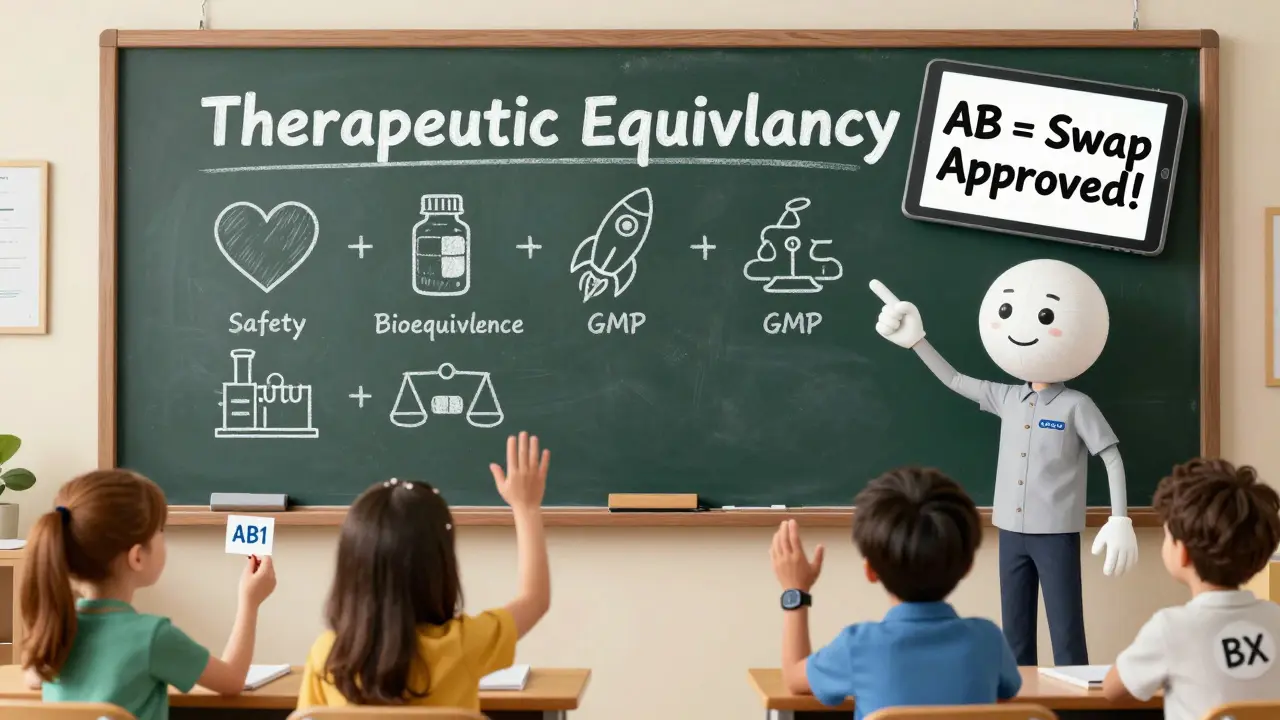
A drug gets rated as therapeutically equivalent only if it meets five strict criteria:
- It’s approved as safe and effective.
- It contains the same active ingredient, in the same amount, as the brand-name drug.
- It’s the same dosage form (tablet, injection, capsule) and route (oral, topical, inhaled).
- It’s bioequivalent-meaning your body absorbs it at the same rate and level as the brand.
- It’s made under strict manufacturing rules (Current Good Manufacturing Practices).
That’s not just paperwork. It’s science. Bioequivalence studies often involve healthy volunteers who take both the brand and generic versions, then have their blood tested over time. If the absorption curves match within FDA limits, the generic passes.
The TE Code System: AB, AB1, AB2, BX
The heart of the Orange Book is its Therapeutic Equivalence (TE) code. This code tells you everything you need to know about substitution.
- AB means the generic is approved as therapeutically equivalent to the reference drug. This is the gold standard. If a generic has an AB rating, pharmacists can substitute it unless state law says otherwise.
- AB1, AB2, AB3 are used when there are multiple reference listed drugs (RLDs) for the same active ingredient. Each number means the generic matches a specific brand, not just any brand. For example, if a drug has two different RLDs (say, one made by Pfizer and one by Merck), the generics will be coded AB1 or AB2 to show which one they’re equivalent to.
- BX is a red flag. It means the generic is not rated as therapeutically equivalent. This could be because bioequivalence data is missing, the dosage form is unusual (like a delayed-release capsule with complex coatings), or there are concerns about consistency.
Don’t assume all generics are equal. A BX rating doesn’t mean the drug is unsafe-it just means the FDA hasn’t confirmed it can be swapped without risk. Many BX drugs are still effective, but pharmacists need to check with the prescriber before substituting.
How to Search the Electronic Orange Book
The FDA’s Electronic Orange Book (EOB) is free, public, and updated every day. Here’s how to use it step by step.
- Start with the brand name. Type the brand name (e.g., Synthroid, Lipitor, Plavix) into the search bar. Don’t use the generic name yet-you need to find the reference listed drug first.
- Look for the Reference Listed Drug (RLD). In the results, one product will have "Yes" in the RLD column. That’s the brand or original version the generics are measured against.
- Find the TE code. The last column shows the rating. If it says "AB," "AB1," or "AB2," then generics with the same code are substitutable.
- Check the active ingredient. Click on any generic product to confirm it has the same active ingredient, strength, and dosage form as the RLD.
- Verify the applicant. The manufacturer’s name is listed. This matters because some companies have multiple versions of the same drug with different TE codes.
Pro tip: Use the "Ingredient Search" option if you’re unsure of the brand name. Just type in the active ingredient (like levothyroxine or metformin), and the system will show every product that contains it, grouped by dosage form.
What the Orange Book Doesn’t Tell You
The Orange Book is powerful-but it’s not the whole story.
First, state laws vary. In some states, pharmacists can substitute AB-rated generics automatically. In others, like Alabama and Texas, they must get the prescriber’s permission for certain drugs-even if the Orange Book says it’s fine. This is especially true for narrow therapeutic index (NTI) drugs like warfarin, levothyroxine, or phenytoin. Even if they’re AB-rated, doctors often require brand-specific prescriptions.
Second, patent and exclusivity dates are listed, but they’re not the same thing. A patent expiring doesn’t mean a generic can enter the market right away. Sometimes, the brand gets 180 days of exclusivity after the first generic is approved. The Orange Book shows both, but you need to read them together.
Third, discontinued products still show up in the database. If you see a drug with no RLD or TE code, check the Discontinued Drug Product List. That product is no longer available-don’t waste time trying to substitute it.
Common Mistakes Pharmacists Make
Based on feedback from the American Pharmacists Association and FDA user surveys, here are the top errors:
- Confusing AB with BX. Some pharmacists assume all generics are interchangeable. But BX-rated drugs (like certain extended-release formulations) can behave differently in patients.
- Mixing up AB1 and AB2. If a drug has two RLDs, substituting an AB1 generic for an AB2 RLD might not be safe. The difference might be minor, but the FDA requires exact matches.
- Trusting third-party apps. Drugs.com, Micromedex, and others pull data from the Orange Book-but they can be 24 to 72 hours behind. For time-sensitive decisions, always check the FDA’s official site.
- Ignoring OTC drugs. The Orange Book doesn’t rate OTC products. Don’t try to apply AB ratings to ibuprofen or loratadine.
Real-World Example: Levothyroxine
Levothyroxine (for hypothyroidism) is one of the most commonly prescribed drugs in the U.S. There are over 50 generic versions. All are AB-rated. But here’s the catch: the FDA and many endocrinologists warn that switching between brands-even AB-rated ones-can cause subtle changes in thyroid hormone levels.
That’s why many doctors write "Do Not Substitute" on prescriptions. The Orange Book says they’re equivalent. But clinical practice says: stick with one.
A 2023 FDA survey found that 42% of pharmacists reported confusion when patients came in asking why their new generic didn’t "feel the same." The answer wasn’t in the Orange Book-it was in the patient’s history, their lab results, and their doctor’s preference.
Tools and Resources
The FDA offers free tools to help:
- Quick Reference Guide (12 pages) - Downloadable PDF with search tips and code explanations.
- Drug Info Rounds Webinars - Bi-monthly live sessions with FDA experts. Recorded versions are on YouTube.
- email support: [email protected] - They respond to 95% of questions within 48 business hours.
For pharmacy teams, the FDA recommends practicing with 5-7 verifications before relying on the system. Most people get comfortable after about 15 minutes of hands-on use.
What’s Next for the Orange Book?
The FDA plans to integrate the Orange Book with the Purple Book (for biologics) by 2024. They’re also moving toward machine-readable data formats like SPL (Structured Product Labeling) so pharmacy systems can pull updates automatically.
By 2027, industry analysts predict 70% of generic verifications will happen through API integrations-not manual searches. But for now, the manual process is still the gold standard. And until that shift completes, knowing how to read the Orange Book yourself is essential.
What does an AB rating mean in the FDA Orange Book?
An AB rating means the generic drug has been determined by the FDA to be therapeutically equivalent to the brand-name reference drug. This means it has the same active ingredient, dosage form, strength, route of administration, and bioequivalence. Pharmacists can legally substitute an AB-rated generic unless state law or the prescriber prohibits it.
Can I trust third-party websites like Drugs.com for Orange Book data?
Third-party sites like Drugs.com and IBM Micromedex pull data from the FDA’s Orange Book, but they can be delayed by 24 to 72 hours. For accurate, real-time verification-especially when making substitution decisions-you should always check the official FDA Electronic Orange Book directly.
Why do some generics have AB1, AB2, or AB3 ratings?
These ratings are used when there are multiple reference listed drugs (RLDs) for the same active ingredient. Each number (AB1, AB2, etc.) indicates which specific brand the generic is equivalent to. For example, if a drug has two different RLDs from different manufacturers, the generics must match one of them exactly. Substituting between AB1 and AB2 products may not be safe.
Are over-the-counter drugs listed in the Orange Book?
No. The FDA Orange Book only includes prescription drugs. OTC medications are not evaluated for therapeutic equivalence because they are not subject to the same substitution rules. You won’t find TE codes for ibuprofen, loratadine, or omeprazole OTC products.
What should I do if a generic drug has a BX rating?
A BX rating means the FDA has not determined the generic to be therapeutically equivalent to the reference drug. This could be due to insufficient bioequivalence data, unusual delivery systems, or formulation issues. Do not substitute a BX-rated product without consulting the prescriber. The drug may still be safe and effective, but substitution carries potential risk.
Do all states allow substitution of AB-rated generics?
No. While the Orange Book provides federal guidance, state laws vary. Some states require prescriber authorization even for AB-rated drugs, especially for narrow therapeutic index medications like warfarin or levothyroxine. Always check your state’s pharmacy board rules before substituting.



Joanna Reyes
February 22, 2026 AT 00:08Okay, I’ve been a pharmacist for 12 years and let me tell you-the Orange Book is the only thing keeping me from getting sued daily. I used to trust Drugs.com until one time a patient got a BX-rated generic and had a seizure because the release profile was off. FDA’s site saved us. Always double-check the TE code. Even if it’s AB, if the manufacturer changes, you gotta re-verify. I keep a printed cheat sheet in my drawer. No app replaces the real thing.
Nerina Devi
February 22, 2026 AT 10:34This is so important for global pharmacists too. In India, we get generics from all over, and sometimes the TE code isn’t clear. I’ve had patients come in confused because their ‘levothyroxine’ from one pharmacy didn’t feel right. I now teach my trainees to cross-reference the FDA database even if the brand is Indian-made. Knowledge isn’t just power-it’s safety.
Dinesh Dawn
February 23, 2026 AT 17:00Love this breakdown. I’m a med student and this made me actually care about regulatory stuff. Used to think it was just bureaucracy. Now I get it-this is what stops people from getting messed up by cheap knockoffs. Also, the part about AB1 vs AB2? Mind blown. Never realized generics could be picky like that. Thanks for the clarity.
Vanessa Drummond
February 24, 2026 AT 04:18Ugh, I hate when pharmacies just swap stuff. My thyroid meds switched last month and I felt like I was in a horror movie. Sweating, heart racing, zero energy. Took me three weeks to get back to normal. The pharmacist said "it’s AB-rated, it’s fine." But my body said otherwise. Doctors need to stop being lazy and write "Do Not Substitute" on EVERYTHING. It’s not just preference-it’s survival.
kirti juneja
February 25, 2026 AT 14:11Y’all need to stop treating the Orange Book like a sacred scroll. It’s a tool-not a god. I’ve seen AB-rated generics fail in real life because the excipients changed. The FDA doesn’t test fillers, binders, or coatings-just the active ingredient. So yes, AB means bioequivalent… but not necessarily clinically identical. My grandma’s BP meds switched and she nearly had a stroke. Her body didn’t care about TE codes. It cared about the pill she’d been taking for 12 years. Don’t confuse regulatory compliance with human biology.
Haley Gumm
February 25, 2026 AT 16:48Let’s be real-the Orange Book is a glorified spreadsheet. The FDA doesn’t even test every batch. They rely on manufacturer submissions. And guess what? Some companies submit cherry-picked data. I’ve seen the same generic with two different TE codes because one batch passed and the next didn’t. The system’s broken. We’re all just hoping for the best.
Gabrielle Conroy
February 26, 2026 AT 07:08OMG YES!! 🙌🙌🙌 This is the most important thing I’ve read all year. I’m a pharmacy tech and I literally cried when I finally understood AB1 vs AB2. I used to just click "substitute" without thinking. Now I check the RLD every single time. Also, the FDA email support? I sent them a question about a weird TE code and they replied in 18 HOURS!! 🥹💖 They’re actual angels. I printed the Quick Reference Guide and laminated it. My boss thinks I’m obsessed. I say: better obsessed than dead.
Spenser Bickett
February 28, 2026 AT 03:01so uhm yeah the orange book is basically the fda’s way of saying "trust us bro" lol. like who even reads this? i bet half the pharmacists just google "levothyroxine generic" and pick the cheapest one. and don’t even get me started on how the FDA lets companies submit their own bioequivalence data. it’s like asking a thief to audit the vault. the whole system is a joke. but hey, at least we have emojis now.
Christopher Wiedenhaupt
March 1, 2026 AT 21:06While the Orange Book provides a necessary framework for therapeutic equivalence, it is imperative to recognize that clinical outcomes are influenced by factors beyond bioequivalence. Variability in patient metabolism, concomitant medications, and gastrointestinal conditions can affect drug absorption. Therefore, while the TE code is a useful administrative tool, it should not be the sole determinant in substitution decisions. A holistic, patient-centered approach remains paramount.
John Smith
March 3, 2026 AT 18:29So we’re supposed to trust a government database that doesn’t even test the pills? Funny. I’ve got a 73-year-old aunt on warfarin who got switched to a generic and ended up in the ER. The pharmacist didn’t even check the TE code. He just saw "AB" and moved on. The system’s not broken. It’s designed to be broken. Big pharma wins. Patients lose. Again.
Joanna Reyes
March 4, 2026 AT 00:19^ This. Exactly. I had the same thing happen last month. Patient on warfarin. Switched from one AB-rated generic to another. INR spiked to 8.3. We had to admit her. Turned out the new generic used a different filler-changed dissolution rate. The Orange Book didn’t catch it. Neither did the pharmacist. We need real-time batch tracking. Not just TE codes. This isn’t 1995 anymore.