
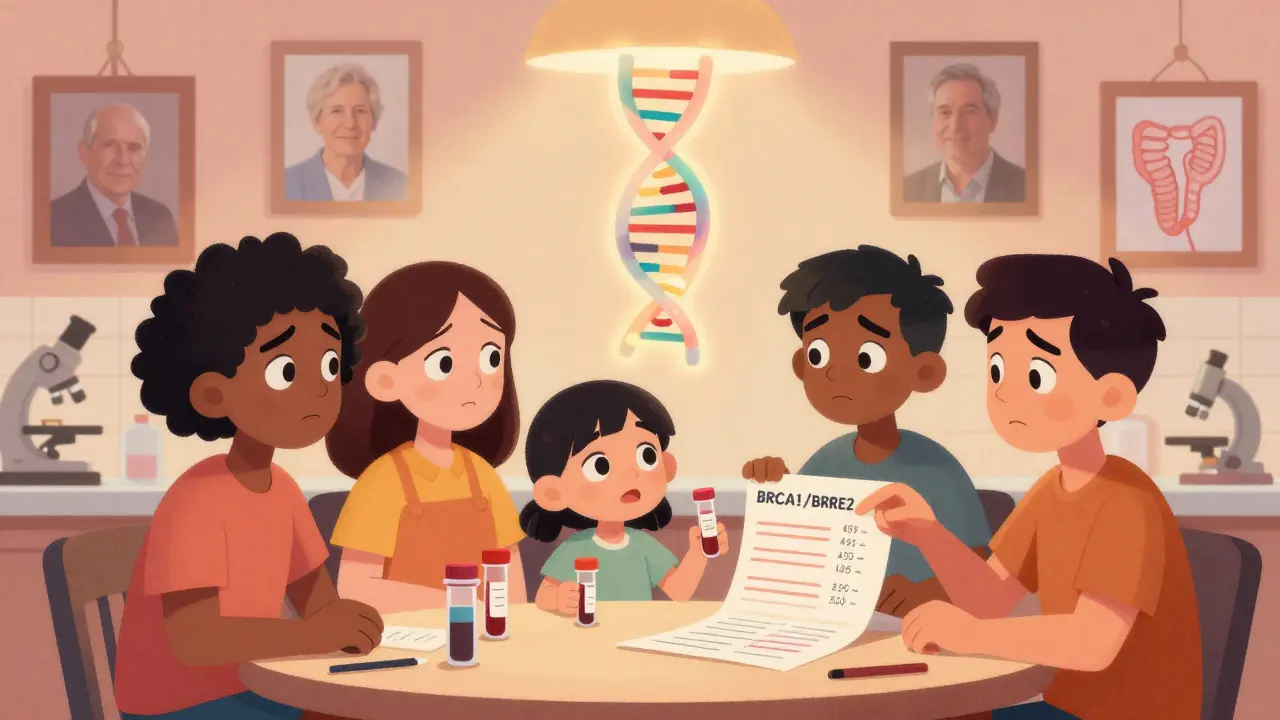
When someone you love gets diagnosed with cancer, the question that often follows isn’t just "why?" It’s "could this have been prevented?" For many families, the answer lies not in lifestyle choices or environmental exposures, but in something written into their DNA long before they were born. Genetic testing for cancer risk isn’t science fiction anymore-it’s a routine part of care for thousands of people in the UK and beyond. And when it’s done right, it can mean the difference between catching cancer early… or never getting it at all.
What BRCA and Lynch Syndrome Actually Mean
Most people hear "BRCA" and think of breast cancer. That’s not wrong-but it’s incomplete. The BRCA1 and BRCA2 genes are tumor suppressors. They normally help fix damaged DNA and stop cells from turning cancerous. When a harmful mutation slips into one of these genes, the repair system breaks down. Women with a BRCA1 mutation have up to a 72% lifetime risk of breast cancer. For BRCA2, it’s about 69%. Ovarian cancer risk jumps to 44% and 17%, respectively. That’s compared to about 13% for breast cancer and less than 2% for ovarian cancer in the general population.
Lynch syndrome is different. It’s not one gene-it’s a group. Mutations in MLH1, MSH2, MSH6, PMS2, or EPCAM mess up the cell’s ability to fix mismatched DNA during replication. This leads to a runaway accumulation of errors. The result? A 10% to 80% lifetime risk of colorectal cancer, depending on which gene is affected. But it doesn’t stop there. Lynch also raises risk for endometrial, ovarian, stomach, pancreatic, and even urinary tract cancers. People with Lynch often get cancer decades earlier than average-sometimes in their 30s or 40s.
How Testing Works Today
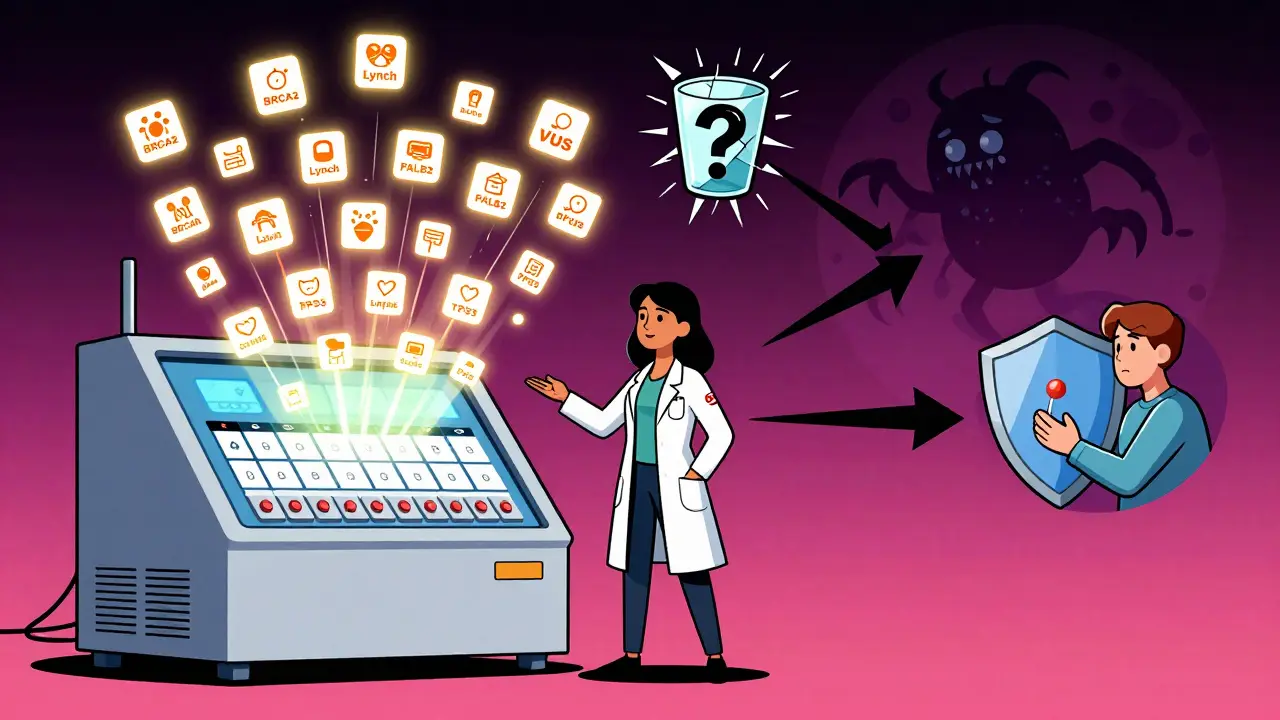
Testing has moved far beyond single-gene tests. In 2025, the standard is multigene panel testing (MGPT). Instead of checking just BRCA1 and BRCA2, labs now scan 30 to 80+ genes at once using next-generation sequencing (NGS). A simple blood or saliva sample is enough. The turnaround time? Usually two to three weeks.
But here’s the catch: not all mutations are clear-cut. About 7.8% of panel tests return a variant of uncertain significance (VUS). That means the lab found a change in the gene, but no one knows if it’s harmful or harmless. It’s like finding a typo in a manual-but you don’t know if it breaks the machine.
That’s where the 2025 Mayo Clinic study changed everything. Researchers used CRISPR-Cas9 to test nearly 7,000 different BRCA2 variants in the lab. They found that 91% of previously unclear changes were actually harmful. That single study slashed BRCA2 VUS rates from 12.7% down to 1.1% in the most critical part of the gene. For thousands of people waiting for answers, this wasn’t just science-it was relief.
Why Multigene Panels Beat Single-Gene Tests
You might think: "If I’m worried about breast cancer, why test for colon cancer genes?" But here’s the reality: people don’t always know their family history. Maybe a relative died young and no one talked about it. Maybe the family tree is small, or adoption changed the story. Single-gene tests miss up to 50% of actionable findings. A 2023 study of over 38,000 people found that 1 in 5 had a harmful mutation in a gene they weren’t even tested for.
For example, PALB2, once considered a "maybe" gene, is now in the top tier of cancer risk genes. Women with PALB2 mutations have a 53% lifetime risk of breast cancer-almost as high as BRCA2. ATM and CHEK2 are also now classified as high-risk. All three were added to the NCCN Guidelines in 2025. If you only tested for BRCA, you’d miss these.
And it’s not just breast and ovarian. APC mutations cause familial adenomatous polyposis-hundreds of colon polyps that turn cancerous if not removed. PTEN increases risk for thyroid, breast, and uterine cancers. TP53 (Li-Fraumeni syndrome) can lead to childhood cancers, sarcomas, brain tumors. All of these show up on a comprehensive panel.
What You Can Do With the Results
Knowing your genetic risk isn’t about fear. It’s about control.
For BRCA carriers, the most powerful tool is risk-reducing surgery. A 2023 meta-analysis of nearly 13,000 women showed that removing the breasts (mastectomy) cuts breast cancer risk by up to 95%. Removing the ovaries and fallopian tubes (oophorectomy) cuts ovarian cancer risk by 80% and also reduces breast cancer risk by 50% in premenopausal women.
For Lynch syndrome, it’s all about colon surveillance. Getting a colonoscopy every one to two years, starting in your 20s, catches precancerous polyps before they turn malignant. In some cases, taking aspirin daily has been shown to cut colorectal cancer risk by up to 60% over 10 years.
And here’s the game-changer: immunotherapy. A 2025 case study from Fred Hutchinson Cancer Center showed a 42-year-old with Lynch-related colorectal cancer went into complete remission after treatment with pembrolizumab-because their tumor had a specific genetic signature that made it vulnerable to immune attack. That wouldn’t have been possible without genetic testing.
The Dark Side: False Reassurance and Insurance Trouble
But genetic testing isn’t perfect. Some people get a "negative" result and think they’re safe. That’s dangerous. A 2024 JAMA Internal Medicine report documented three cases where people tested negative on a panel-then developed cancer later. Why? Because the test didn’t cover the gene that caused their cancer, or the mutation was too rare to be detected. Or worse: they had a VUS and were told it was "likely benign"-but science didn’t know yet.
And then there’s insurance. The Genetic Information Nondiscrimination Act (GINA) protects against health insurance discrimination. But it doesn’t cover life insurance, long-term care, or disability policies. A Reddit thread from January 2025 had 43 users who were denied coverage for cascade testing (testing relatives after a positive result) despite NCCN guidelines. One woman in Birmingham was told her life insurance premiums would double after her BRCA2 result-even though she’d never had cancer.
Direct-to-consumer tests like 23andMe make this worse. They only check for three specific BRCA mutations common in Ashkenazi Jewish populations. If you’re not from that group, you’re 97% likely to miss a real mutation. A 2024 NEJM study found people who relied on these tests had a false sense of security-and delayed medical care.
Who Should Get Tested?
The NCCN doesn’t recommend testing everyone. But if any of these apply to you, talk to your doctor:
- You or a close relative had breast cancer before age 50
- You have ovarian, pancreatic, metastatic prostate, or male breast cancer
- Three or more relatives on the same side have colorectal, endometrial, or other Lynch-related cancers
- You have 10 or more colon polyps
- You’re of Ashkenazi Jewish descent and have any personal or family history of breast, ovarian, or pancreatic cancer
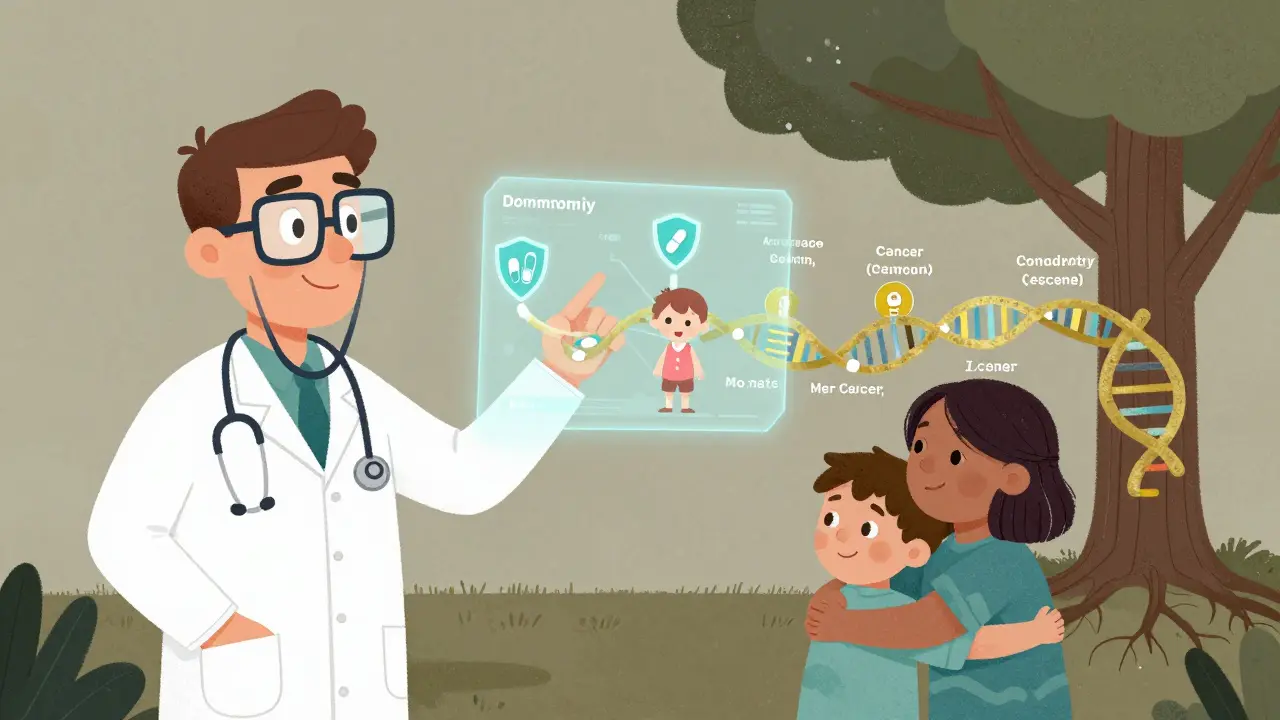
And if you’ve had cancer yourself? Testing is now standard of care. It can guide your treatment. It can save your children’s lives.
The Future: Beyond the Panel
Scientists aren’t stopping at genes. Stanford researchers recently mapped 380 genetic variants that don’t change the protein code-but control how much of a protein is made. These "expression-controlling" variants may one day be added to risk scores. Imagine a test that doesn’t just say "you have BRCA" but "your combination of 12 genetic signals puts you at 78% risk for breast cancer by age 60."
That’s the next frontier. But for now, the most powerful tool we have is knowing your genes. Not to live in fear. But to take action.
Is genetic testing for cancer risk covered by the NHS?
Yes-but only if you meet strict clinical criteria. The NHS offers genetic testing through regional genetics services if you have a strong family history of cancer, early-onset cancer, or multiple related cancers. Testing is free if approved. However, you won’t be offered a multigene panel unless your personal or family history matches NCCN guidelines. Private testing is available but costs between £300 and £800 depending on the panel.
Can I get tested if I don’t have cancer?
Absolutely. In fact, testing is most valuable before cancer develops. If you have a family history that suggests hereditary cancer, getting tested while you’re healthy lets you take preventive steps-like more frequent screenings, lifestyle changes, or even surgery-before cancer has a chance to grow. Many people who test positive say the biggest relief isn’t knowing they’re at risk… it’s knowing they can do something about it.
What if I get a VUS result?
Don’t panic. A VUS means "we don’t know yet." It’s not a diagnosis. Most VUS are eventually reclassified as benign. The key is to avoid drastic decisions based on a VUS. Continue regular screening based on your family history. Stay in touch with your genetic counselor-many labs automatically re-evaluate VUS every 1-2 years as new data emerges. The Mayo Clinic’s 2025 breakthrough means thousands of past VUS results are now being reclassified as either harmful or harmless.
Should I test my children?
Generally, no-not until they’re adults. Most hereditary cancer syndromes don’t cause cancer in childhood, and testing minors removes their future right to decide. Exceptions exist for syndromes like Li-Fraumeni (TP53), where childhood cancers are common. For BRCA or Lynch, wait until age 18-25. But if you test positive, your children have a 50% chance of inheriting the mutation. When they’re older, encourage them to get tested. That’s called cascade testing-and it’s one of the most powerful ways to prevent cancer in families.
Do I need to see a genetic counselor?
Yes. Genetic testing isn’t like ordering a blood test. It’s a complex decision with lifelong consequences. A certified genetic counselor helps you understand your risk, interpret results, and plan next steps. They also help you talk to family members. In the UK, you’re usually referred by your GP or oncologist. If you’re testing privately, make sure the lab requires pre- and post-test counseling. Skipping this step is like driving without a map-you might get somewhere, but you won’t know if it’s the right place.
What Comes Next
Genetic testing for cancer risk isn’t going away. It’s getting better, faster, and more precise. In five years, we may all have our entire genome sequenced at birth. But for now, the power is in knowing your genes-not to be defined by them, but to protect yourself and your family.
It’s not about fear. It’s about foresight.


Amisha Patel
March 14, 2026 AT 11:49Elsa Rodriguez
March 15, 2026 AT 17:34Serena Petrie
March 17, 2026 AT 09:58Buddy Nataatmadja
March 17, 2026 AT 22:30mir yasir
March 19, 2026 AT 09:47Stephanie Paluch
March 19, 2026 AT 18:37tynece roberts
March 21, 2026 AT 02:23Hugh Breen
March 22, 2026 AT 13:28Byron Boror
March 23, 2026 AT 08:47Lorna Brown
March 23, 2026 AT 23:25Rex Regum
March 25, 2026 AT 06:22Kelsey Vonk
March 26, 2026 AT 02:50Emma Nicolls
March 27, 2026 AT 13:00Jimmy V
March 29, 2026 AT 12:17