
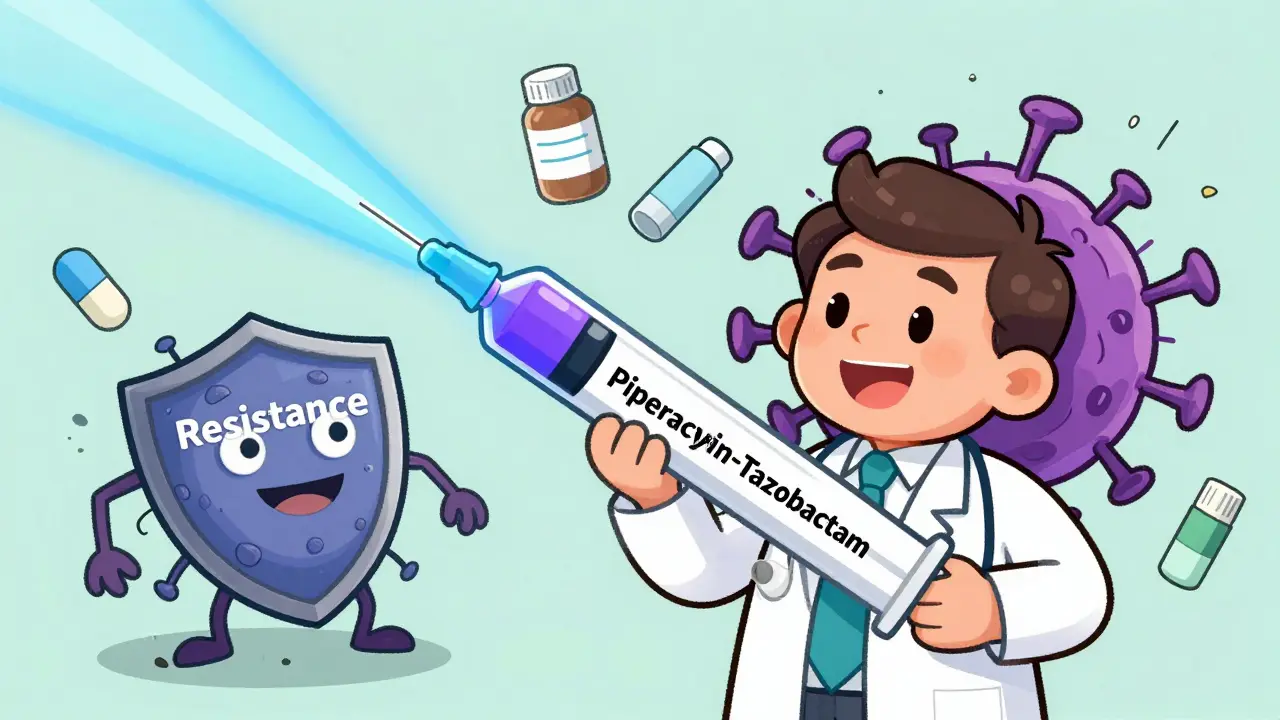
When you’re prescribed an antibiotic like piperacillin-tazobactam, you might not realize you’re getting a combination product. These aren’t just two pills in one bottle-they’re carefully engineered mixtures of two or more active drugs, sometimes paired with a delivery device like an inhaler or prefilled syringe, designed to work better together than alone. For infections that resist single antibiotics, these combinations can be lifesavers. But here’s the real question: are generic versions of these complex products actually available, and if so, why does it matter so much?
What Exactly Are Antibiotic Combination Products?
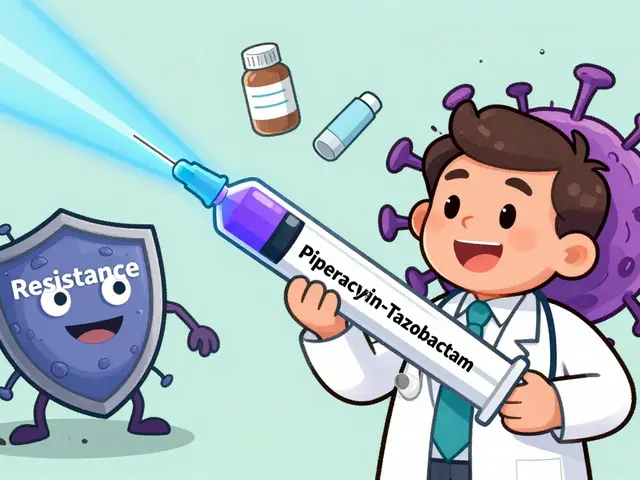
Antibiotic combination products aren’t random blends. They’re FDA-approved formulations where two or more antibiotics are combined to fight resistant bacteria, or where an antibiotic is packaged with a device to make delivery easier or more effective. Think of it like a hammer and nail-not just two tools, but a system designed to do one job better. Piperacillin and tazobactam, for example, work as a team: one kills bacteria, the other blocks the bacteria’s defense mechanism. Together, they handle infections that would shrug off either drug alone.
Some combinations include delivery systems too-like inhalers for cystic fibrosis patients or prefilled syringes for hospital use. These are called generic drug-device combination products (g-DDCPs). They’re trickier to copy than a simple pill because the device has to match the original in every way: how it’s held, how much drug it delivers, even how the label looks. A small difference could mean the patient gets too little-or too much-medication.
How Do Generic Versions Get Approved?
Getting a generic antibiotic combination product approved isn’t like copying a single-drug pill. The FDA doesn’t require new clinical trials for generics, but they do demand proof that the copy works the same way as the brand-name version. This is done through the Abbreviated New Drug Application, or ANDA. For combination products, the ANDA has to include detailed comparisons of:
- How the drug is absorbed in the body
- Stability of the mixture over time
- Performance of the delivery device (if applicable)
- Labeling and instructions for use
The FDA’s Office of Combination Products (OCP) decides which center reviews the application-drug, device, or biologic-based on what’s called the Primary Mode of Action. If the drug does the main job, it’s reviewed by the drug team. If the device delivers the drug in a way that’s essential to its effect, the device team leads. This process is more complex than for single-drug generics, which is why fewer companies bother.
The first major win came in 2010, when Hospira launched the first generic version of piperacillin-tazobactam for injection. That opened the door. Since then, more have followed, but progress has been slow. Why? Because proving equivalence for a device-based product requires more data, more testing, and more time. One manufacturer told regulators they spent over two years just documenting differences in the syringe’s plunger force and needle gauge-things that sound minor but can change how the drug is delivered.
Why Generic Availability Matters-Beyond the Price Tag
Let’s cut to the chase: generics save money. A 2021 study in Nature Communications found that when brand-name antibiotics went generic, prices dropped by 30% to 80%. Between 2010 and 2020, generic drugs saved the U.S. healthcare system an estimated $2.2 trillion. That’s not just corporate profit-it’s real relief for patients paying out of pocket, for hospitals stretching budgets, and for insurers trying to keep premiums down.
But cost isn’t the only benefit. When antibiotics become cheaper, doctors are more likely to prescribe them as needed, not hold back because of cost. Studies show that when patients pay less, they take their full course. That’s huge. Incomplete antibiotic courses are one of the biggest drivers of drug-resistant superbugs. Cheaper generics mean better adherence, fewer resistant infections, and fewer hospitalizations.
Take aztreonam, for example. After its generic version hit the market, prescriptions jumped by over 400% in some areas. Why? Because it was also being used by cystic fibrosis patients preparing for inhalation therapy. The lower price made it feasible for more patients to get the treatment they needed. That’s not just savings-it’s better health outcomes.
Not All Generics Enter the Market the Same Way
Here’s where things get messy. Generic entry doesn’t always mean more prescriptions. The same Nature Communications study looked at 13 antibiotics and found wildly different results:
- Five antibiotics-aztreonam, cefpodoxime, ciprofloxacin, levofloxacin, and ofloxacin-saw big jumps in prescriptions after generics arrived.
- Cefdinir? Prescriptions dropped. Why? Probably because doctors switched to newer, more targeted drugs.
- Others like clarithromycin and cefuroxime axetil saw rising trends, but not because of generics-they were already trending up.
This isn’t random. It shows that market behavior depends on the drug, the disease, the prescriber’s habits, and even what other treatments are available. A generic doesn’t automatically mean more use. Sometimes it just means cheaper use.
And then there’s the legal side. State laws that allow pharmacists to swap brand drugs for generics were written for simple pills. They don’t fit well with combination products. If a doctor prescribes a branded inhaler with a specific antibiotic mix, a pharmacist can’t just swap it for a generic version-even if it’s FDA-approved-because the device might look different. That’s a loophole that’s costing patients access.
Barriers Still Holding Back Wider Access
Even though the science and the savings are clear, there are major roadblocks:
- Regulatory complexity: The ANDA process for g-DDCPs requires more data than for single-drug generics. Manufacturers need to prove every part of the device works identically.
- Cost of development: Testing, documentation, and regulatory fees can cost millions. Small companies can’t afford it.
- State substitution laws: Many states don’t allow substitution for combination products, even if they’re equivalent. That means patients get stuck with the brand name unless their doctor specifically writes “dispense as written.”
- Lack of provider awareness: Many doctors don’t know which combination products have generics or how to prescribe them correctly.
One manufacturer said they spent 18 months just getting the FDA to agree on what “equivalent” meant for a prefilled syringe. The agency wanted data on the exact pressure needed to push the plunger. That’s not something you find in a textbook-it’s engineering-level detail.
What’s Changing? What’s Next?
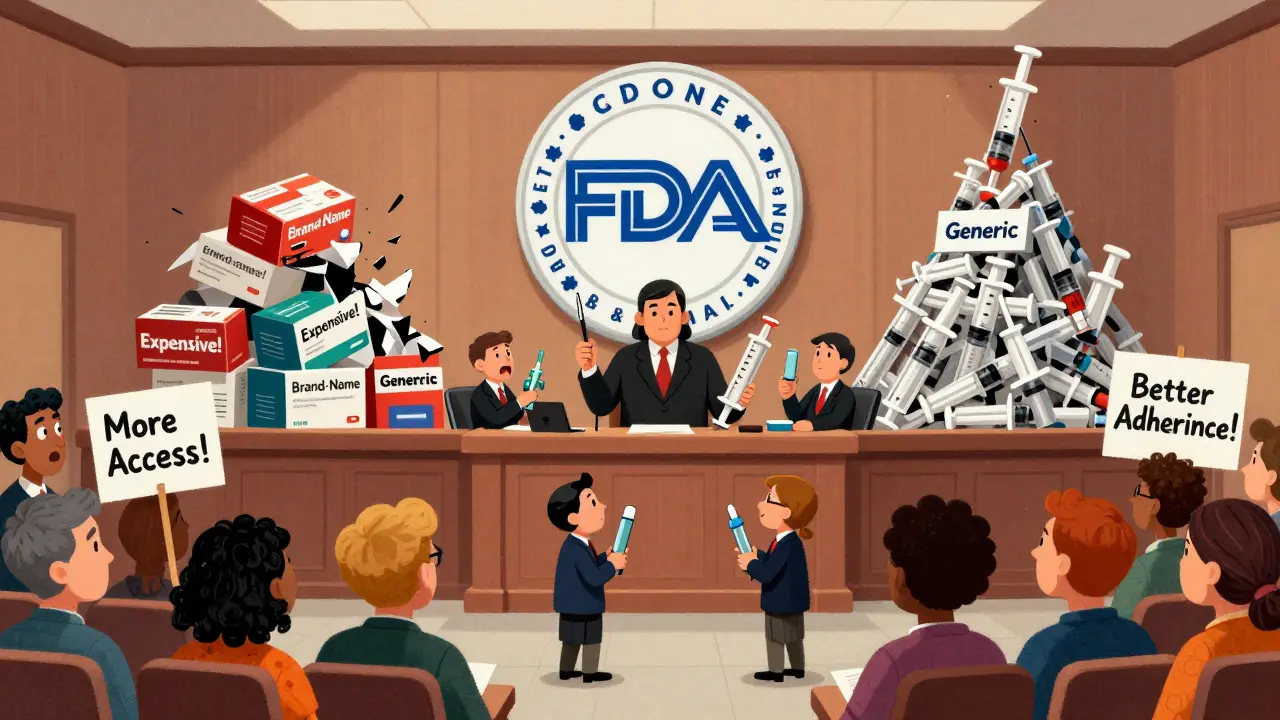
The FDA is trying to fix this. In September 2024, they held a major conference called REdI to update guidance on combination products. They’re working on a six-phase development pathway to make it easier for manufacturers to navigate approval without cutting corners on safety.
Experts agree: the number of combination products is going to keep rising. More cancer drugs, more antibiotics, more inhalers-all combining drugs with devices. If we don’t fix the system now, we’ll face bigger shortages and higher costs later.
What needs to happen?
- States need to update substitution laws to include FDA-approved generic combination products.
- The FDA should create clearer, faster pathways for g-DDCPs.
- Pharmacies need training on how to handle these products.
- Doctors need better tools to know which generics are available and when to use them.
The goal isn’t just to copy a drug. It’s to copy a system-and make sure that system still works for the patient.
What This Means for You
If you or a loved one is on an antibiotic combination product, ask your doctor or pharmacist: Is there a generic version? Even if it’s not on the shelf yet, knowing it exists could help you advocate for change. Some insurers now require generics before covering brand-name versions. If yours doesn’t, ask why.
And if you’re a patient who’s been told, “This one doesn’t have a generic,” dig deeper. It might. The market is changing. What was true in 2020 isn’t true in 2026.
Generic antibiotic combination products aren’t just cheaper-they’re smarter. They’re how we make life-saving treatments accessible to more people without sacrificing safety. The system isn’t perfect yet. But it’s moving. And that matters.
Are generic antibiotic combination products as effective as brand-name ones?
Yes. The FDA requires generic versions of combination products to prove they’re therapeutically equivalent to the brand-name version. That means they deliver the same amount of drug, work the same way in the body, and produce the same clinical results. For drug-device combinations, the device must also function identically. No new clinical trials are needed-just rigorous testing of the formulation and delivery system.
Why aren’t there more generic antibiotic combination products on the market?
Because they’re harder and more expensive to develop. Unlike single-drug generics, combination products require proof that both the drug and the delivery device (like a syringe or inhaler) work exactly like the original. This means more testing, more documentation, and higher costs. Many manufacturers avoid them because the return on investment isn’t as clear as with simple pills.
Can a pharmacist substitute a generic antibiotic combination product for the brand name?
It depends on your state’s laws. Most states allow substitution for single-drug generics, but many don’t have clear rules for combination products-even if they’re FDA-approved as equivalent. Some pharmacists won’t swap them unless the prescription says “dispense as written.” You may need to ask your doctor to specify substitution is allowed.
How do I know if a combination product has a generic version?
Check the FDA’s Orange Book, which lists approved generic drugs and their equivalence ratings. You can also ask your pharmacist or use a pharmacy app that shows generic availability. For combination products, look for the same active ingredients and delivery method. If you’re unsure, ask your doctor to confirm it’s an FDA-approved generic.
Do generic antibiotic combinations save patients money?
Yes, often significantly. Prices for generic antibiotic combinations typically drop 30% to 80% after the brand-name patent expires. For patients paying out of pocket, that can mean the difference between affording a full course of treatment or skipping doses. Lower costs also improve adherence, which reduces the risk of antibiotic resistance and future hospital visits.


Ben McKibbin
January 21, 2026 AT 06:36Let’s be real-this isn’t just about pills and syringes. It’s about who gets to live when the system’s rigged. Generic combo products aren’t ‘copies’-they’re acts of rebellion against corporate greed. The FDA’s slow-walking this because Big Pharma pays the lobbyists who write the rules. We’re talking lifesaving drugs held hostage by patent trolls and regulatory theater. It’s not incompetence-it’s intentional.
Rod Wheatley
January 22, 2026 AT 03:57Wow-this is actually one of the most important public health pieces I’ve read in years. Thank you for breaking this down so clearly! I work in hospital pharmacy, and I see this daily: patients skipping doses because they can’t afford the brand, or pharmacists refusing to substitute because ‘the device looks different.’ It’s heartbreaking. The FDA’s new six-phase pathway? Long overdue. Let’s push for state law reforms too-pharmacists need legal clarity, not fear of liability. We can fix this. Let’s not wait for another superbug outbreak.
Uju Megafu
January 23, 2026 AT 20:21Oh my god, this is why America is collapsing. First they let Big Pharma charge $10,000 for a shot of insulin, now they’re letting generics sit on the shelf because some bureaucrat can’t decide if a plunger’s force matters?! This isn’t science-it’s a capitalist nightmare. And don’t even get me started on how doctors don’t even know what’s available! Who’s paying these people?! We need a revolution. #PharmaMurder #GenericOrDie
Ashok Sakra
January 24, 2026 AT 13:15so why dont they just make the generic? its not hard. people die because of money. sad.
Andrew Rinaldi
January 24, 2026 AT 15:50It’s fascinating how something so technically complex-matching a syringe’s plunger force, ensuring identical drug release kinetics-becomes a moral litmus test. We treat medicine like a commodity, but it’s a covenant between human beings. The fact that we need to prove equivalence down to the micron-level of a needle gauge shows how far we’ve gone in trying to preserve safety… and how far we’ve fallen in prioritizing access. Maybe the real question isn’t ‘why aren’t there more generics?’ but ‘why do we make this so hard for the people who need it most?’
Gerard Jordan
January 25, 2026 AT 10:42👏👏👏 This is the kind of deep-dive we need more of. Seriously-thank you for writing this. I’ve got a cousin with cystic fibrosis who’s been on aztreonam for years. When the generic came out, her mom cried because the copay dropped from $450 to $80. That’s not just savings-that’s dignity. 🙏 Let’s get this info out to every pharmacist, every doctor, every patient. We’ve got to fix the system. #GenericAccessNow 💉🌍
michelle Brownsea
January 26, 2026 AT 09:57Actually, I find it deeply disturbing that we’re even having this conversation. The FDA is supposed to protect public health-not enable cost-cutting at the expense of precision. If a syringe’s plunger requires 0.3 Newtons more force, that’s not ‘equivalent’-that’s a potential overdose. And let’s not pretend that ‘lower cost’ equals ‘better outcomes.’ We’re normalizing mediocrity under the guise of accessibility. Where’s the ethical line? I’m not anti-generic-I’m pro-safety. And this isn’t a debate. It’s a warning.
Roisin Kelly
January 27, 2026 AT 17:28Yeah right. ‘Generic versions are safe.’ Sure. And I’m sure the FDA didn’t get pressured by lobbyists to approve them faster. You think they didn’t cut corners? You think they tested every single syringe in every batch? Please. This is just corporate greed with a lab coat. My uncle got sick after switching to a ‘generic’ combo drug. They said it was ‘therapeutically equivalent.’ He died anyway. Coincidence? I think not.
lokesh prasanth
January 28, 2026 AT 18:51regulation slow because pharma pays. its always money. no one cares about patients. just profit.
Malvina Tomja
January 30, 2026 AT 11:28Let me be perfectly clear: this is not a healthcare issue. It’s a legal liability issue. If a pharmacist substitutes a device-based generic and the patient has a reaction-even if the FDA approved it-the provider gets sued. The system is designed to protect corporations, not patients. You want change? Sue the states. Sue the FDA. Sue the manufacturers. But don’t pretend this is about science-it’s about who holds the liability.
Samuel Mendoza
January 30, 2026 AT 16:45Actually, most combo generics aren’t even needed. Doctors just overprescribe antibiotics anyway. The real problem is misuse-not lack of generics.
Alex Carletti Gouvea
January 31, 2026 AT 16:55You people are naive. The U.S. doesn’t need more generics-we need more American-made drugs. These ‘equivalent’ generics? Half of them are made in India or China. You think they’re testing plunger force the same way we do? They’re cutting corners. And when the next superbug hits, it’s gonna be on our soil, because we outsourced our safety. This isn’t progress-it’s surrender. America first. Medicine first. Not some cheap knockoff from a factory with no OSHA rules.