
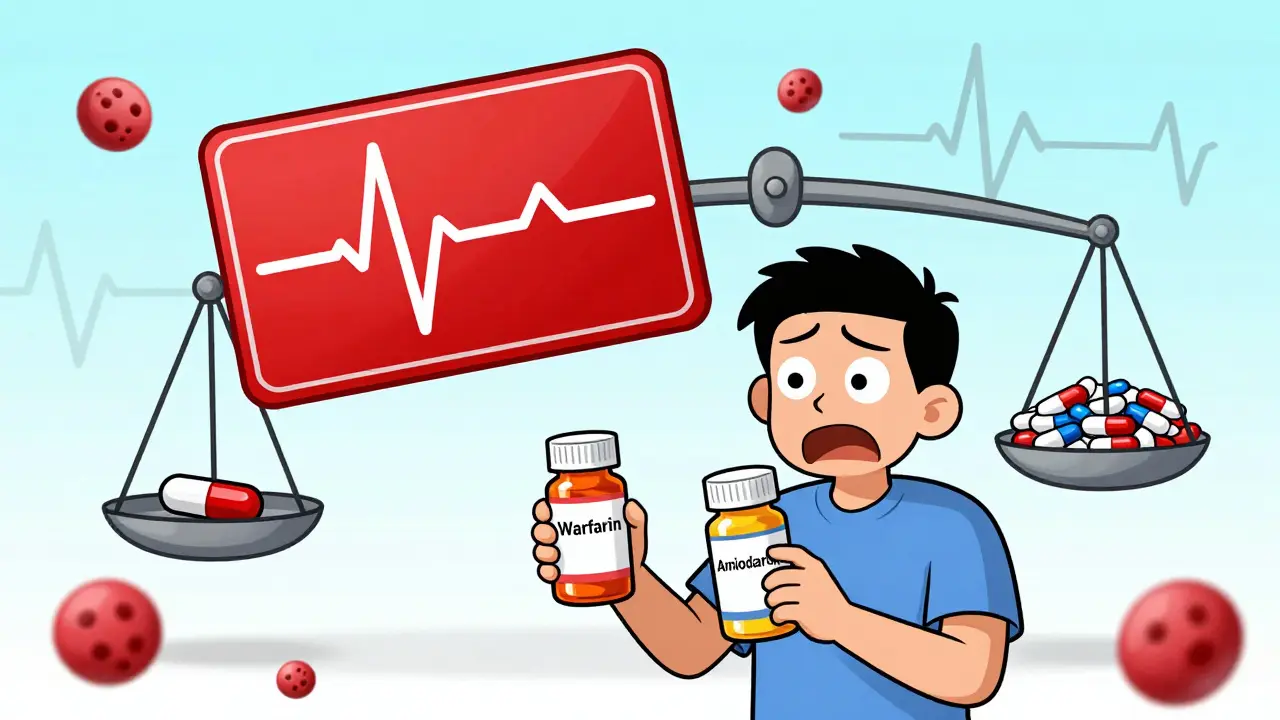
When two drugs with a narrow therapeutic index are combined, the margin for error shrinks to almost nothing. These aren’t just any medications-they’re the kind where a tiny change in blood levels can mean the difference between healing and hospitalization. Think warfarin, lithium, or phenytoin. Now imagine combining two of them in a single pill. Sounds efficient, right? But here’s the catch: no such combination generics exist in the U.S. market. Not one. And the reason isn’t lack of demand-it’s science, regulation, and risk.
What Makes a Drug ‘Narrow Therapeutic Index’?
NTI drugs have a razor-thin line between working and causing harm. The FDA defines them as having less than a twofold difference between the lowest dose that causes toxicity and the lowest dose that provides benefit. That means if your blood level of warfarin climbs just 10% above target, you could bleed internally. Drop it 10% below, and you’re at risk for a stroke. There’s no room for guesswork.
These drugs require constant monitoring. Patients on levothyroxine get their TSH checked every 6-8 weeks. Those on lithium need regular kidney and thyroid tests. Even small changes in absorption, metabolism, or timing can throw off the balance. And that’s just for one drug.
Why Combination NTI Therapy Exists
Doctors use combination NTI regimens when single drugs aren’t enough. In oncology, combining methotrexate with other agents prevents cancer cells from developing resistance. In heart failure, adding digoxin to anticoagulants can improve outcomes when monotherapy fails. In tuberculosis, isoniazid (an NTI drug) is paired with rifampin to stop resistance.
But here’s the problem: these combinations are almost always given as separate pills. Why? Because when you combine two NTI drugs into one tablet, you lose the ability to adjust each one independently. A patient might need 2.5 mg of warfarin and 200 mg of amiodarone today, but tomorrow, only the warfarin dose needs to change. Fixed-dose combinations lock you in-no flexibility, no fine-tuning.
The Bioequivalence Wall
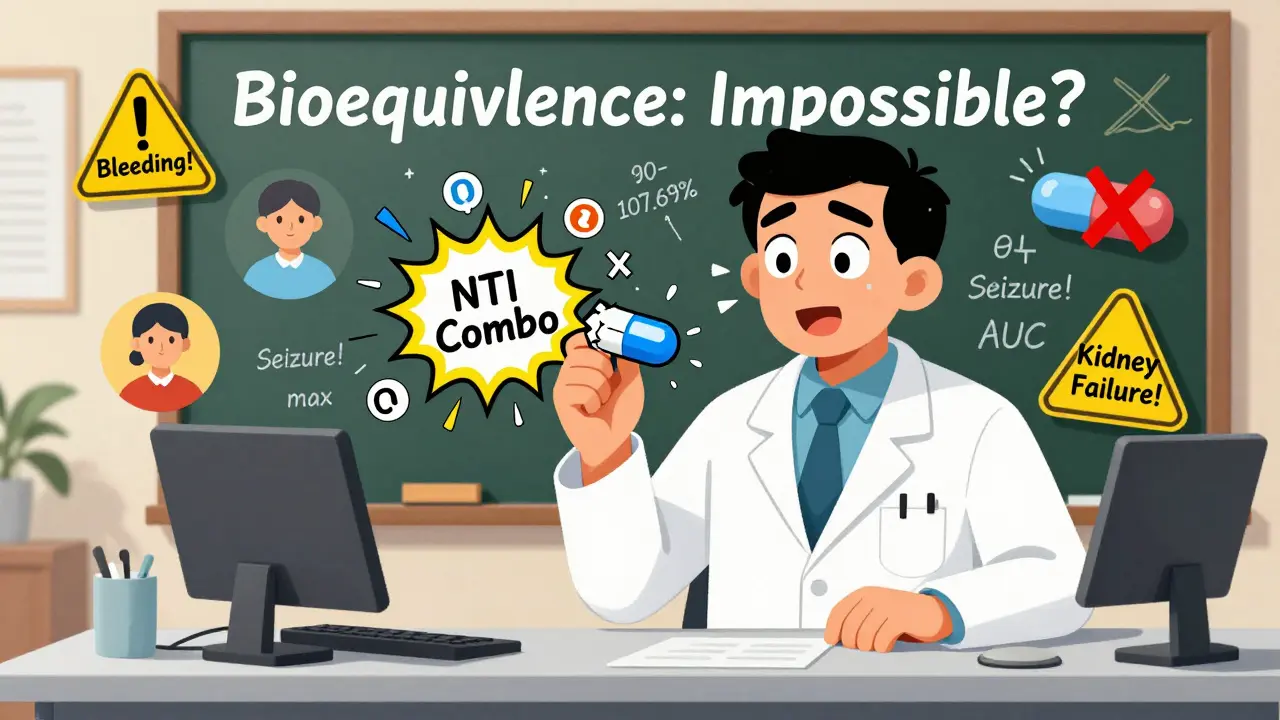
Generic drugs must prove they’re bioequivalent to the brand-meaning they deliver the same amount of drug into the bloodstream at the same rate. For regular drugs, that’s an 80-125% range for absorption (AUC) and peak levels (Cmax). For NTI drugs, the FDA tightened that to 90-111% for Cmax and 90-112% for AUC back in 2014. But for combination NTI products? There’s no official standard yet-just a 2023 draft guidance proposing even stricter limits: 90-107.69% for Cmax and 90-110% for AUC.
Why so tight? Because when you combine two NTI drugs, their variations multiply. If each drug has a 10% variability, together they can have up to 20% total variation. That’s not just statistically significant-it’s clinically dangerous. A 2021 study in Nature Reviews Drug Discovery pointed out that even the current 90-111% window allows 22% total variation. When you stack two drugs, that’s a 44% swing in total exposure. That’s not bioequivalence. That’s a gamble.
Why No Generic Combination NTI Drugs Exist
There are 11 approved generic versions of warfarin. None of them are combined with another NTI drug. Same with lithium, phenytoin, digoxin. The FDA’s Orange Book shows that while 87.4% of NTI monotherapies have generics, only 12.6% of combination regimens involving NTI drugs do. And even those few aren’t true fixed-dose combinations-they’re just co-prescribed generics.
Manufacturers don’t even try. Why? Because the cost to prove bioequivalence for a combination NTI product could exceed $50 million. The trials need to be fully replicated, four-way crossover studies with dozens of healthy volunteers, multiple blood draws per person, and statistical models that account for drug-drug interactions. No company wants to spend that kind of money when the market is tiny and the liability is enormous.
Real-World Risks Are Already Here
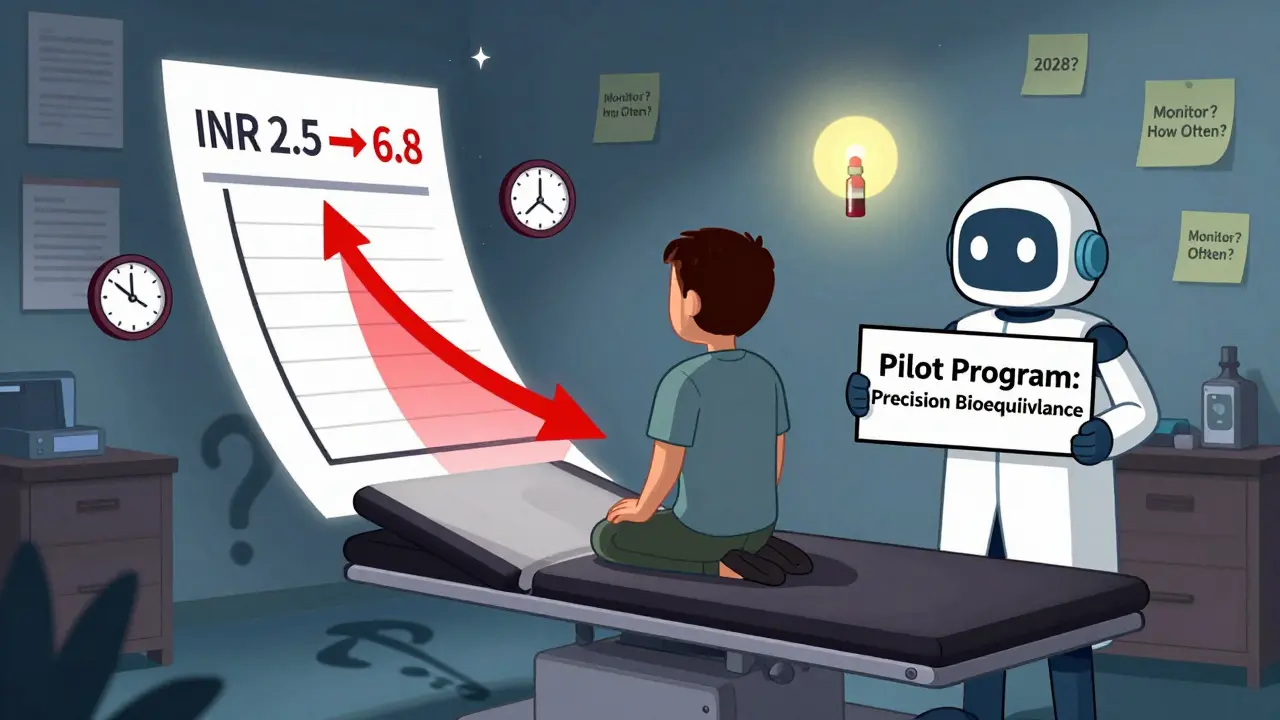
You don’t need a combination pill to see the danger. Patients on two separate generic NTI drugs are already at risk. A 2020 JAMA Internal Medicine study found that when one NTI drug was switched to a generic, adverse events jumped by 27%-compared to just 8% for non-NTI drugs. One patient on warfarin and amiodarone (both NTI) posted on HealthUnlocked: “My INR went from 2.5 to 6.8 in three days after my pharmacy switched to generic warfarin. I ended up in the ER.”
Pharmacists report the same. A 2023 ASHP survey of 856 pharmacists found 78.3% had seen therapeutic failure after switching to generics in NTI combinations. Over 40% reported serious adverse events-bleeding, seizures, arrhythmias, kidney failure. And it’s not just patients. A Reddit user, u/ThyroidWarrior, said their levothyroxine + selenium combo generics worked fine for two years. But that’s the exception. FDA data shows fewer than 15% of combination NTI scenarios have stable outcomes with generics.
Who’s Saying What?
Doctors and pharmacists are divided. The American Society of Health-System Pharmacists (ASHP) says automatic substitution of NTI drugs in combinations is “unacceptable.” They’ve issued formal position statements against it. Dr. Aaron Kesselheim from Harvard showed that 18.7% of patients on generic warfarin had unstable INRs-compared to 4.3% on brand. That’s a fourfold increase.
But some manufacturers argue it’s possible. Teva and Sandoz point to Europe, where generic levothyroxine combinations have been used since 2015 with under 2% adverse events. The EMA approved them under strict monitoring protocols. The problem? The U.S. doesn’t have the same infrastructure. Only 12 out of 50 major U.S. academic hospitals have specialized NTI combination clinics. Most community pharmacies don’t have the training, tools, or time to manage these regimens.
The Cost of Monitoring Is Sky-High
Managing a combination NTI therapy isn’t just about taking pills. It’s about blood tests, dose adjustments, and constant oversight. On average, patients spend $1,200 to $2,500 a year on monitoring alone. That’s three to six times more than non-NTI combinations. Each adjustment takes 6-8 weeks to stabilize. Patients need 3.2 dose changes on average, versus 1.8 for non-NTI drugs.
Pharmacists need over 120 hours of specialized training to manage these cases. Yet most pharmacy schools don’t require it. The result? Inconsistent care. One patient might get weekly INR checks. Another might be told to come back in a month. Documentation quality for combination NTI products scores just 2.8 out of 5-far below the 4.2 for monotherapies.
What’s Next?
The FDA is working on a pilot program for “precision bioequivalence” using pharmacometric modeling. Instead of testing 50 healthy volunteers, they might use computer simulations based on real-world patient data. That could cut development time from 4.7 years to under 2. But it’s still years away.
Meanwhile, the market keeps growing. The global NTI drug market hit $48.7 billion in 2023 and is projected to reach $78.3 billion by 2028. But combination NTI products? They’ll remain under 1% of that market. The science isn’t there yet. The regulatory path is too narrow. And the risk to patients is too high.
For now, if you’re on a combination of NTI drugs, stick with brand-name versions if you can. If you’re switched to generics, demand close monitoring. Ask your pharmacist: “Is this a combination NTI regimen? Are you tracking levels closely?” Don’t assume it’s safe because it’s cheaper. It’s not.
Frequently Asked Questions
What exactly is a narrow therapeutic index (NTI) drug?
An NTI drug has a very small difference between the dose that works and the dose that causes harm. For example, warfarin’s therapeutic range is so narrow that a 10% increase in blood level can cause dangerous bleeding, while a 10% drop can lead to a clot. The FDA defines NTI drugs by their low ratio of toxic to effective concentration-usually less than 2:1. These drugs require frequent blood tests and careful dosing.
Why are there no generic combination NTI drugs in the U.S.?
Because proving bioequivalence is scientifically impossible under current standards. When two NTI drugs are combined, their individual variations multiply. Even if each drug stays within the tight 90-111% bioequivalence window, together they can swing up to 44% in total exposure. That’s too risky. No manufacturer has been able to design a study that proves safety without exposing patients to unacceptable danger.
Can I safely switch to generic NTI drugs if I’m on a combination therapy?
It’s not recommended. Studies show a 27% higher rate of adverse events when generics are substituted in combination NTI regimens. If you’re on two NTI drugs-even as separate pills-switching one to a generic can destabilize your entire regimen. Always talk to your doctor before any switch. Demand more frequent blood tests if a change happens.
Are combination NTI drugs used anywhere in the world?
Yes, but sparingly. In Europe, some generic combinations of levothyroxine with selenium or other supplements have been approved since 2015, with low adverse event rates. But these are not true NTI-NTI combinations like warfarin + amiodarone. The EMA requires strict monitoring and patient education. The U.S. has not followed this path due to differences in healthcare infrastructure and regulatory caution.
How can I tell if I’m on a combination NTI therapy?
Check your prescription. If you’re taking two drugs that are both on the FDA’s NTI list-like warfarin, lithium, phenytoin, digoxin, or levothyroxine-you’re on a combination NTI regimen. Ask your pharmacist for a list of NTI drugs. If both are NTI, assume you’re in a high-risk category. Don’t accept automatic substitution without explicit approval from your prescriber.
What should I do if my pharmacy switches my NTI drugs to generics?
Call your doctor immediately. Request a blood test within 3-5 days. Monitor for symptoms like unusual bruising, fatigue, dizziness, or irregular heartbeat. Document everything. If you’re on a combination, insist on staying on brand-name versions unless your doctor and pharmacist agree that switching is safe-with close monitoring. Most insurance plans will cover brand-name NTI drugs if you document medical necessity.
What’s the Bottom Line?
Combination NTI therapy is a lifeline for some patients-but it’s also a minefield. The drugs work. The science behind them is solid. But the generic market hasn’t caught up. Not because of greed, but because the margins are too thin. Too many variables. Too much at stake.
Until the FDA finalizes new bioequivalence standards-and until pharmacies get the tools to manage them-patients on these regimens should treat every switch like a medical event. Not a billing decision. Your life depends on precision. Don’t let cost-cutting compromise it.





Colin Pierce
January 27, 2026 AT 12:03Just had a patient on warfarin + lithium switch to generics last month. INR went from 2.8 to 5.1 in 72 hours. She ended up in the ER with a subdural hematoma. This isn’t theoretical-this is happening in real clinics every week. If your pharmacy auto-substitutes NTI combos, push back hard. Your life isn’t a cost-saving metric.
Mark Alan
January 29, 2026 AT 11:58USA STILL LETS PHARMACIES SWITCH OUR LIFE-DRUGS?? 😡🇺🇸 This is why I hate our healthcare system. We let corporations gamble with people’s brains and kidneys just to save $2 a pill. I’d rather pay $300 a month than end up in a coma because some pharmacist thought ‘generic = same.’
Ambrose Curtis
January 31, 2026 AT 08:09look i get why no one makes combo generics-math is brutal. if each drug’s got 10% var, together you’re looking at 20% swing? that’s like driving with your eyes half shut. but here’s the thing: we DO have combo generics for non-NTI stuff, like HIV meds. why’s this different? because the FDA’s scared. not because it’s impossible. just because they don’t wanna be the one who says ‘it’s fine’ and someone dies. sad. but also… kinda understandable?
Phil Davis
February 2, 2026 AT 05:55Interesting. So the FDA is effectively protecting the brand-name market under the guise of patient safety. How noble. Meanwhile, patients are stuck paying $400 for warfarin while their insurance denies the brand because ‘there’s a generic.’ The irony is thick enough to spread on toast.
Anna Lou Chen
February 2, 2026 AT 21:15Ah, the neoliberal biopolitical apparatus has rendered the human body into a statistical abstraction-bioequivalence as a neoliberal sacrament. The NTI drug regime exposes the ontological violence of pharmacoeconomics: when the body becomes a variable in a regression model, death is merely a p-value. The EMA’s 2% adverse event rate? That’s not safety. That’s colonial biopower exported through regulatory aesthetics.
Bryan Fracchia
February 3, 2026 AT 21:28There’s a lot of fear here, and honestly, it’s justified. But I also think we’re underestimating how smart pharmacists and clinicians can be if given the tools. We don’t need fixed-dose combos to solve this-we need better monitoring tech, better training, and maybe even AI-driven dose prediction. It’s not about avoiding change. It’s about changing smart. Let’s not throw the baby out with the bathwater-just make sure the bathwater’s not boiling.
Timothy Davis
February 3, 2026 AT 22:36Everyone’s acting like this is some new crisis. Newsflash: this has been going on for a decade. The 27% spike in adverse events? That’s from one JAMA study. The real data? Most patients don’t even notice. You think your INR is so precise? It’s not. You think your pharmacist doesn’t know what they’re doing? They do. Stop being paranoid. The real problem is patients who Google everything and panic because they read a Reddit post.
fiona vaz
February 4, 2026 AT 11:29My dad’s on digoxin + amiodarone. Brand only. No switches. Ever. He’s 79. His cardiologist told him: ‘If it ain’t broke, don’t let them fix it.’ I’m just glad we have the means to afford it. For everyone else? They’re rolling the dice. This isn’t about generics being bad-it’s about us not having the system to make them safe.