
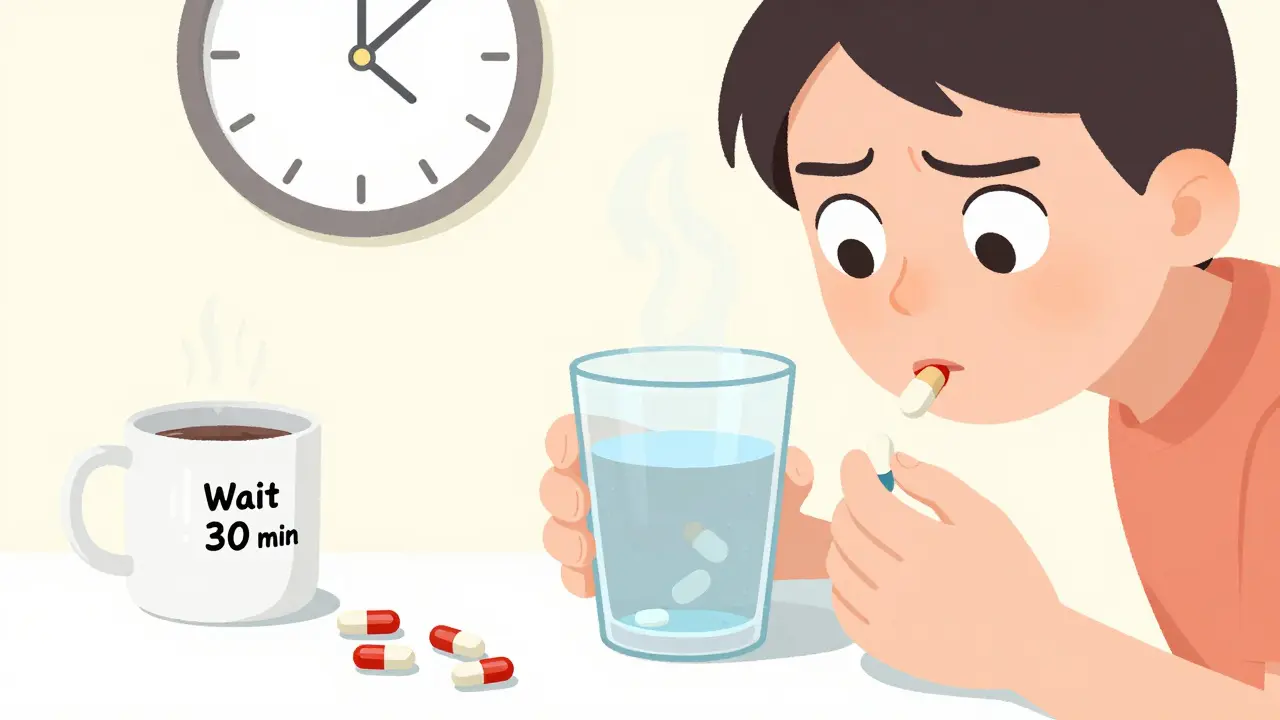
If you're taking levothyroxine for hypothyroidism, and you're also taking calcium or iron supplements, you might be unknowingly making your medication less effective. This isn't a minor issue - it's one of the most common reasons thyroid levels stay out of range even when people take their pills every day. The problem isn't that the supplements are bad. It's that they physically block your body from absorbing the thyroid hormone properly.
Why Calcium and Iron Ruin Thyroid Medication Absorption
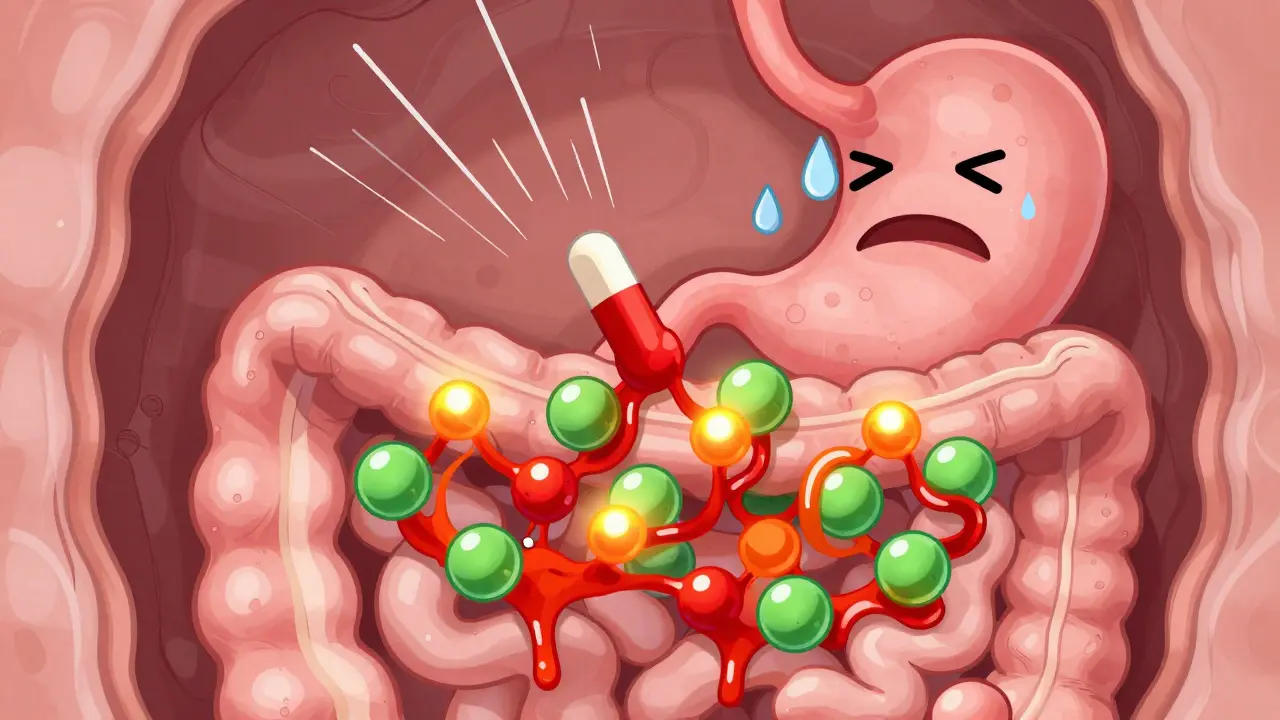
Levothyroxine, the synthetic form of thyroid hormone, needs to be absorbed in the small intestine to work. But calcium and iron don’t just float through your gut. They bind tightly to the medication like glue, forming a solid lump your body can’t absorb. This isn’t theory - it’s been proven in study after study. When taken together, calcium supplements can reduce levothyroxine absorption by 22% to 36%. Iron? It knocks it down by 21% or more. That means if you normally need 75 mcg of levothyroxine to feel right, you might only be getting 50 mcg when you take your supplements at the same time.
The science is clear: calcium (especially calcium carbonate) and iron (ferrous sulfate, ferrous fumarate, ferrous gluconate) are both divalent or trivalent cations. These charged particles latch onto levothyroxine molecules and trap them. No absorption. No effect. Just wasted pills.
How Long Should You Wait?
Timing isn’t optional - it’s medical necessity. The American Thyroid Association and Mayo Clinic both say: wait at least four hours between taking levothyroxine and calcium supplements. For iron, most guidelines say two to four hours. That’s not a suggestion. It’s the difference between feeling fatigued and having energy, between constant coldness and normal body temperature.
Here’s how to make it work in real life:
- Take your thyroid medication first thing in the morning, on an empty stomach, with a full glass of water.
- Wait at least 30 to 60 minutes before eating, drinking coffee, tea, or juice.
- Take calcium supplements at bedtime, or with dinner - at least four hours after your thyroid pill.
- Take iron supplements at lunch, or right before bed - but not within four hours of your thyroid dose.
Some people switch their thyroid medication to bedtime. That works for many, especially if they struggle with morning timing. But you still need to wait at least four hours after eating, and avoid calcium or iron within that window. A 2022 Reddit thread from a user named u/HypoMama described how switching to nighttime levothyroxine fixed her TSH levels after she started iron for postpartum anemia. She wasn’t alone.
What About Calcium-Fortified Foods?
You might think, "I’m not taking a supplement - I’m just drinking orange juice." But that’s not enough. An 8-ounce glass of calcium-fortified orange juice has about 350 mg of calcium. That’s more than enough to interfere. Same with almond milk, soy milk, or oat milk that’s been fortified. If you drink it within four hours of your thyroid pill, you’re sabotaging your treatment.
Even foods naturally high in calcium - like yogurt, cheese, or broccoli - can cause issues if eaten right after your pill. Stick to water only for the first hour. Eat your breakfast, your yogurt, your fortified cereal - later.
Iron and Pregnancy: A High-Risk Combo
Pregnant women and those with heavy periods are often prescribed iron. But if they’re also on thyroid medication, they’re at higher risk of under-treatment. A case study published in 2017 showed a pregnant woman taking iron just four hours after levothyroxine still had a TSH of 8.2 mU/L - way above normal. Her baby’s development was at risk. She needed a dose increase.
Thyroid function drops during pregnancy, so many women need higher doses of levothyroxine anyway. Add in iron without proper timing, and you’re doubling the problem. If you’re pregnant and on thyroid meds, talk to your doctor about when to take iron. Don’t assume your prenatal vitamin is safe. Many contain calcium or iron.
Other Things That Interfere (And What to Do)
Calcium and iron aren’t the only troublemakers:
- Soy products - tofu, soy milk, edamame - can reduce absorption by 18-30%. Avoid within a few hours of your pill.
- Walnuts - one study showed a 24% drop in absorption when eaten with levothyroxine.
- High-fiber foods - like bran cereal or beans - can raise TSH by 15-25% if eaten within an hour of your dose.
- Coffee and tea - tannins block absorption. Wait at least an hour.
- Biotin - found in hair and nail supplements - doesn’t block absorption, but it messes up lab tests. If you take more than 5 mg daily, your TSH and T4 results could look fake. Tell your doctor before your blood test.
These aren’t "maybe" problems. They’re proven, documented, and repeated in clinical practice. And they’re easy to fix - if you know what to avoid and when.
What Happens If You Ignore This?
Ignoring timing doesn’t just mean you feel tired. It means your body thinks you’re hypothyroid - even if you’re taking the right dose. Your TSH rises. Your free T4 drops. Your doctor sees abnormal labs and assumes your dose is too low. So they increase it. And increase it again. Meanwhile, you’re still feeling awful.
That’s not just frustrating - it’s expensive. A 2022 study estimated that improper timing of supplements with thyroid meds leads to $187 million in unnecessary healthcare costs in the U.S. every year. That’s thousands of extra blood tests, unnecessary dose changes, and doctor visits - all because people didn’t know when to take their supplements.
And here’s the worst part: a 2023 study found only 42% of patients were properly counseled about these interactions when they first got their prescription. Most doctors assume you’ll read the leaflet. But leaflets get lost. And if you’re on five other meds, thyroid timing isn’t top of mind.
What About Newer Thyroid Medications?
There’s hope. A new liquid formulation of levothyroxine, currently in Phase III trials, shows only an 8% drop in absorption when taken with calcium - compared to 32% with regular tablets. That’s a game-changer. But it’s not available yet, and when it is, it’ll cost around $350 a month. Generic tablets? $15.
For now, the cheapest, most effective solution is still timing. Not magic. Not supplements. Just patience and planning.
Real-Life Fix: A Simple Routine That Works
Here’s what a successful daily schedule looks like for someone on levothyroxine with calcium and iron needs:
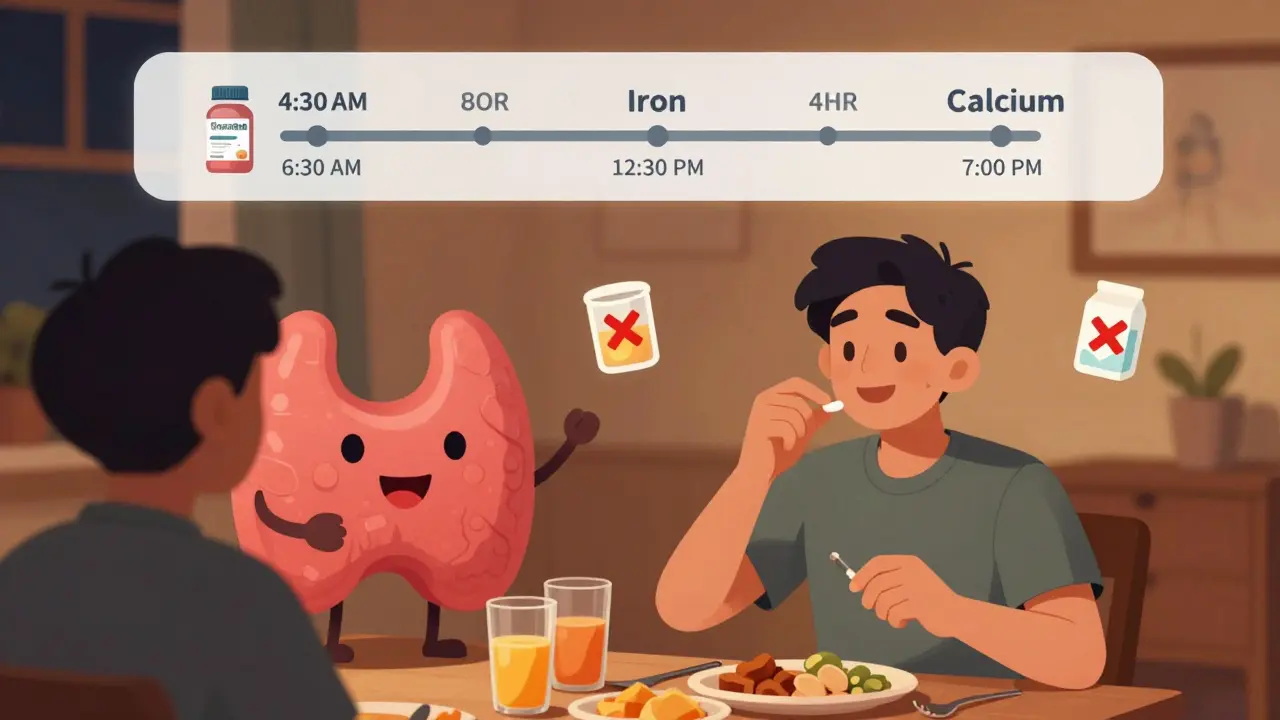
- 6:30 AM: Take levothyroxine with water. No food. No coffee. No supplements.
- 7:30 AM: Eat breakfast - toast, eggs, fruit. No fortified milk or yogurt.
- 12:30 PM: Take iron supplement with lunch.
- 7:00 PM: Take calcium supplement with dinner.
- 10:00 PM: Take any other nighttime meds - but no more iron or calcium.
That’s it. Four hours between thyroid and calcium. Two to four hours between thyroid and iron. Simple. No guesswork. No risk.
What If You Already Took Them Together?
If you accidentally took your calcium or iron with your thyroid pill, don’t panic. Don’t double up on your dose. That’s dangerous. Just wait until the next day and get back on schedule. One slip won’t ruin your treatment. But if it keeps happening, your levels will drift. And that’s when symptoms come back - weight gain, brain fog, depression, cold hands, hair loss.
Set phone alarms. Write it on your calendar. Put your supplements in a different drawer than your thyroid pills. Make it visual. Your body depends on this routine.
Can I take calcium and iron together?
Yes, you can take calcium and iron together - but not with your thyroid medication. They don’t interfere with each other. The problem is only when either one is taken near levothyroxine. Take them together at dinner, at least four hours after your thyroid pill.
Is it safe to take thyroid medication at night?
Yes, many people find nighttime dosing easier. Take it at least four hours after your last meal and avoid calcium or iron within that window. Studies show nighttime levothyroxine works just as well as morning dosing - and it’s often easier to stick to.
Do all calcium supplements interfere?
Yes. Calcium carbonate, calcium citrate, and calcium in fortified foods all interfere. The amount matters - even 200 mg can reduce absorption. Stick to the four-hour rule regardless of the form.
Can I take a multivitamin with my thyroid pill?
Most multivitamins contain iron, calcium, or magnesium - all of which interfere. Wait at least four hours after your thyroid medication to take a multivitamin. Or choose one without minerals and take it at night.
How do I know if my supplements are affecting my thyroid levels?
If your TSH has been rising despite taking your medication regularly, and your diet or supplement routine changed recently, timing is likely the issue. Talk to your doctor about checking your levels after you’ve followed proper timing for 6-8 weeks. Many see their TSH drop back into range once they fix the schedule.
If you’re on thyroid medication and take calcium or iron, your health depends on this one simple rule: space them out. No exceptions. No shortcuts. Your body doesn’t care how busy you are. It only cares if the medicine gets absorbed. Get it right - and you’ll finally feel like yourself again.



Hayley Ash
December 30, 2025 AT 14:55So let me get this straight - you’re telling me I can’t have my oat milk latte before noon because some study says it might bind to my thyroid pill like a clingy ex? Cool. I’ll just sip water and stare at the wall until 7:30 AM. Meanwhile my coffee addiction is now a medical violation.
kelly tracy
December 31, 2025 AT 12:19This post is textbook fearmongering dressed up as medical advice. You act like calcium and iron are poison when they’re just minerals. People have been taking them together for decades without turning into zombies. The real problem? Doctors who don’t bother explaining this properly - not the supplements.
srishti Jain
December 31, 2025 AT 18:40My TSH was 12. I took iron at night. Switched to morning thyroid. TSH dropped to 3.5 in 6 weeks. No magic. Just timing. Stop overcomplicating it.
Cheyenne Sims
January 1, 2026 AT 16:21The assertion that calcium and iron reduce levothyroxine absorption by 21–36% is scientifically valid and well-documented in peer-reviewed literature. To suggest otherwise is not merely incorrect - it is medically irresponsible. Adherence to evidence-based guidelines is non-negotiable in endocrine management.
Shae Chapman
January 2, 2026 AT 08:09THIS. THIS IS THE MOST IMPORTANT THING I’VE READ ALL YEAR. 🙏 I was taking my iron at breakfast with my thyroid med and felt like a zombie. Now I take iron at 8 PM and I have actual energy. I cried when my TSH normalized. Thank you for writing this. I’m sharing it with everyone I know.
Nadia Spira
January 4, 2026 AT 06:46Let’s deconstruct the epistemological fallacy here: you’re conflating pharmacokinetic interference with clinical significance. Absorption reduction ≠ therapeutic failure. The studies cited are in vitro or short-term. Real-world outcomes? Messy. Population-level data shows no consistent correlation between supplement timing and TSH stability - unless you’re conflating compliance bias with causality.
henry mateo
January 4, 2026 AT 19:36i read this and i was like ohhhhhhh that’s why i was so tired all the time. i took my calcium with my thyroid pill for 3 years. i just started spacing it out like you said and today i actually felt like myself for the first time in ages. thank you. i’m gonna set 3 alarms now lol
Kunal Karakoti
January 6, 2026 AT 05:56There’s an irony here: we treat thyroid hormone as a precise chemical signal, yet we expect our bodies to adapt to chaotic, modern lifestyles. Perhaps the real issue isn’t calcium timing - it’s that we’ve outsourced biological rhythm to alarm clocks and multivitamins. The body knows when to absorb. We just forgot how to listen.
Glendon Cone
January 7, 2026 AT 15:17Biggest game-changer for me: switching to nighttime levothyroxine. I used to forget to wait an hour before coffee. Now I take it right before bed, no food for 4 hours, and boom - steady TSH for 2 years. Also, I keep my iron and calcium in a separate drawer labeled ‘Thyroid Enemy Zone’ 🧠💀
Henry Ward
January 9, 2026 AT 12:16People like you who write these posts make me sick. You treat patients like dumb machines that need rigid schedules. Some of us have jobs, kids, life. We can’t play clockwork monk. If your doctor can’t adjust your dose for real-world behavior, they’re not a good doctor.
Aayush Khandelwal
January 11, 2026 AT 00:25The calcium-iron-thyroid triangle is a beautiful example of biochemical ballet - ions dancing with molecules, blocking absorption like jealous lovers. It’s not about rules, it’s about molecular intimacy. Levothyroxine wants to be free. Calcium and iron? They want to hold hands. And your gut? Just the stage.
Sandeep Mishra
January 12, 2026 AT 23:53If you're new to this, don't panic. Start small. Pick one thing to fix - maybe move your calcium to bedtime. That’s enough for week one. Then tackle iron next. Your body doesn’t need perfection. It needs consistency. And you’ve got this. 💪
Joseph Corry
January 13, 2026 AT 02:27How quaint. You assume everyone has the luxury of a 6:30 AM routine, access to non-fortified foods, and the cognitive bandwidth to maintain a 4-hour buffer between pills and meals. The working class, single parents, and the chronically ill don’t get the privilege of pharmacological precision. This post is elitist nonsense wrapped in pseudoscientific garb.
Kelly Gerrard
January 14, 2026 AT 15:32Thank you for this. I’ve been on levothyroxine for 12 years and never knew about the calcium issue. My TSH was 9.8. I moved my calcium to bedtime. Two months later: 2.1. I’m alive again. This is not a suggestion. It’s a lifeline.