
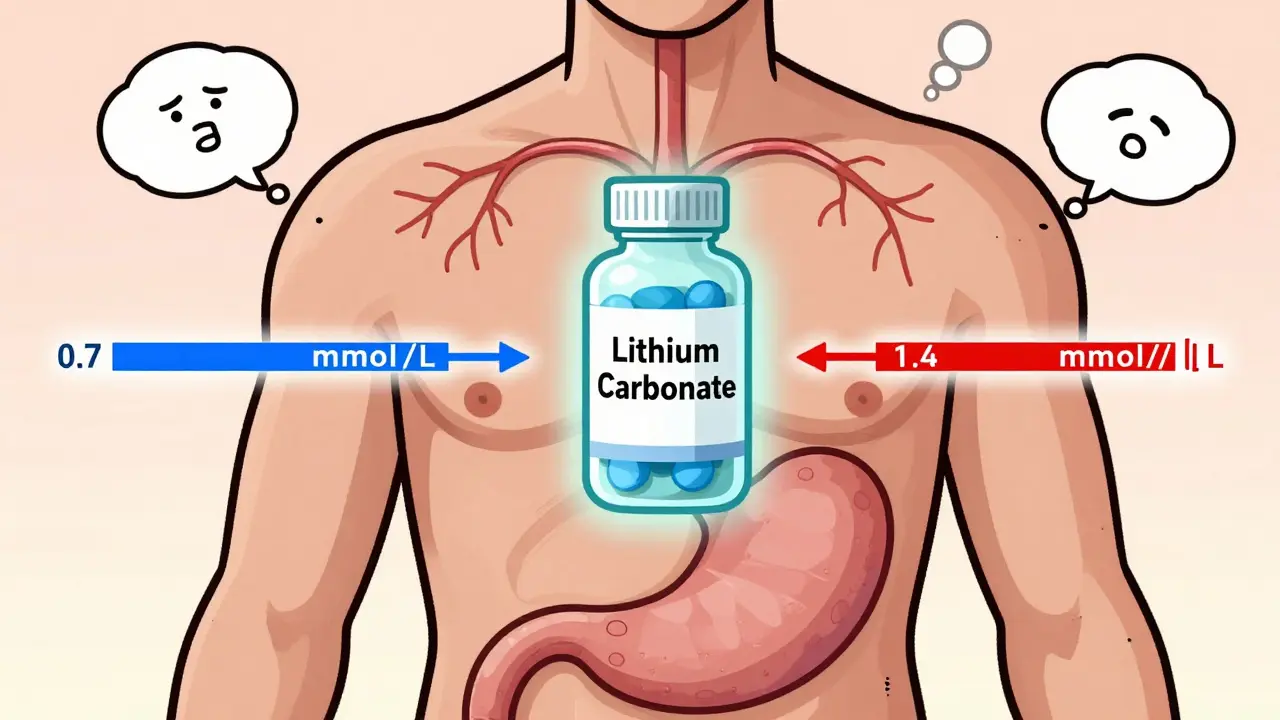
When you're managing bipolar disorder with lithium carbonate, the brand on the bottle can actually matter more than you think. Even though all generics are supposed to be the same as the brand name, lithium carbonate isn't like other medications. It's one of the few drugs classified as an NTI - a narrow therapeutic index drug. That means the difference between working well and causing serious harm is tiny. A serum level of 0.7 mmol/L might keep your mood stable. Jump to 1.4 mmol/L, and you could be headed for tremors, confusion, or worse.
Why Lithium Isn't Like Other Pills
Lithium carbonate has been used since the 1940s to stabilize moods in bipolar disorder. It's not new, but it's still one of the most effective treatments we have for preventing mania and reducing suicide risk. Studies show it cuts relapse rates by more than half compared to placebo. But here's the catch: your body doesn't handle it like it does aspirin or statins. The therapeutic range? Between 0.6 and 1.2 mmol/L. Go above 1.5, and you're in danger zone. Below 0.5, and it might not work at all.
What makes lithium extra tricky is how small changes in how your body absorbs it can swing your blood levels. Two pills that look identical - same dose, same manufacturer - can behave differently if one is immediate-release and the other is extended-release. Even switching between generic brands can cause your serum lithium level to rise or drop without you changing your dose.
Generics Aren't Always Interchangeable
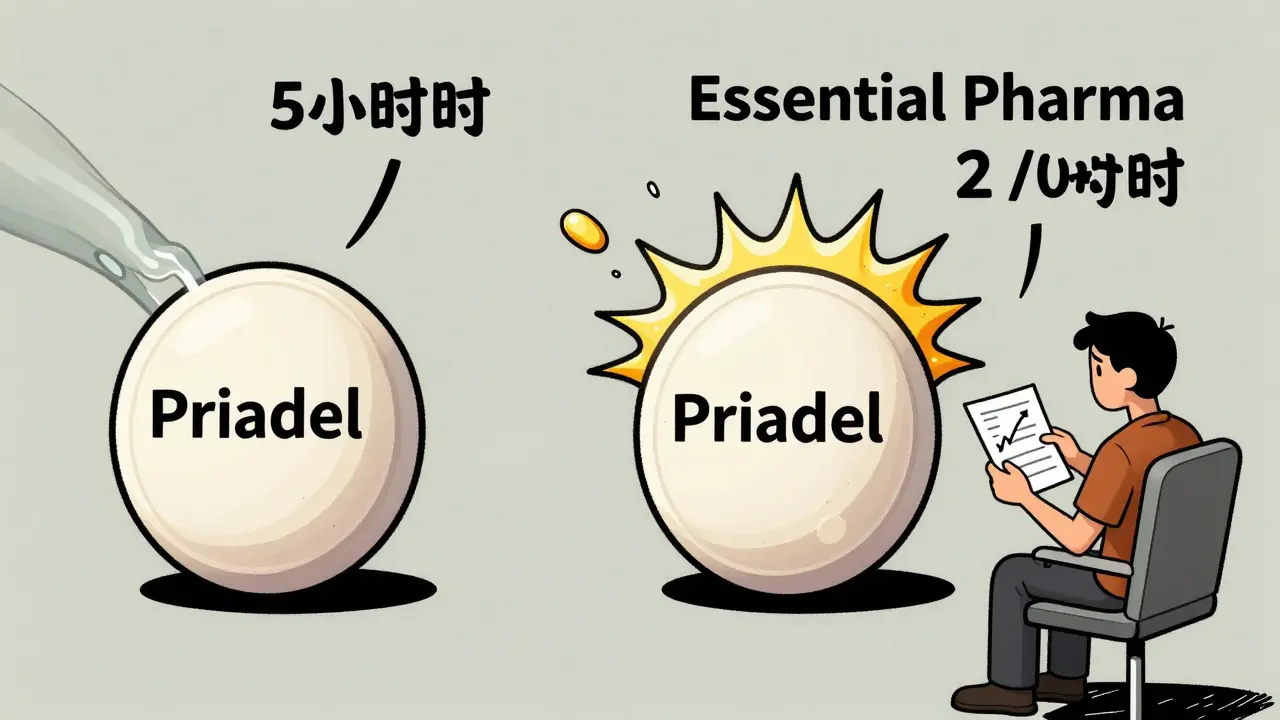
There are dozens of generic lithium carbonate products on the market. In the U.S., about 12 are FDA-approved. In the UK, you'll see brands like Camcolit and Priadel - both are sustained-release versions, but they're not the same. A 2024 study found that patients switched from Camcolit to Priadel ended up with serum levels 11% higher, even when the dose stayed the same. That’s not a small shift. That’s enough to push someone from safe into toxic territory.
Why? Because of how the pills break down in your gut. Immediate-release forms hit peak concentration in 1-2 hours. Sustained-release versions like Priadel and Camcolit take 4-5 hours. That slower release changes how much lithium is in your blood at any given time. If you’re on a once-daily sustained-release pill, your blood level is measured 24 hours after your last dose. If you’re on a three-times-daily immediate-release version, it’s measured 12 hours after the last dose. Mix up the timing, and your test results don’t mean what you think they do.
What Your Doctor Should Be Checking
When you’re on lithium, your doctor isn’t just checking your mood. They’re checking your kidneys, your thyroid, and your blood levels - regularly. Every 3 to 6 months during stable treatment. More often if you’re new to lithium or if your dose just changed. And if you switch brands? Expect a blood test within 1-2 weeks.
Here’s what gets tested:
- Serum lithium level - the most critical number. Target is 0.6-0.8 mmol/L for maintenance, 0.8-1.0 mmol/L if you’re still in an active phase.
- Thyroid function - lithium causes hypothyroidism in up to 15% of people. TSH levels need to be checked at least once a year.
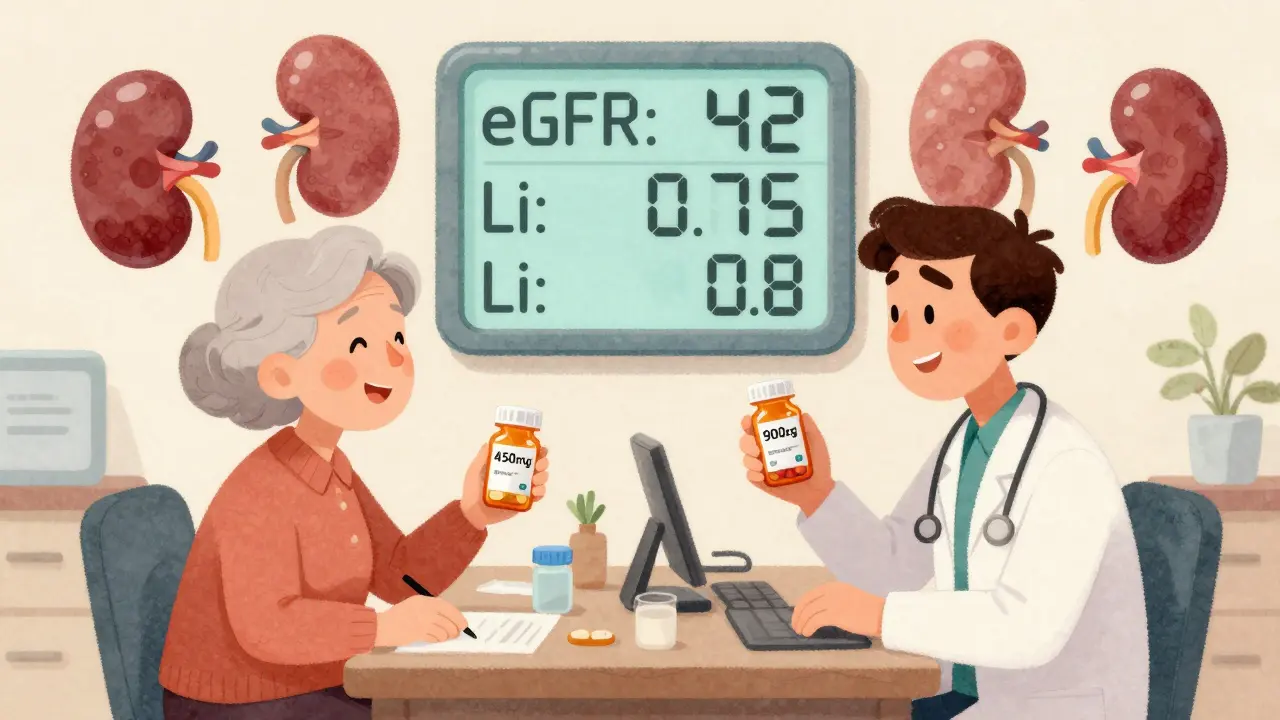
- Renal function - lithium can damage kidneys over time. Creatinine and eGFR (especially cystatin C-based eGFR) are tracked closely. If your eGFR drops below 45, your dose usually needs to come down.
- Electrolytes - sodium levels affect how your body holds onto lithium. A low-salt diet or excessive sweating can spike your levels unexpectedly.
And don’t assume your lab results are foolproof. If you took your pill at 8 a.m. and had blood drawn at 10 a.m., your level will look artificially high. Always tell your phlebotomist when you last took your dose.
Age, Gender, and Body Size Matter
Lithium dosing isn’t one-size-fits-all. A 25-year-old man weighing 80 kg might need 900 mg daily. A 75-year-old woman weighing 55 kg might need only 450 mg. Why? Because lithium is cleared by the kidneys, and kidney function declines with age. Studies show people over 60 need 20-25% less lithium than younger adults. Women, on average, require about 96 mg less per day than men, even after adjusting for weight.
That’s why blanket dosing - like giving everyone 600 mg twice daily - is dangerous. It’s why your doctor should adjust your dose based on your age, weight, and kidney function, not just what’s written on the prescription pad. The 2022 CANMAT guidelines recommend starting low and going slow, especially in older patients. And if you’re over 80? You’re likely on a dose 437 mg lower than someone under 30, even if you both have the same diagnosis.
What Happens When You Switch Brands
Imagine this: You’ve been stable on Priadel for two years. Your lithium level is 0.75 mmol/L. Your pharmacy runs out. They give you a different generic - say, Essential Pharma. You don’t notice a difference. But two weeks later, you feel foggy. Your hands shake. You get nauseous. You go to the ER. Your lithium level? 1.88 mmol/L - toxic.
This isn’t hypothetical. The same 2024 study documented four patients who ended up with lithium levels above 1.3 mmol/L after switching between brands. One hit 1.88 - nearly double the upper safe limit. That’s not a fluke. It’s a known risk. The FDA requires generics to be bioequivalent within 80-125% of the brand. That’s a 45% window. For lithium, that’s too wide.
That’s why many psychiatrists insist on staying on the same brand. If your doctor prescribes “lithium carbonate,” the pharmacy can swap it. But if they write “Priadel” or “Camcolit,” the pharmacy has to give you that specific version. Always ask for the brand if you’re stable on it. Don’t let a pharmacy change it without telling you.
The Future: Personalized Lithium Dosing
There’s new hope on the horizon. Researchers at the International Consortium on Lithium Genetics (ConLiGen) have found 30 genetic variants linked to how people process lithium. Some people naturally clear it faster. Others hold onto it longer. That could mean one day, a simple blood test could tell your doctor exactly how much lithium you need - no trial and error.
Some hospitals are already testing AI tools that pull data from your electronic records - age, weight, kidney function, recent labs, even your sodium intake - and suggest a dose. One pilot program reduced lithium-related hospitalizations by 37% in just six months.
But until those tools are everywhere, the old rules still apply: Know your level. Know your brand. Know your kidneys. And never assume a generic is interchangeable with another - not with lithium.
What You Can Do Today
- Always know your latest lithium level. Ask for a copy of your lab report.
- If your pharmacy switches your brand, ask your doctor for a blood test within 10 days.
- Keep a log of your dose, timing, and any side effects - tremors, frequent urination, weight gain, nausea.
- Don’t change your salt intake suddenly. Avoid low-sodium diets unless your doctor says so.
- Drink water consistently. Dehydration can spike lithium levels fast.
- Ask your doctor: "Is this prescription written as a brand name?" If not, request it.
Lithium isn’t going away. Even with newer drugs like lamotrigine and valproate, it remains the gold standard for long-term bipolar maintenance. But it’s not a drug you can treat like a vitamin. It demands attention. Precision. And respect for the tiny window between healing and harm.
Can I switch between generic lithium brands without problems?
No. Even though generics are required to be bioequivalent, lithium has a narrow therapeutic index, meaning small differences in absorption can push levels into toxic range. Studies show switching brands can raise serum levels by 10-20%. Always check your lithium level 7-14 days after any brand change.
What’s the ideal lithium serum level for maintenance?
For most adults in maintenance, 0.6-0.8 mmol/L is recommended. If you’re still recovering from a recent episode, 0.8-1.0 mmol/L may be used temporarily. For sustained-release formulations like Priadel or Camcolit, aim for the upper end of the range because they release lithium more slowly.
Why do older adults need lower lithium doses?
Kidney function declines with age, and lithium is cleared almost entirely by the kidneys. People over 60 typically have 20-25% lower clearance rates. Higher doses can lead to toxicity even if levels seem "normal" for younger patients. Dosing should be based on kidney function, not just age or weight alone.
Can I take lithium with other medications?
Some medications can dangerously raise lithium levels. These include ACE inhibitors, NSAIDs (like ibuprofen), diuretics, and certain antidepressants. Always tell your prescriber about every medication - including over-the-counter painkillers and herbal supplements - before starting or stopping anything.
How often should I get my lithium level checked?
When you first start lithium, check every 1-2 weeks until stable. Once stable, every 3-6 months is standard. After any dose change, brand switch, illness, or dehydration, check within 7-10 days. Annual thyroid and kidney tests are mandatory.
What are the signs of lithium toxicity?
Early signs: nausea, vomiting, diarrhea, hand tremors, increased thirst, frequent urination. Moderate toxicity: confusion, dizziness, muscle weakness, slurred speech. Severe toxicity (levels >2.0 mmol/L): seizures, coma, irregular heartbeat. If you have any of these symptoms, stop lithium and seek emergency care immediately.



Nicki Aries
February 1, 2026 AT 23:17I’ve been on lithium for 12 years, and switching generics nearly sent me to the ER. One month I was fine on Priadel, next month my pharmacy gave me Essential Pharma-no warning, no lab check. I woke up with tremors so bad I couldn’t hold my coffee cup. My level was 1.7. I cried in the doctor’s office. This isn’t just medical advice-it’s survival. Always ask for the brand. Always. Always. Always.
Lilliana Lowe
February 3, 2026 AT 04:53It’s astonishing how many clinicians still treat lithium as if it were acetaminophen. The FDA’s 80–125% bioequivalence window is an abomination for NTI drugs. Lithium’s therapeutic index is narrower than warfarin’s-yet we allow pharmacy substitutions without mandatory retesting? This is regulatory negligence masquerading as cost-efficiency. The 2024 UK study cited in the post is not an anomaly-it’s the rule. Any prescriber who permits brand-switching without a 72-hour post-switch level is practicing malpractice by omission.
Bob Cohen
February 4, 2026 AT 13:04So let me get this straight-you’re telling me I can’t just swap my lithium pill like I swap my toilet paper brand? Wow. I thought generics were generics. Guess I’m just lucky I never had a bad reaction. But hey, if your doctor’s not checking your levels every few months, maybe you need a new doctor. Or a new pharmacy. Or a new life.
Nidhi Rajpara
February 4, 2026 AT 13:18I am from India and I am using lithium for last five years. My doctor always prescribed Camcolit. Once pharmacy gave me different brand. I felt very tired, headache, and my hands were shaking. I went to doctor and they said my level was 1.4. I was scared. Now I always ask for brand name. I think in India also this problem is there. Many patients do not know. Please spread awareness.
Donna Macaranas
February 5, 2026 AT 06:37My therapist told me to keep a little logbook of my doses and how I felt each day. Best thing I ever did. One time I switched brands and didn’t realize I was getting foggy until I looked back at my notes. Two weeks of feeling ‘off’-turned out my level had spiked. Now I check my levels right after any switch. Small habits save lives.
Jamie Allan Brown
February 6, 2026 AT 12:12My brother was on lithium for 18 years. Stable. Happy. Then the pharmacy switched him to a cheaper generic without telling him. He didn’t know anything was wrong until he started forgetting his own birthday. By the time they tested his levels, he was at 1.9. He spent a week in the hospital. We’ve never let them switch since. If your doctor doesn’t insist on brand consistency, ask why. If they hesitate, find a new one.
Lisa Rodriguez
February 7, 2026 AT 13:17Just a heads up-don’t forget to tell the phlebotomist when you took your last dose. I had a level come back at 1.3 once and panicked until I realized I’d taken my pill at 7am and they drew blood at 8:15. That’s not toxicity, that’s bad timing. Always tell them. Always. Also, if you’re sweating buckets at the gym or skipping meals because you’re on a keto diet-your lithium level is going up. Water. Salt. Consistency. It’s not rocket science, but it’s life-saving.
Ed Di Cristofaro
February 9, 2026 AT 04:39People who don’t take lithium don’t get it. You think it’s just a pill? Nah. It’s a tightrope walk with a knife on your back. One wrong swap and you’re a vegetable. If your pharmacy gives you a different brand, call your doctor. Don’t wait. Don’t hope. Don’t be cool about it. This ain’t Starbucks.
vivian papadatu
February 10, 2026 AT 12:45My mom’s been on lithium since 1987. She’s 82 now. She takes 300mg a day. Same brand. Same time. Same lab schedule. She’s one of the few people I know who’s been stable for over 35 years. That’s the power of precision. We don’t need fancy AI tools to fix this-we need doctors who listen, pharmacies that respect prescriptions, and patients who know their own bodies. Thank you for this post. It’s the kind of thing that saves lives.
Deep Rank
February 11, 2026 AT 07:58Wow, you all sound so dramatic. I mean, lithium is just a salt. People have been taking it for decades. If you can’t handle a little fluctuation, maybe you’re not ready for the real world. My cousin switched brands and was fine. He didn’t even notice. Maybe your brain is just too sensitive? Or maybe you’re just looking for reasons to feel sick. I’ve seen people make mountains out of molehills with this stuff. It’s not magic. It’s chemistry. And chemistry doesn’t care about your feelings.
Naomi Walsh
February 12, 2026 AT 00:06Let’s be clear: the FDA’s approval of interchangeable lithium generics is a public health failure of monumental proportions. The 80–125% bioequivalence standard was designed for drugs with wide therapeutic windows-not for neurotoxic salts that can induce renal failure and neurological damage. The fact that this is still allowed is a testament to how little regulatory bodies understand pharmacokinetics. I’ve written to the FDA three times. They’ve never replied. That’s not bureaucracy-it’s complicity.
Aditya Gupta
February 13, 2026 AT 00:20My uncle in Delhi got switched to a local generic. He stopped sleeping, started shaking. We got his blood test done-1.6. He was lucky. He didn’t go to the hospital. Now we get his meds from the same pharmacy every time. Simple. Don’t overcomplicate. Stick to one brand. Check levels. Drink water. Done.
Nancy Nino
February 14, 2026 AT 11:25While I appreciate the thoroughness of this post, I must point out that the term 'NTI' is not universally standardized across international regulatory frameworks. In the EU, the EMA classifies lithium under 'low therapeutic index' rather than 'narrow,' and their guidance on bioequivalence differs slightly. While the clinical implications remain the same, the terminology matters for precision in cross-border medical communication. A minor quibble, but one that could prevent misinterpretation in academic or clinical settings.
Chris & Kara Cutler
February 14, 2026 AT 20:13Just got my new script-brand name only. 💪💧❤️ Stay safe out there, lithium warriors. You got this.