
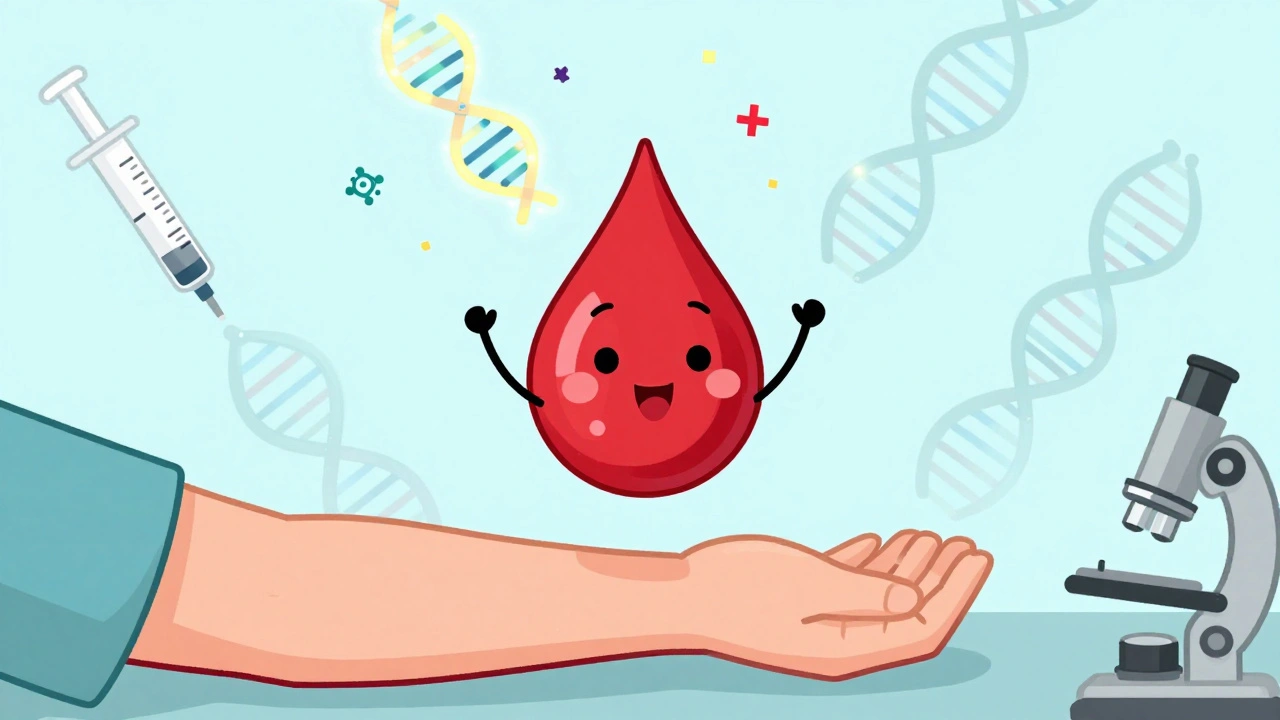
For years, checking if cancer was growing or shrinking meant going under the knife-literally. A tissue biopsy, while accurate, was painful, risky, and often impossible to repeat. Now, a simple blood draw is giving doctors a real-time window into what’s happening inside a tumor. This isn’t science fiction. It’s circulating tumor DNA, or ctDNA, and it’s reshaping how cancer is tracked, treated, and managed.
What Is Circulating Tumor DNA?
When cancer cells die, they break apart and spill bits of their DNA into the bloodstream. These fragments are called circulating tumor DNA, or ctDNA. Unlike healthy DNA floating around, ctDNA carries the exact genetic mistakes that make cancer cells behave badly-mutations in genes like EGFR, KRAS, or BRCA. The trick is finding them. There’s maybe one cancer DNA fragment for every 10,000 normal ones in a blood sample. But modern tools like digital droplet PCR and next-generation sequencing can spot them.
This isn’t about finding cancer cells floating around-it’s about reading their genetic fingerprints. That’s why ctDNA is more powerful than older methods like looking for whole tumor cells in blood. You don’t need the whole cell. Just the broken pieces of its DNA tell you what’s going on.
Why It Beats Traditional Biopsies
Traditional biopsies grab a tiny piece of tumor from one spot. But tumors aren’t uniform. One part might have a mutation that makes it respond to a drug, while another part doesn’t. That’s called tumor heterogeneity. A single biopsy can miss up to 30% of these key changes.
Liquid biopsy pulls DNA from all over the body. It’s like getting a full snapshot instead of a single photo. That’s why it’s better at spotting resistance. If a tumor starts mutating to escape treatment, ctDNA picks it up fast-often months before a scan shows any growth.
And it’s safer. A lung biopsy can cause a collapsed lung. A liver biopsy risks bleeding. A brain biopsy? Nearly impossible without major surgery. Liquid biopsy? A needle in the arm. No hospital stay. No recovery time. Patients can get tested every few weeks without stress.
How It’s Used in Real-World Cancer Care
At major cancer centers like MD Anderson, liquid biopsies are now routine for patients with advanced lung, colorectal, or breast cancer. Here’s how it works in practice:
- Early detection after surgery: After removing a tumor, doctors check ctDNA to see if any cancer cells are still hiding. If ctDNA is found, it means the cancer is likely to come back-often 6 to 11 months before a scan shows anything. That gives time to start treatment early.
- Tracking treatment response: If a drug is working, ctDNA levels drop. If they rise, it’s a sign the treatment is failing. This helps doctors switch therapies faster, without waiting for tumors to grow on scans.
- Finding targetable mutations: In lung cancer, about 92% of cases where tissue wasn’t enough for testing had actionable mutations found in ctDNA. That means patients who would’ve missed out on life-extending drugs now get them.
- Spotting resistance: When a drug stops working, ctDNA can reveal why. Is it a new EGFR mutation? A change in the KRAS gene? This tells doctors exactly which next drug to try.
One patient in Birmingham, diagnosed with stage IV colon cancer, had ctDNA tested every six weeks during treatment. After three months, her levels dropped to near zero. Three months later, they started rising again-even though her CT scan looked fine. Her oncologist switched her to a new targeted therapy. By the time the scan showed progression, she’d already been on a better drug for two months.
The Limits of Liquid Biopsy
It’s not magic. Liquid biopsy has blind spots.
For early-stage cancers-stage I or II-ctDNA levels are often too low to detect. Sensitivity drops to 50-70%. That means one in two early cancers might be missed. It’s not reliable for screening healthy people yet.
Some cancers just don’t shed much DNA. Brain tumors, slow-growing prostate cancers, and certain blood cancers often give false negatives. In these cases, a tissue biopsy is still needed.
And not every DNA change means cancer. Older adults often have harmless mutations in their blood cells-called clonal hematopoiesis. These can look like cancer mutations. Labs now use special filters to spot these, but mistakes still happen. About 15-20% of reports show variants of unknown significance-changes we don’t fully understand yet.
Even the test itself isn’t standardized. Two labs testing the same blood sample might give different results. That’s why guidelines now say: use FDA-approved tests like Guardant360 CDx or FoundationOne Liquid CDx when possible.
What’s Next: Methylation, Fragmentomics, and AI
The next wave isn’t just about mutations. Scientists are now looking at how ctDNA is shaped.
Normal DNA breaks in predictable ways. Cancer DNA breaks differently-shorter, longer, tangled up. These patterns, called fragmentomics, are unique to tumor type. Combine that with methylation (chemical tags on DNA that turn genes on or off), and you get a much clearer picture.
Studies show that adding methylation analysis boosts detection rates by 20-30%. For early-stage cancers, that could be the difference between catching it in time or not.
And then there’s AI. At MD Anderson, machine learning models now analyze ctDNA fragment patterns to predict tumor origin and aggressiveness. Early results show a 15-20% boost in accuracy. Imagine a blood test that not only says “cancer is here” but also “this is likely lung cancer, it’s growing fast, and it’s resistant to drug X.” That’s the goal.
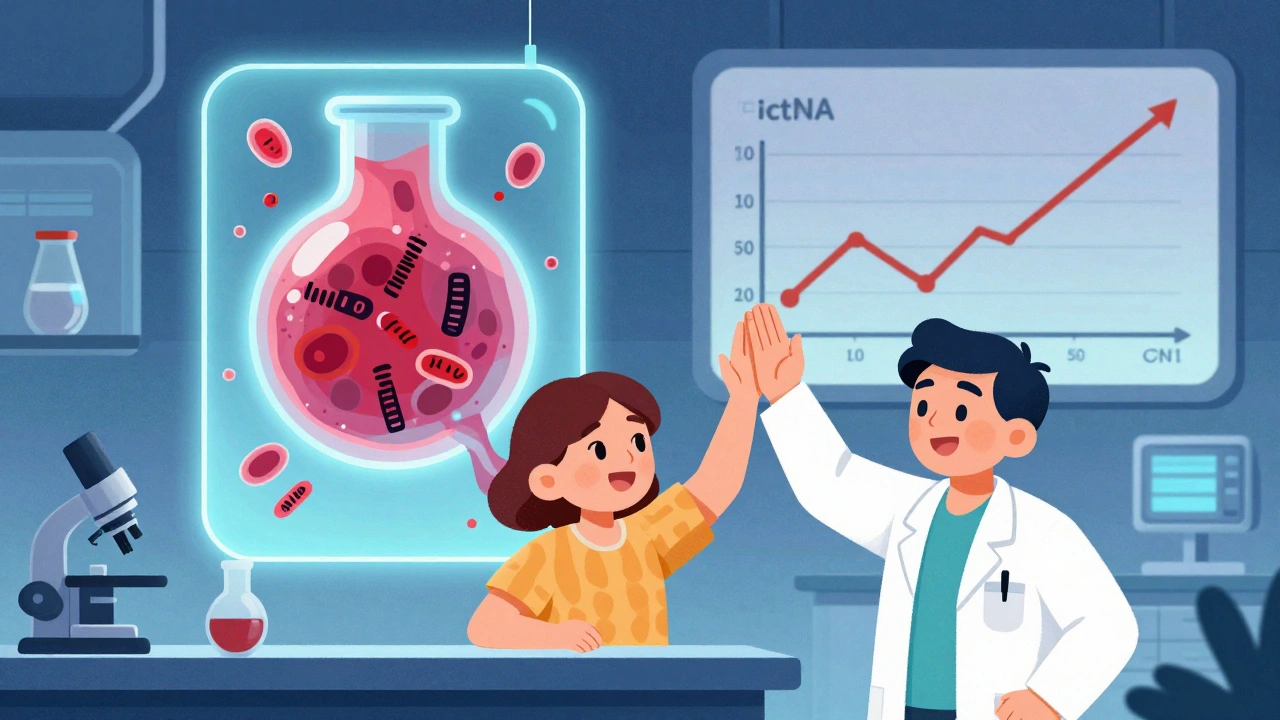
Who Gets Tested? And How Often?
Right now, liquid biopsy is mainly for patients with advanced cancer. Guidelines from ASCO and NCCN recommend it for:
- Advanced non-small cell lung cancer when tissue isn’t available
- Metastatic colorectal cancer to check for KRAS, NRAS, and BRAF mutations
- HER2-negative metastatic breast cancer to monitor treatment response
Testing frequency depends on the situation:
- During active treatment: Every 4 to 8 weeks
- After treatment ends: Every 3 to 6 months for surveillance
- For recurrence risk: Once after surgery, then again at 3 and 6 months
Cost is still a barrier. In the UK, NHS coverage is limited to specific cases. Private tests range from £500 to £1,500. But prices are falling fast. As adoption grows, insurance and public health systems will follow.
The Bigger Picture: A New Standard of Care
The global liquid biopsy market is expected to hit $19.5 billion by 2030. That’s not just because it’s trendy-it’s because it works.
Doctors report a 25-30% drop in repeat tissue biopsies since liquid biopsy became available. Patients avoid complications. Hospitals save money. Treatment becomes more precise.
Experts agree: within five to seven years, liquid biopsy won’t be an option. It’ll be the standard. For monitoring. For guiding therapy. For catching recurrence before it spreads.
It’s not replacing tissue biopsy. It’s complementing it. Tissue still gives the full picture. But ctDNA gives the real-time story. Together, they’re making cancer care smarter, faster, and kinder.
Can liquid biopsy detect cancer early?
Liquid biopsy can detect some early-stage cancers, but not reliably yet. Sensitivity for stage I cancers is only 50-70%, meaning nearly half may be missed. It’s most effective for monitoring known cancer or checking for recurrence after treatment. For true early screening in healthy people, methylation-based tests are showing promise but aren’t ready for routine use.
Is liquid biopsy covered by insurance or the NHS?
In the UK, the NHS covers liquid biopsy for specific advanced cancers-like non-small cell lung cancer-when tissue biopsy isn’t possible. For other uses, such as monitoring or recurrence checks, coverage varies by region and hospital. Private testing is available but can cost between £500 and £1,500. Insurance in the US typically covers FDA-approved tests for approved indications.
Can ctDNA distinguish between cancer and other conditions?
Sometimes, no. Aging can cause harmless mutations in blood cells called clonal hematopoiesis, which look like cancer DNA. Labs use filters to spot these, but false positives still happen in 10-15% of patients over 65. That’s why results are always interpreted alongside imaging, symptoms, and medical history-not in isolation.
How long does it take to get results from a liquid biopsy?
Results typically take 7 to 14 days. Some labs offer faster turnaround (5-7 days) for urgent cases, like when a patient’s treatment needs to be changed quickly. Standard tests take longer because they require deep sequencing and complex bioinformatics analysis.
Does a negative liquid biopsy mean I’m cancer-free?
Not necessarily. A negative result means no ctDNA was detected at the time of testing. But if the tumor sheds very little DNA-like in brain or prostate cancer-it could still be there. Negative results must be interpreted with caution, especially in cancers known to have low ctDNA release. Imaging and clinical symptoms still matter.
Can liquid biopsy replace imaging like CT or MRI scans?
No. Imaging shows where tumors are and how big they are. ctDNA tells you what’s happening genetically. They work together. A scan might show a tumor shrinking, but ctDNA could reveal it’s still mutating and resistant. Conversely, ctDNA might rise before a tumor is visible on a scan. Both are needed for full picture.
What Should Patients Do?
If you’re undergoing treatment for advanced cancer, ask your oncologist: “Is liquid biopsy right for me?” If you’ve had surgery and are in follow-up, ask if ctDNA testing can help monitor for recurrence. Don’t assume it’s automatic-it’s still not offered everywhere.
Keep in mind: this isn’t a test you can order online. It requires a doctor’s order, proper lab processing, and expert interpretation. But it’s no longer experimental. It’s part of modern oncology-and it’s getting better every year.
Michael Dioso
December 5, 2025 AT 19:47Norene Fulwiler
December 7, 2025 AT 07:33Chris Brown
December 8, 2025 AT 11:54Stephanie Fiero
December 8, 2025 AT 13:05Krishan Patel
December 8, 2025 AT 21:02sean whitfield
December 10, 2025 AT 12:46Carole Nkosi
December 12, 2025 AT 10:49Stephanie Bodde
December 13, 2025 AT 14:08ashlie perry
December 15, 2025 AT 03:23Juliet Morgan
December 16, 2025 AT 06:25William Chin
December 17, 2025 AT 15:58Ada Maklagina
December 18, 2025 AT 02:19Harry Nguyen
December 19, 2025 AT 22:55Philip Kristy Wijaya
December 21, 2025 AT 05:11Katie Allan
December 21, 2025 AT 07:58