
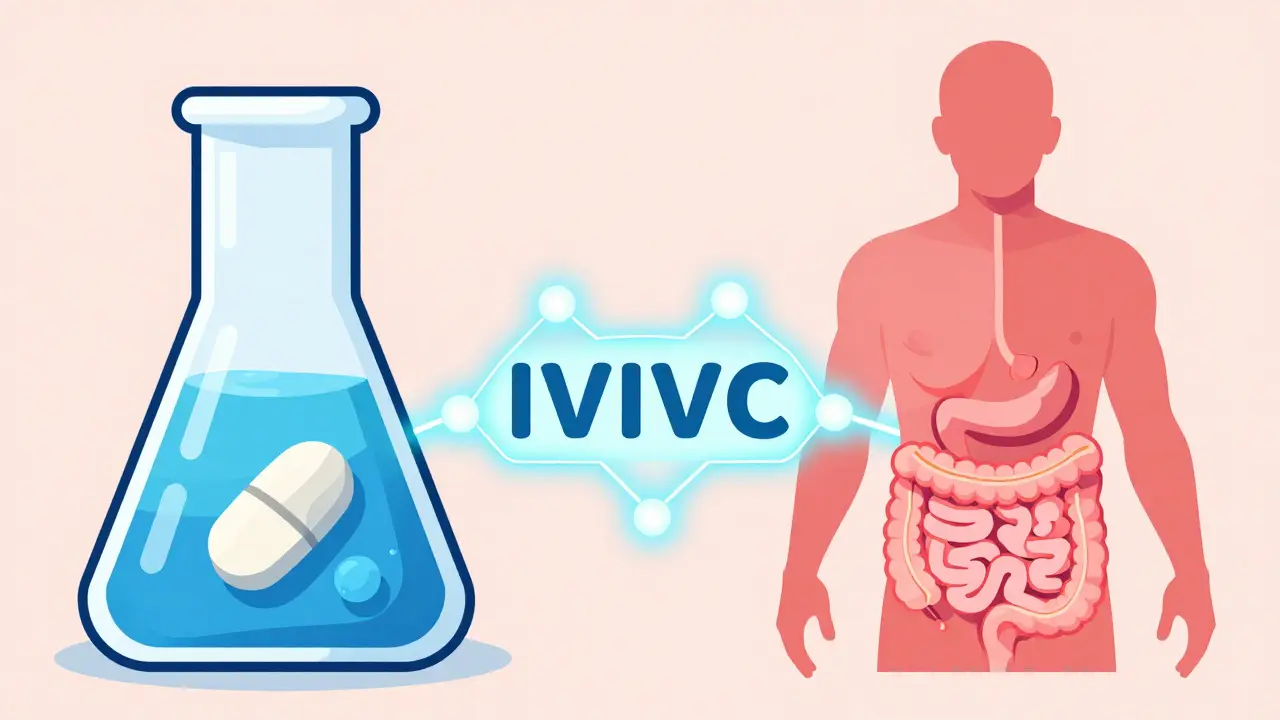
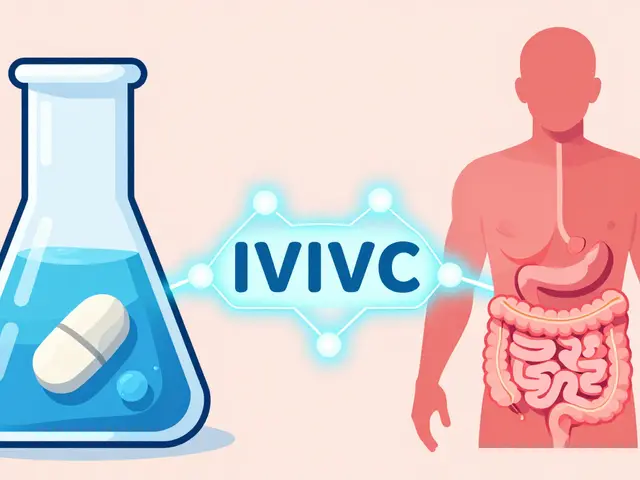
Imagine spending two million dollars and eighteen months on a clinical trial, only to find out a tiny tweak in your tablet's coating requires you to do the whole thing over again. For pharmaceutical companies, this is a nightmare scenario. The solution lies in IVIVC is a predictive mathematical model that links how a drug dissolves in a lab beaker (in vitro) to how it actually behaves inside a human body (in vivo). Also known as In Vitro-In Vivo Correlation, it allows developers to prove that a drug works without always needing to recruit dozens of human volunteers for every single change.
What exactly is an IVIVC?
At its simplest, IVIVC is a bridge. On one side, you have Dissolution Testing is a laboratory process that measures the rate at which a drug substance is released from its dosage form into a solvent. On the other side, you have pharmacokinetics-the study of how the body absorbs, distributes, and excretes the drug. When a company can mathematically prove that the lab results perfectly predict the blood concentration levels in humans, they've hit the jackpot.
Why does this matter? Because human Bioequivalence is the demonstration that a generic drug product is therapeutically equivalent to a brand-name drug in terms of rate and extent of absorption studies are expensive and slow. If the FDA or EMA accepts an IVIVC model, a company can apply for a biowaiver. This essentially means the regulator says, "We trust your lab tests enough that you don't need to run another human trial for this specific change." This can shave 6 to 12 months off a development timeline and save millions in costs.
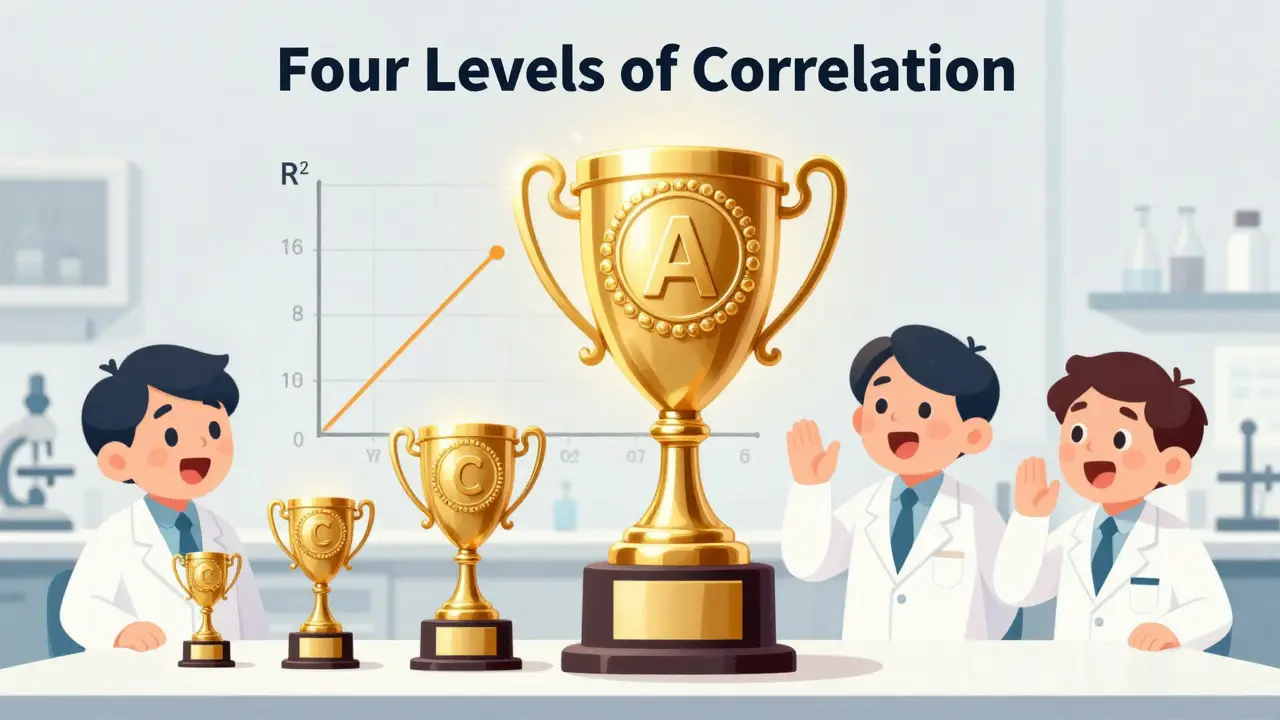
The Four Levels of Correlation
Not all correlations are created equal. The regulators categorize them into levels, and the higher the level, the more likely you are to get that coveted biowaiver.
- Level A: The gold standard. It's a point-to-point relationship. If you know the dissolution rate at every minute in the lab, you can predict the exact plasma concentration at every minute in the body. It requires a linear regression with an R² value typically above 0.95.
- Level B: A bit broader. It relates the average time it takes for a drug to dissolve to the average time it stays in the body. It's useful, but it can't predict the full pharmacokinetic profile.
- Level C: A single-point snapshot. For example, if 50% of the drug is gone at hour one in the lab, the peak blood concentration (Cmax) will be X. It's limited because it only predicts one specific variable.
- Multiple Level C: Like Level C, but using several time points to predict several different pharmacokinetic parameters.
| Level | Relationship Type | Predictive Power | Biowaiver Potential |
|---|---|---|---|
| Level A | Point-to-point | Full PK Profile | Very High |
| Level B | Mean-to-mean | Average Residence Time | Moderate |
| Level C | Single point | Single Parameter (e.g. Cmax) | Low/Supporting |
| Multiple C | Multi-point | Multiple Parameters | Moderate |
How to actually get a Biowaiver
You can't just run one test and call it a day. To convince the FDA is the U.S. government agency responsible for ensuring the safety and efficacy of drugs or the EMA is the European Union agency responsible for the scientific evaluation and monitoring of medicines that your model is valid, you need a rigorous setup. First, you need a discriminatory dissolution method. This means your lab test must be sensitive enough to detect a 10% change in a formulation variable. If your test is too "forgiving," the regulator will reject it because it doesn't prove that your lab results actually reflect reality.
Most companies start by creating 3 to 5 different formulations with varying release rates. They then run pharmacokinetic studies with 12 to 24 subjects for each. If the data aligns, they build the model. For the FDA to accept a model for regulatory purposes, the predictions for AUC (Area Under the Curve) must be within ±10% and Cmax must be within ±15% of the actual human data.
For those dealing with complex generics, Biorelevant Dissolution is testing that uses fluids simulating the actual pH and bile salt concentrations of the human gut is becoming the new standard. Traditional "beaker and water" tests often fail because they don't mimic the harsh environment of the stomach or the absorption characteristics of the small intestine.
When does IVIVC fail?
It sounds like a magic wand, but IVIVC doesn't work for everything. If a drug has a narrow therapeutic index-meaning the difference between a helpful dose and a toxic dose is tiny-regulators usually insist on real human data. Similarly, if a drug has non-linear pharmacokinetics (where doubling the dose doesn't double the blood concentration), the math falls apart.
Implementation is also a huge hurdle. Only about 15% of pharma companies have the internal expertise to build these models. It requires a mix of advanced pharmaceutics and complex data modeling. Many companies end up hiring CROs (Contract Research Organizations) like Alturas Analytics to handle the math. The risk is real: some firms have spent over a million dollars over 18 months only for the model to fail during validation against real-world food-effect data.
Real-World Impact and Future Trends
The industry is shifting. We're seeing a move away from the BCS is the Biopharmaceutics Classification System, which categorizes drugs based on solubility and permeability to predict absorption approach, which works great for simple immediate-release drugs, toward IVIVC for complex, extended-release products. In fact, for modified-release drugs, IVIVC is often the only way to avoid a full bioequivalence study when moving a manufacturing site or scaling up production.
Looking ahead, we're seeing the rise of machine learning. The EMA and FDA have expressed interest in AI-enhanced models that can handle the non-linearities of drug absorption. There's also a push to move IVIVC beyond oral pills. Recent draft guidance suggests using these principles for topical creams and injectables, which have historically been incredibly difficult to model.
Can any drug get a biowaiver through IVIVC?
No. Drugs with narrow therapeutic indices, complex absorption mechanisms, or non-linear pharmacokinetics typically require traditional in vivo bioequivalence studies because the risk of a mathematical error leading to therapeutic failure is too high.
What is the difference between Level A and Level C correlation?
Level A is a point-to-point relationship that can predict the entire blood concentration profile over time. Level C is a single-point relationship that can only predict one specific value, such as the peak concentration (Cmax), based on a single dissolution time point.
How much money can a company save with a biowaiver?
Depending on the study, a single bioequivalence study can cost between $500,000 and $2 million. Avoiding several of these during post-approval changes can save a company millions of dollars and months of development time.
Why do so many IVIVC submissions get rejected?
The most common reasons for rejection are a lack of physiological relevance in the dissolution method (the lab test doesn't mimic the body) and insufficient validation of the mathematical model.
Is the BCS approach better than IVIVC?
It's not about which is "better," but which is applicable. The BCS approach is much simpler and faster for high-solubility, high-permeability immediate-release drugs. However, for complex extended-release products, the BCS approach doesn't work, making IVIVC the essential tool.
Next Steps for Developers
If you're developing a generic modified-release product, don't wait until the end to think about IVIVC. Start during prototype formulation. Focus on creating a dissolution method that is truly discriminatory-if it can't tell the difference between a "good" and "bad" batch, your model will never pass regulatory scrutiny. For those without in-house PK/PD experts, engaging a specialized CRO early can increase your success rate from the industry average of 30% up to 70%.



Del Bourne
April 5, 2026 AT 04:21The emphasis on discriminatory dissolution methods is spot on. Many developers fail because they use standard USP methods that simply aren't sensitive enough to capture the formulation changes that actually impact in vivo performance.
It's also worth noting that biorelevant media, like FaSSIF and FeSSIF, can be game-changers for drugs with poor solubility, as they better mimic the fasted and fed states of the human stomach.
Darius Prorok
April 5, 2026 AT 06:04Basically, it's just math to avoid paying for people to eat pills.
GOPESH KUMAR
April 6, 2026 AT 19:25The pursuit of a biowaiver is essentially a pursuit of the illusion of certainty. We try to reduce a complex biological organism to a series of linear regressions and R² values, forgetting that the human body is not a beaker. It's quite amusing how we trust these "gold standards" when the variance in human gut motility alone could render a Level A correlation meaningless in a real-world setting. The industry's obsession with cost-cutting through modeling is just another layer of corporate detachment from actual patient physiology.
Nathan Kreider
April 7, 2026 AT 17:01It's really great to see how these methods can make medicine more affordable and faster to get to the people who need it!
jack hunter
April 8, 2026 AT 07:07math is just a way to hide the truth. why do we even care about R2 values when the whole system is riged anyway. its all just a game of convincing the FDA with fancy graphs while the actual drug laegs behind. truth is relative and so is dissolution rate.
Benjamin cusden
April 8, 2026 AT 14:34The mention of the BCS approach is almost quaint. Anyone with a basic understanding of pharmaceutics knows that relying on BCS for modified-release products is a fool's errand. The transition to IVIVC isn't a "trend," it is a necessity for anyone attempting to actually succeed in complex generic development. The failure rate for those without internal PK experts is a direct result of intellectual laziness in the industry.
Kathleen Painter
April 8, 2026 AT 20:24I think it's so important that we keep talking about the human element here, because even though these models are incredibly helpful for the bottom line and for speeding up the process, we should always remember that the goal is patient safety. It's wonderful that we have these different levels of correlation to guide us, and I think it's really helpful for newer researchers to understand that a Level C isn't a failure, it's just a different starting point in the learning process of a drug's behavior. Maybe we can all find a middle ground where we trust the math but never stop valuing the clinical reality of the people taking these medications.
Windy Phillips
April 9, 2026 AT 01:31Of course, some people believe a simple linear regression is a substitute for real clinical evidence... how naive!!! It is simply tragic that we prioritize "shaving months off a timeline" over the absolute certainty of human safety... truly disheartening...
Ruth Swansburg
April 9, 2026 AT 08:59This is a fantastic summary of a complex topic! Keep pushing the boundaries of AI in this field!
Nikhil Bhatia
April 10, 2026 AT 10:20Too much jargon. Just tell me if the pills work or not.
Stephen Luce
April 10, 2026 AT 19:37I can totally see why companies are stressed about those two million dollar trials failing. That's a lot of pressure on the formulation team.
shelley wales
April 12, 2026 AT 01:59It's so heartening to see how technology is evolving to make these processes more efficient. Everyone in the industry is learning together.
charles mcbride
April 13, 2026 AT 14:22The potential for AI to handle non-linear pharmacokinetics is truly an exciting prospect for the future of the industry.
Alexander Idle
April 15, 2026 AT 07:07I find it absolutely scandalous that a mere 15% of companies have the expertise to do this! It is a complete disaster of educational standards in the pharmaceutical sector! The sheer audacity of relying on CROs for the fundamental math of your own product is simply laughable!