
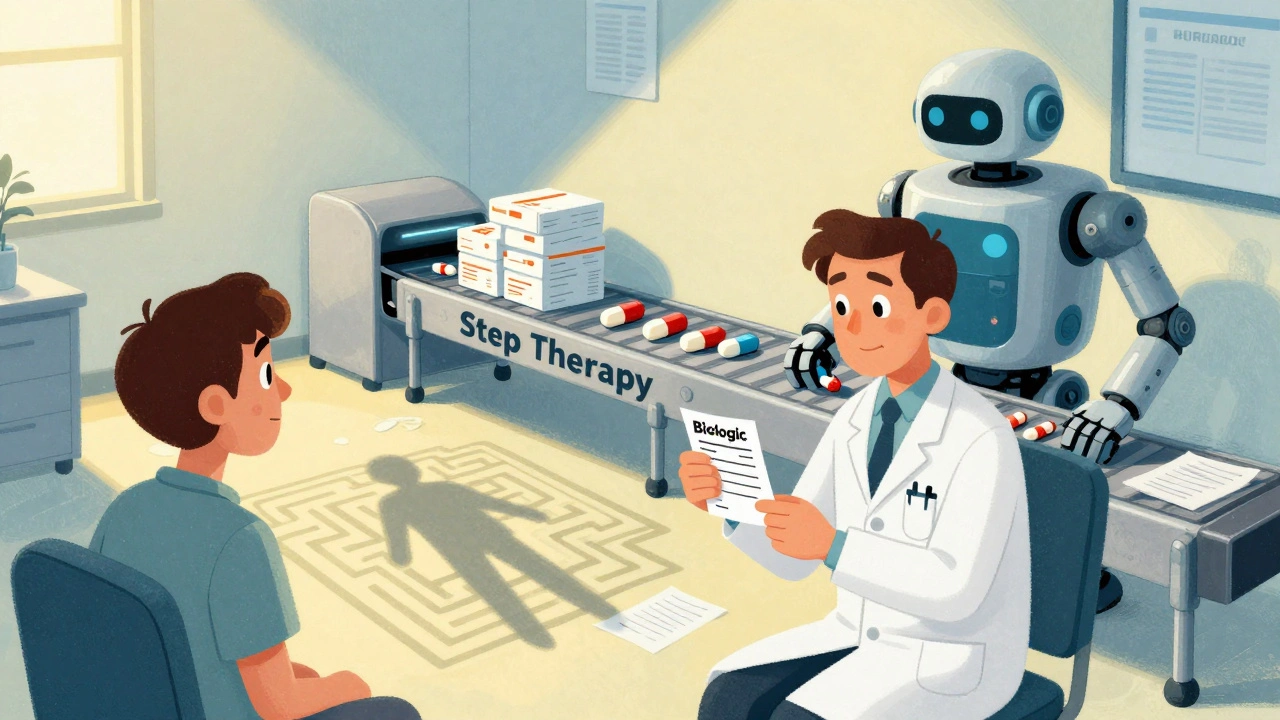
If you’ve ever been told by your doctor to try a cheaper pill before getting the one they originally prescribed, you’ve run into step therapy. It’s not a glitch in the system-it’s by design. Insurance companies use step therapy to force patients to try generic or older drugs before covering newer, more expensive ones. For many, it’s a harmless shortcut. For others, it’s a dangerous delay that can make chronic pain worse, cause joint damage, or even lead to hospital visits.
How Step Therapy Actually Works
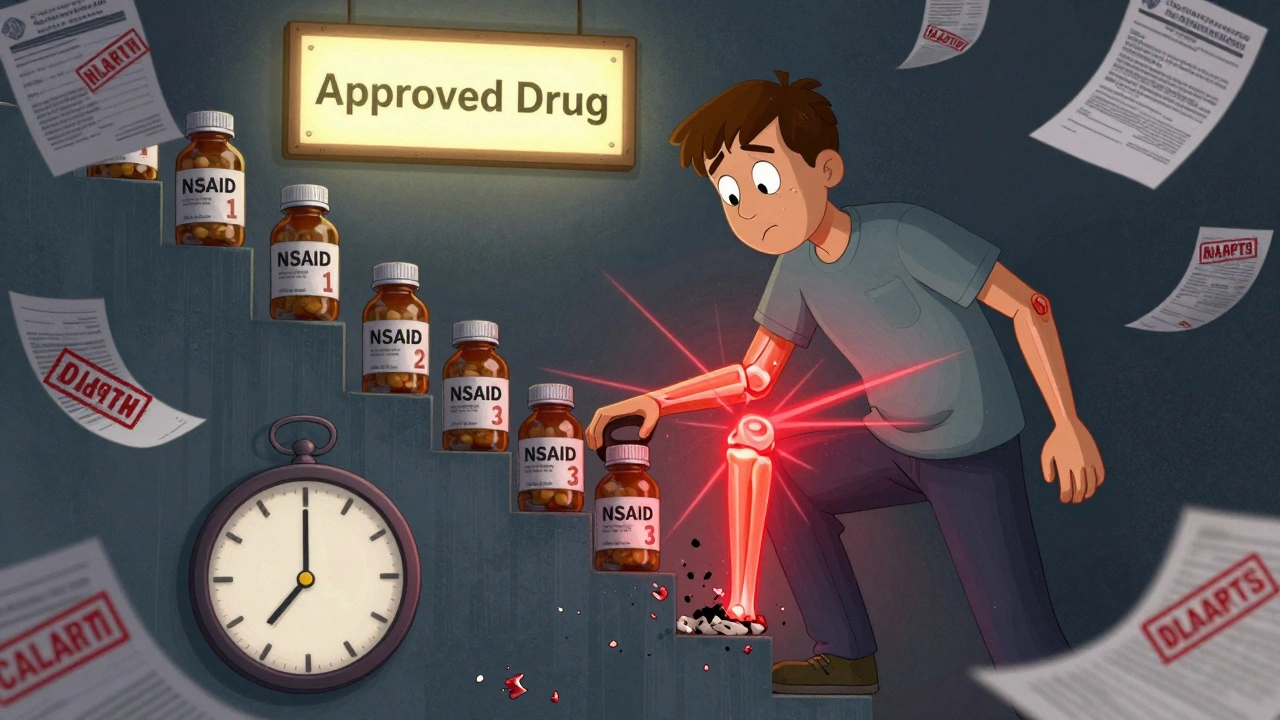
Step therapy, sometimes called a "fail-first" policy, is a rule built into most insurance formularies. It says: you can’t get Drug B unless you’ve tried and failed Drug A first. Drug A is almost always a generic version-cheaper, older, and often less effective for certain conditions. Drug B might be a brand-name biologic, a newer targeted therapy, or something your doctor knows works better for your specific case.Here’s how it plays out in real life: You have rheumatoid arthritis. Your rheumatologist prescribes a biologic that stops joint damage. But your insurance says no-they want you to try two or three NSAIDs first. Even if you’ve tried them before and they did nothing. Even if you’re already in pain. Even if your joints are already deteriorating. You have to fail those first.
It’s not just for arthritis. Step therapy applies to asthma inhalers, diabetes medications, depression treatments, and even MS drugs. In fact, about 40% of all prescription drug plans in the U.S. use step therapy, according to a 2021 NIH analysis. That number has been climbing since 2018, and experts predict it’ll hit 55% of specialty drug prescriptions by 2025.
Why Insurers Push for Generics First
The math is simple for insurance companies. Generic drugs cost 80-90% less than brand-name versions. In 2022, the Congressional Budget Office found step therapy could cut drug spending by 5-15% depending on the condition. That’s millions of dollars saved per insurer per year.But here’s the catch: those savings come from shifting costs onto patients and doctors. A patient might spend six months trying three ineffective drugs, paying copays each time, dealing with side effects, and losing time at work. Meanwhile, their condition worsens. The insurer saves money now-but might pay more later in ER visits, hospitalizations, or lost productivity.
Insurers argue they’re just making sure patients get the "most reasonably priced and effective" option. But what’s "effective"? For someone with Crohn’s disease, a generic steroid might control symptoms for a while-but not stop the inflammation. The real effectiveness? Preventing bowel damage. That’s not something a formulary algorithm can measure.
When Step Therapy Can Hurt
The biggest problem isn’t the rule-it’s the time it takes to get around it. The American College of Rheumatology says appeals for step therapy exceptions can take four to eight weeks. That’s not a delay. That’s a health crisis for someone with an autoimmune disease.One Reddit user, "ChronicPainWarrior," shared their story: they had to fail three different NSAIDs over six months before their insurance approved a biologic for rheumatoid arthritis. By then, their joints were permanently damaged. The Arthritis Foundation’s 2022 survey found 68% of patients experienced negative health outcomes because of step therapy. Nearly half reported disease progression during the required trial period.
And it’s not just physical damage. Switching insurance plans means restarting the whole process-even if you’ve been on the same medication for years. A 2023 Healthinsurance.org report found patients often lose coverage mid-treatment because their new plan doesn’t recognize their history. That’s not just inconvenient. It’s dangerous.
What Exceptions Exist-and How to Get Them
Step therapy isn’t absolute. Federal and state laws require insurers to allow exceptions. The Safe Step Act, reintroduced in 2021, outlines five clear situations where insurers must bypass the step process:- The required drug was already tried and didn’t work
- Delaying treatment could cause severe or irreversible harm
- The required drug is contraindicated (you’re allergic or it interacts badly with other meds)
- The required drug would stop you from doing basic daily tasks
- You’re already stable on your current drug and it was previously approved
But getting an exception isn’t easy. Your doctor has to submit medical records, lab results, and a letter explaining why the step therapy drug won’t work for you. Blue Cross Blue Shield of Michigan says they review standard requests in 72 business hours. But that’s just the rule. In practice, many patients wait weeks.
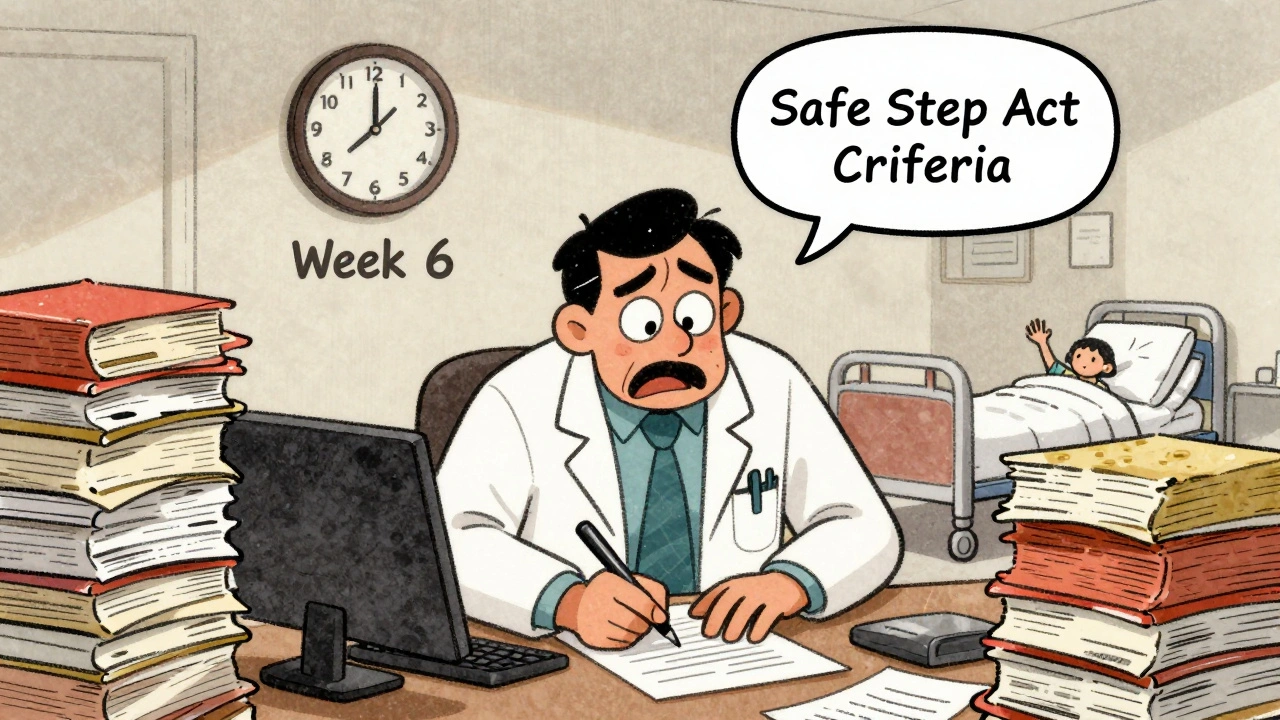
Doctors are drowning in paperwork. The ACR found physicians spend an average of 18.3 hours a week just managing prior authorizations and step therapy appeals. That’s almost half a workday-time that could be spent with patients.
State Laws Vary-And Many Don’t Cover Everyone
As of 2025, 29 states have passed laws requiring insurers to allow exceptions. But here’s the loophole: those laws usually only apply to fully-insured plans-meaning plans where the insurance company actually pays the bills.Most large employers use self-insured plans. That means the employer pays the claims directly, and the insurer just administers them. These plans are regulated by federal law (ERISA), not state laws. That’s a problem because 61% of Americans get their insurance through self-insured employer plans.
So if you work for a big company like Amazon, Walmart, or Google, your step therapy rules are set by federal guidelines-and those are weaker. You might be stuck with the same barriers, even if your state has strong protections.
What You Can Do
If your insurance denies your prescribed medication:- Ask your doctor to file a step therapy exception immediately. Don’t wait.
- Get a copy of your insurance’s formulary. Find the exact step therapy protocol for your condition.
- Document every failed trial. Save receipts, lab reports, and notes from your doctor.
- If the exception is denied, appeal in writing. Mention the Safe Step Act criteria.
- Check if your drug manufacturer offers a patient assistance program. Over 78% of big pharma companies have them.
Some patients find success with co-pay cards or coupons. These don’t always bypass step therapy, but they can make the required generic drugs more affordable-so you’re not stuck paying hundreds per month just to meet the insurer’s requirement.
Is Step Therapy Ever Helpful?
Yes. For some people, the generic drug works just fine. A 2023 GoodRx survey found 17% of patients ended up managing their condition well on the step therapy-required medication. They avoided the cost-and side effects-of a stronger drug.But that’s not the point. Step therapy shouldn’t be a lottery. It shouldn’t force people to suffer through ineffective treatments just to get the one that works. The system assumes all patients are the same. They’re not. Your body, your condition, your history-those matter.
The Future of Step Therapy
More states are trying to tighten the rules. In 2023, 14 more introduced legislation, and 8 strengthened existing laws to require faster decisions-like 24-hour turnaround for urgent cases. But without federal action, the system stays broken for millions.The Safe Step Act could fix that. If passed, it would require self-insured plans to follow the same exception rules as state-regulated ones. That would cover the majority of Americans. But it’s still stuck in Congress.
Until then, step therapy remains a cost-cutting tool with real human costs. It’s not evil. It’s not even always wrong. But when it delays treatment for someone with a progressive disease? That’s not efficiency. That’s negligence.




Ben Greening
December 10, 2025 AT 10:27Step therapy is one of those systemic quirks that makes sense on paper but collapses under real-world pressure. I’ve seen it firsthand in my work with elderly patients-prescribing a $3 generic NSAID when someone’s already tried three and their joints are grinding like rusted gears. The savings are real, but the human cost? Often invisible until it’s too late.
It’s not about opposing generics. It’s about acknowledging that medicine isn’t a one-size-fits-all spreadsheet. Some people don’t ‘fail’-they just deteriorate while waiting for bureaucracy to catch up.
Nikki Smellie
December 10, 2025 AT 11:38Let’s be honest: this isn’t about cost control. It’s about insurance corporations secretly colluding with Big Pharma to keep generics cheap and biologics expensive-so they can jack up prices later under the guise of ‘medical necessity.’
Did you know? The same executives who approve these policies also hold stock in pharmaceutical companies. Coincidence? Or a well-oiled machine designed to extract profit from suffering?
They’ll say ‘exceptions exist’-but only if you have the time, energy, and legal resources to fight them. Meanwhile, your body decays. And they call it ‘efficiency.’
:-(
Michaux Hyatt
December 11, 2025 AT 06:44If you’re dealing with step therapy right now, don’t panic-there are ways through this. First, get your doctor to submit a letter using the exact language from the Safe Step Act. Don’t paraphrase. Use their words.
Second: check if your drug has a patient assistance program. Most do. Even if you make too much for Medicaid, you might still qualify for free or discounted meds.
Third: keep every single piece of paper-copay receipts, lab results, even the date you called customer service. You’ll need it for appeals.
You’re not alone. Thousands of us have been here. It’s exhausting, but you can get through it. One step at a time.
Jack Appleby
December 12, 2025 AT 21:58Step therapy is not merely a policy-it is a grotesque epistemological failure in the application of clinical governance. The assumption that ‘failure’ can be quantified by a formulary algorithm is not only scientifically bankrupt, it is ethically indefensible.
One cannot ‘fail’ a drug in the same way one fails a calculus exam. Physiology is not binary. Inflammation does not obey insurance tiers. To conflate pharmacoeconomic efficiency with therapeutic efficacy is to mistake accounting for anatomy.
And let us not forget: the 17% who ‘succeed’ on generics are not the norm-they are the statistical outliers in a system that treats human beings as actuarial variables.
Until we decouple clinical decision-making from balance sheets, we are not practicing medicine. We are practicing capitalism with a stethoscope.
Frank Nouwens
December 13, 2025 AT 17:40It’s interesting how step therapy is framed as a cost-saving measure, but rarely discussed in terms of long-term societal burden. The insurer saves $500 now, but if the patient ends up in the ER six months later because their arthritis flared uncontrollably, the cost jumps to $25,000.
And that’s not even counting lost wages, caregiver strain, or mental health deterioration. We’re trading short-term balance sheets for long-term systemic collapse.
It’s like refusing to fix a leaky roof because the shingles are cheap-then being shocked when the foundation rots.
Regan Mears
December 13, 2025 AT 23:32I’ve been on both sides of this-patient and caregiver. My mom spent 11 weeks waiting for an exception to get her MS drug. She lost mobility. She lost sleep. She lost hope.
Doctors are drowning in paperwork. Nurses are stretched thin. Patients are left to scream into the void of automated phone systems.
This isn’t about ‘being tough’ or ‘trying cheaper options.’ This is about dignity. About time. About not having your body treated like a spreadsheet.
If you’re reading this and you’re in the middle of this mess-you’re not being lazy. You’re not being difficult. You’re being brave. And you deserve better.
Keep fighting. Document everything. And if you can, find someone who’s been through it. You’re not alone.
Neelam Kumari
December 14, 2025 AT 08:19Wow. So you're telling me people actually expect healthcare to be... humane? In America? How quaint.
You think insurance companies care if your joints turn to dust? They care if your premiums go up. That’s it.
Go ahead. Submit your paperwork. Wait 8 weeks. Cry into your $40 generic pill bottle.
At least you’re alive to complain about it. Most people just give up.
:)
David Palmer
December 15, 2025 AT 23:42