

When a woman with PCOS tries to get pregnant, the road isn’t just about timing intercourse or tracking cycles. Often, the real issue lies deeper-inside her cells. Metformin isn’t just a diabetes drug. For many women with PCOS, it’s the missing piece that helps the body finally start ovulating again.
Why PCOS Stops Ovulation
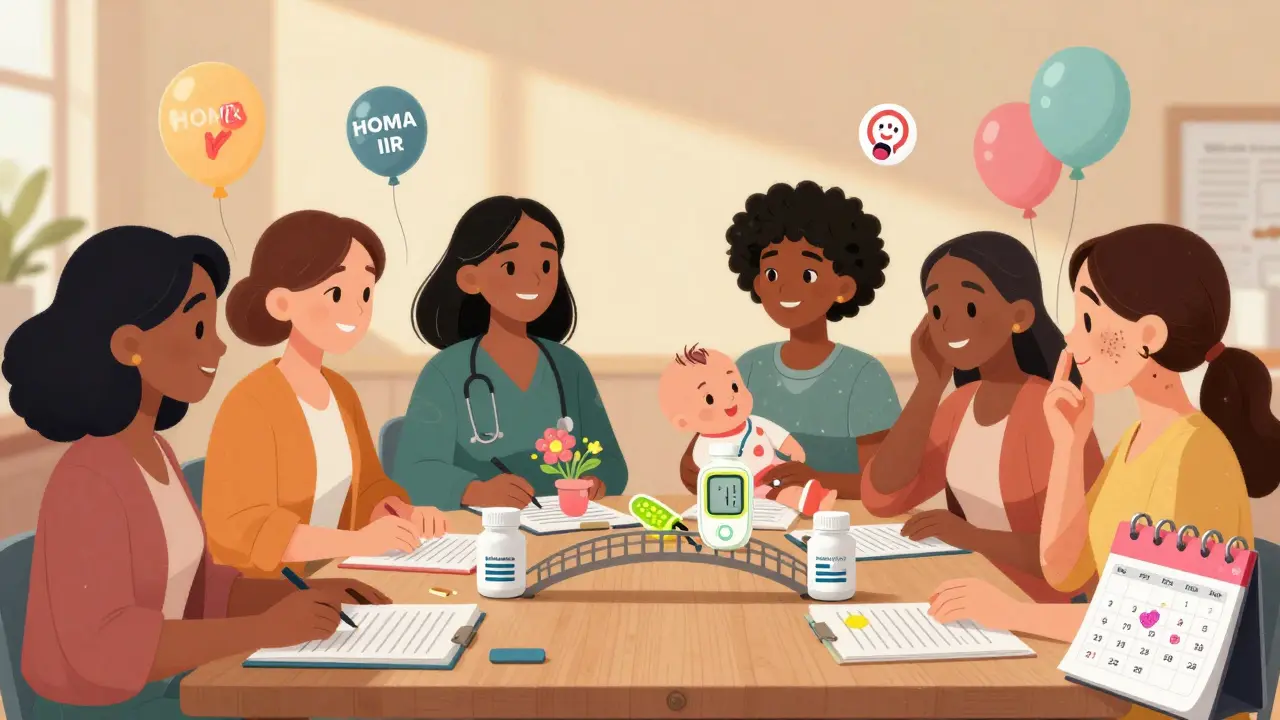
Polycystic Ovary Syndrome affects 6-12% of women of childbearing age. It’s not just about cysts on the ovaries. The core problem? Insulin resistance. When your body doesn’t respond well to insulin, your pancreas pumps out more of it. That extra insulin doesn’t just raise blood sugar-it tricks your ovaries into making too much testosterone. High testosterone? That shuts down ovulation. Your cycle becomes irregular, or stops altogether. And without ovulation, pregnancy can’t happen.That’s where metformin comes in. It doesn’t force ovulation like some drugs do. Instead, it fixes the root cause: insulin resistance.
How Metformin Actually Works
Metformin has been around since the 1950s, but its role in PCOS wasn’t clear until the 2000s. It doesn’t lower blood sugar by pushing insulin out. It works smarter. It tells the liver to stop making so much glucose. It slows down how much sugar gets absorbed from your gut. And it helps your muscles and fat cells use insulin better. That means less insulin in your blood. And less insulin? That means less testosterone production.This isn’t theory. A 2023 Cochrane review of 44 studies found that women taking metformin had over 2.5 times higher odds of ovulating compared to those on placebo. That’s not a small boost. That’s a game-changer for women who’ve been told their bodies just don’t work right.
Metformin vs. Other Fertility Drugs
You’ve probably heard of clomiphene or letrozole. These are the go-to drugs for triggering ovulation. But here’s the catch: they don’t fix insulin resistance. They just force the ovaries to respond. Metformin does both-it lowers insulin and helps the ovaries respond naturally.One 2023 study of 72 women showed that combining metformin with letrozole led to ovulation in 88.9% of cases. Metformin alone? 69.4%. That difference matters. But here’s what most people miss: metformin alone works just as well as clomiphene for non-obese women with PCOS who have insulin resistance. And unlike clomiphene, metformin doesn’t increase the risk of multiples.
Even better? If you’re planning IVF, metformin cuts your risk of ovarian hyperstimulation syndrome (OHSS) by more than 70%. OHSS can be dangerous. Metformin makes the whole process safer.
Who Benefits Most?
Not every woman with PCOS responds the same. If you’re overweight, metformin helps-but not as dramatically. The real winners? Women who are normal weight or only slightly overweight, but still have high insulin levels. These women often have regular periods but never ovulate. Their bodies are stuck. Metformin unsticks them.Studies show these women have the best chance of ovulating within 3 months of starting metformin. Their cycles become regular. Their androgen levels drop. Their acne and facial hair may improve-even if they’re not trying to get pregnant.

Dosing and Side Effects
Most doctors start at 500mg once a day with dinner. After a week, they bump it to 500mg twice daily. Over 4-8 weeks, many go up to 1,500-2,000mg per day. The goal? Find the lowest dose that works without making you sick.Side effects? Nausea, diarrhea, bloating. About 1 in 4 women feel them at first. But here’s the good news: they fade. Most women stop feeling them after 2-4 weeks. The extended-release version (metformin XR) cuts side effects by half. If you can’t tolerate regular metformin, XR is the answer.
Don’t take it on an empty stomach. Always take it with food. And drink plenty of water. Dehydration makes side effects worse.
How Long Until You Ovulate?
It takes time. Don’t expect results in 2 weeks. Most women see their period return to normal between 3 and 6 months. Ovulation usually follows soon after. Doctors check for ovulation with a blood test around day 21 of your cycle. If your progesterone is over 3 ng/mL, you ovulated.Some women ovulate within 2 months. Others take 6. Patience matters. But if you’re consistent, the odds shift in your favor.
What About Pregnancy?
Here’s where it gets interesting. The Cochrane review found metformin improved live birth rates compared to placebo-from 19% to up to 37%. But some clinics report no big difference. Why? Because pregnancy isn’t just about ovulation. It’s about egg quality, sperm, fallopian tubes, timing, stress. Metformin fixes one piece. It doesn’t fix everything.But here’s the kicker: if you continue metformin through the first trimester, your chance of a clinical pregnancy goes up. One 2023 meta-analysis of 12 trials showed better outcomes when women kept taking it. It may reduce miscarriage risk, especially in women with high insulin levels. That’s why some doctors keep patients on it during early pregnancy-even though it’s not officially approved for that use.
Metformin Beyond Fertility
You don’t have to want a baby to benefit. Metformin helps with acne, excess hair, and mood swings in PCOS. It lowers your long-term risk of type 2 diabetes. A 2017 study called REPOSE showed it might cut diabetes risk by nearly 50% over 10 years. That’s huge. PCOS isn’t just a fertility issue. It’s a metabolic one. Metformin treats both.For women who can’t take birth control pills (because of blood clots, migraines, or personal choice), metformin is one of the few options that helps with both hormones and insulin.
Cost and Accessibility
Metformin costs $4-$10 a month in the U.S. Generic, widely available, no patent. Clomiphene? $30-$50. Letrozole? $50-$100. If you’re paying out of pocket, metformin is the smartest choice. Even if you combine it with another drug, it lowers the total cost.What’s Next?
Doctors are still debating whether metformin should be first-line for PCOS infertility. Some say yes. Others still push clomiphene or letrozole. But the evidence is shifting. For non-obese women with insulin resistance, metformin isn’t just an add-on-it’s the foundation.Future research is looking at who responds best. Blood tests for insulin levels, fasting glucose, and HOMA-IR scores are becoming more common. If your numbers are high, metformin is likely your best bet. If they’re normal? Maybe not.
One thing’s clear: if you have PCOS and you’re not ovulating, don’t just accept it. Ask about metformin. It’s not magic. But for many, it’s the first step back to a normal cycle-and a chance at pregnancy.
Can metformin help me ovulate if I have PCOS?
Yes. Metformin improves insulin sensitivity, which lowers testosterone and restores ovulation in many women with PCOS. Studies show it increases ovulation rates by over 2.5 times compared to placebo. It works best for women with insulin resistance, even if they’re not overweight.
How long does it take for metformin to start working for PCOS?
It takes time. Most women notice their periods becoming more regular within 2-3 months. Ovulation usually follows 3-6 months after starting treatment. Some see results sooner, but patience is key. Side effects like nausea often fade within 2-4 weeks, especially with the extended-release form.
Is metformin better than clomiphene for PCOS infertility?
It depends. Clomiphene is better at triggering ovulation in the short term. But metformin fixes the root cause-insulin resistance-and has fewer side effects like multiple pregnancies. For non-obese women with high insulin levels, metformin alone can be just as effective as clomiphene. Many doctors now use them together for the best results.
Does metformin help with acne and facial hair in PCOS?
Yes. By lowering insulin and testosterone, metformin can reduce acne and unwanted hair growth. It’s often used as an alternative to birth control pills, especially for women who can’t take them due to health risks or personal preference.
Should I keep taking metformin if I get pregnant?
Some doctors recommend continuing metformin through the first trimester, especially if you have insulin resistance or a history of miscarriage. Studies show higher pregnancy rates when metformin is continued. However, this is off-label use, and decisions should be made with your doctor. Most stop it after the first trimester unless there’s a clear medical reason to continue.



Tom Sanders
March 8, 2026 AT 14:31bro i took metformin for 3 months and all it did was give me diarrhea and make me feel like a zombie. my period didn't even change. they're selling this like it's some miracle drug but nah.
George Vou
March 9, 2026 AT 17:00you guys realize this is just the pharmaceutical industry’s way of keeping women dependent on pills instead of fixing the real problem-processed food and sugar? metformin doesn’t cure insulin resistance, it just masks it. they don’t want you to know that a simple low-carb diet would’ve done the same thing for free. also, did you know the FDA almost banned this drug in the 90s? they just rebranded it as a ‘PCOS fix’ to keep profits rolling. 🤡
Scott Easterling
March 11, 2026 AT 05:05Oh great. Another miracle drug. Let me guess-next they’ll say sunlight cures cancer? Metformin? Really? It’s a diabetic drug repurposed because Big Pharma ran out of ideas. And don’t get me started on the ‘extended-release’ version-that’s just a scam to make you pay more. Side effects? 1 in 4? I’d say it’s more like 1 in 2 if you’re honest. Also, ‘ovulation after 3-6 months’? That’s not treatment-that’s a waiting game with nausea.
Mantooth Lehto
March 12, 2026 AT 20:11I cried reading this. After 4 years of trying, metformin gave me my first real period in 7 years. My acne cleared up. I stopped hating my reflection. I didn’t just ovulate-I felt like myself again. 💕 Thank you for writing this. I wish I’d known sooner. You’re a lifesaver.
Melba Miller
March 14, 2026 AT 10:55Why are we letting corporations dictate women’s health? Metformin is cheap because it’s old. But if this were a new patent, it’d cost $2000/month. And don’t get me started on how they market this as ‘natural’ when it’s still a synthetic drug. We need real solutions-like food sovereignty and hormone-free living-not more pills disguised as empowerment. This isn’t medicine-it’s control dressed in lab coats.
Katy Shamitz
March 14, 2026 AT 18:59OMG I’m so glad someone finally said this! I’ve been telling my friends for years-metformin isn’t magic, but it’s the only thing that didn’t make me feel worse. I started at 500mg, and wow, the bloating was brutal. But once I switched to XR? Life changed. My skin cleared, my mood stabilized, and I ovulated at month 4. I didn’t even need IVF. 🙌 If you’re struggling, don’t give up. It’s slow, but it works. And yes, I kept it through my first trimester-my OB said it was fine. God bless science.
Nicholas Gama
March 16, 2026 AT 07:47Metformin works because it’s a mitochondrial poison. It forces cells to burn glucose inefficiently. That’s why insulin drops. It’s not fixing anything-it’s stressing the system into compliance. And yet, we call this medicine? Pathetic.
Mary Beth Brook
March 17, 2026 AT 11:57Insulin resistance is the primary metabolic driver of anovulation in PCOS. Metformin, as a hepatic gluconeogenesis inhibitor and AMPK activator, improves insulin sensitivity, thereby reducing hyperinsulinemia-driven ovarian androgen excess. The Cochrane meta-analysis confirms statistically significant ovulation rate improvement (OR 2.63; 95% CI 2.1–3.3). Clinical guidelines now endorse it as first-line for insulin-resistant phenotypes, particularly in non-obese patients. Adjunctive use with letrozole yields synergistic ovulation rates exceeding 85%. This is evidence-based endocrinology, not anecdote.
Jazminn Jones
March 18, 2026 AT 22:10While the data presented is methodologically sound, I must express concern over the conflation of correlation with causation in the live birth rate claims. The Cochrane review explicitly states that confounding variables-such as partner fertility, tubal patency, and endometrial receptivity-were not fully controlled. Furthermore, the continued use of metformin during pregnancy lacks robust Phase III trials. This post reads like a promotional pamphlet masquerading as clinical insight. Caution is warranted.