
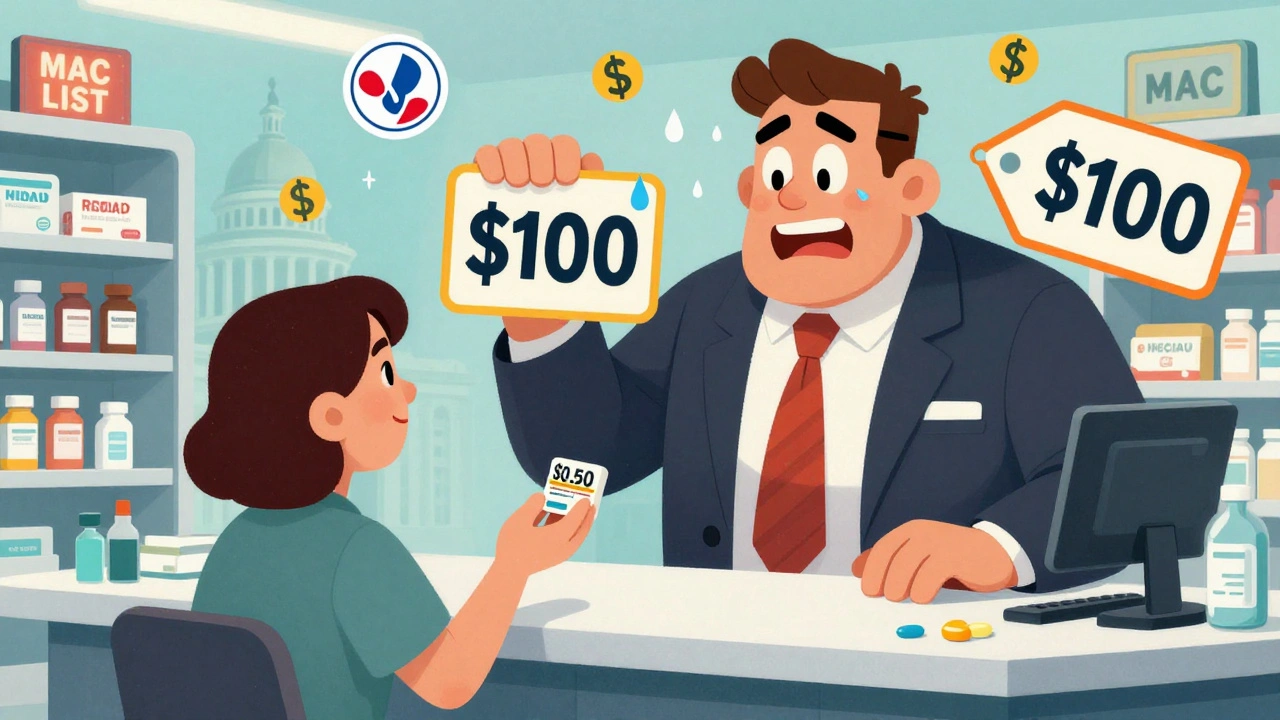
Medicaid spends billions each year on prescription drugs, but most of that money isn’t going to brand-name pills. It’s going to generics - the cheap, effective copies of popular medications. In 2023, generic drugs made up 84.7% of all Medicaid prescriptions, yet they only accounted for 15.9% of total drug spending. That’s the power of generics. But even with these savings, states are still scrambling to control costs. Why? Because when a single generic drug suddenly jumps in price - sometimes by hundreds of percent - it can blow a hole in state budgets. And with more than half of Medicaid enrollees relying on prescription drugs, the stakes are high.
How the Federal System Already Saves Money
The federal Medicaid Drug Rebate Program (MDRP), created in 1990, is the backbone of generic drug pricing in Medicaid. Under this program, drugmakers must pay rebates to states in exchange for having their drugs covered. For generic drugs, the rebate is either 13% of the Average Manufacturer Price (AMP) or the difference between AMP and the "best price" the manufacturer offers elsewhere - whichever is higher. It sounds simple, but it’s not enough. Unlike brand-name drugs, where states can negotiate extra rebates on top of the federal requirement, generic rebates are locked in by law. States can’t haggle. They can’t demand more. That leaves them with limited tools to fight price spikes.
Still, the system works. Without MDRP, Medicaid drug spending would be far higher. But as generic drug manufacturers consolidate - just three companies now control 65% of the injectable generic market - the leverage shifts. When there are few suppliers, prices can rise fast. And when one plant shuts down or faces a shortage, the ripple effect hits state budgets hard.
Maximum Allowable Cost Lists: The Most Common State Tool
Forty-two states use Maximum Allowable Cost (MAC) lists to cap what they pay for generic drugs. Think of it like a price ceiling. If a pharmacy tries to bill Medicaid for a generic pill at $10, but the state’s MAC is $3, the state only pays $3. The pharmacy eats the rest - or finds a cheaper supplier.
MAC lists are updated regularly, but not always fast enough. In 2024, 68% of states updated their MAC lists monthly or less. That’s a problem. Generic drug prices can drop overnight due to new competition or bulk purchasing. If a state’s MAC is stuck at $5 when the market price is $2, pharmacies can’t get paid fairly. That leads to delayed payments, denied claims, and even pharmacies refusing to fill Medicaid prescriptions. A 2024 survey of 1,200 independent pharmacies found that 74% had experienced payment issues tied to outdated MAC lists.
Thirty-one states update their MAC lists quarterly or more often. Those states see fewer disruptions. But even they struggle. The market moves faster than bureaucracy.
Mandatory Generic Substitution and Preferred Drug Lists
Forty-nine states require pharmacists to substitute a generic version when one is available - unless the doctor says no. This isn’t just policy; it’s law. It’s also one of the most effective cost controls. When a patient walks in with a prescription for a brand-name statin, the pharmacist gives them the generic version - and Medicaid pays less.
Thirty-seven states go further by using therapeutic interchange policies. These let pharmacists swap one generic for another within the same drug class - even if the doctor didn’t specify it. For example, if a patient is on one generic version of lisinopril, the pharmacist can switch them to a cheaper one without calling the doctor. This pushes competition among generic makers. The lowest-priced version wins.
Twenty-eight states also use Preferred Drug Lists (PDLs). These lists rank drugs by cost and effectiveness. If a drug isn’t on the list, the prescriber has to jump through hoops - like submitting prior authorization - to get it covered. PDLs aren’t just for brand-name drugs anymore. States are putting generics on these lists too, favoring the cheapest, most reliable options.
Cracking Down on Price Gouging
Some states aren’t waiting for the market to fix itself. They’re writing laws to stop price gouging on generic drugs. Maryland was one of the first, passing a law in 2020 that lets the state investigate and penalize manufacturers who hike prices on generic drugs without new clinical data. If a drug’s price jumps 50% or more in a year, and there’s no new reason for it - like a new formulation or patent - the state can demand justification. If the company can’t prove it’s fair, the state can restrict Medicaid coverage.
Other states are following. California, Colorado, and Maryland have created Prescription Drug Affordability Boards (PDABs) with the power to set upper payment limits on drugs that cost too much. Minnesota uses prices from the Inflation Reduction Act as a guide for what it will pay. These aren’t just about brand-name drugs anymore. PDABs are starting to look at high-cost generics too - especially those with few competitors.
Pharmacy Benefit Managers: The Hidden Middlemen
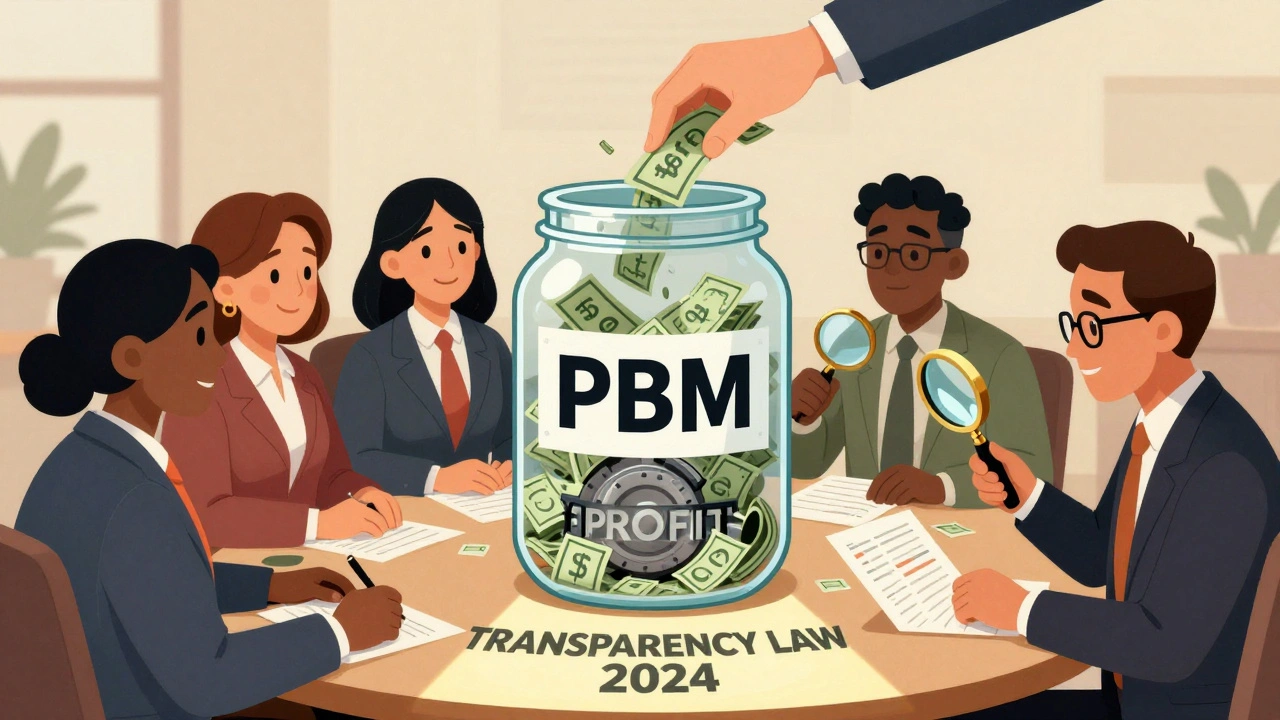
Most states don’t pay pharmacies directly. They hire Pharmacy Benefit Managers (PBMs) like OptumRx, Magellan, or Conduent to handle drug payments. PBMs negotiate discounts, manage formularies, and process claims. But here’s the catch: PBMs often keep a portion of the savings as profit. And they don’t always pass those savings on to the state.
That’s why 27 states passed new transparency rules in 2024. Nineteen of them now require PBMs to disclose exactly how much they paid for each generic drug. If a PBM buys a generic for $1 and bills Medicaid $5, the state can see it. That’s forcing PBMs to be more honest. It’s also giving states the data they need to renegotiate contracts and demand better deals.
Supply Chain Woes and Stockpiling
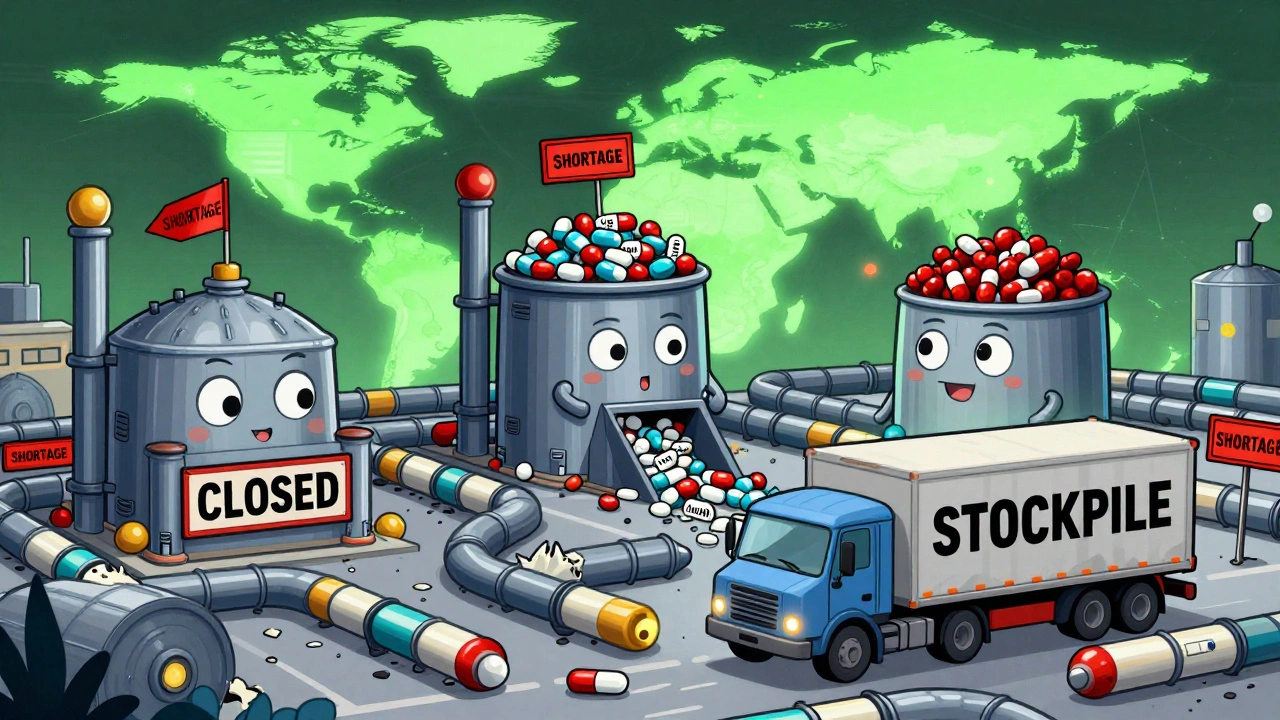
One of the biggest threats to generic drug access isn’t price - it’s shortage. In 2023, 23 states reported shortages of critical generic medications. The average shortage lasted nearly five months. These aren’t rare drugs. They’re things like insulin, antibiotics, and blood pressure pills - the kind people need every day.
Twelve states introduced legislation in 2024 to build strategic stockpiles of these essential generics. Oregon and Texas are testing new risk pools to ensure steady supply. New Hampshire is creating a state-managed reserve for high-demand generics. These efforts are still small, but they’re growing. By 2026, the National Academy for State Health Policy predicts 22 states will have formal stockpiling programs.
The Trade-Off: Savings vs. Access
Every cost-cutting move has a downside. Strict MAC lists can make pharmacies lose money. Price caps can scare manufacturers away. If a company thinks it can’t make a profit on a generic drug in your state, it might stop making it. Then you get a shortage. The Congressional Budget Office warned in 2024 that overly aggressive state price controls could reduce generic availability - and push patients toward more expensive brand-name drugs instead.
That’s why the smartest states are balancing three things: controlling costs, keeping drugs available, and protecting pharmacies. They’re not just trying to pay less. They’re trying to pay smart.
What’s Next? The Future of Generic Drug Control
More states are coming. In 2024, 34 states had at least one drug affordability policy. By 2025, the Congressional Budget Office expects 15 more to join. The focus is shifting from just brand-name drugs to generics - especially those with few manufacturers.
Some states are forming buying coalitions. Oregon and Washington now lead a multi-state pool that negotiates supplemental rebates for 47 high-volume generic drugs. That’s like Costco for Medicaid. They buy in bulk, get better prices, and share the savings.
And then there’s the looming question: GLP-1 drugs for obesity. These new medications cost $12,000 a year. Thirteen states already cover them under Medicaid - with strict rules. If a federal rule forces all Medicaid programs to cover them, state budgets could be hit with an extra $1.2 billion annually. That’s not a generic drug problem - but it’s forcing states to rethink how they manage all drug spending.
One thing is clear: states won’t stop trying to control drug costs. Generics are the foundation. But the game is changing. The next few years will be about smarter rules, better data, and stronger supply chains - not just lower prices.


Isabelle Bujold
December 4, 2025 AT 06:22It’s wild how much we rely on generics without realizing it. I work in pharmacy admin in Ontario, and we see the same patterns-MAC lists that lag behind market shifts, pharmacies getting squeezed, and patients confused when their ‘same pill’ suddenly costs more or isn’t covered. The real issue isn’t the price of the drug-it’s the lag in policy adaptation. States update MAC lists monthly or quarterly, but drug prices can swing in days. We need real-time pricing feeds tied to wholesale acquisition cost databases, not spreadsheets updated by interns. Also, PBMs are the silent tax on every generic transaction. If states could bypass them entirely and negotiate direct with manufacturers, we’d save billions. But bureaucracy hates disruption.
Karl Barrett
December 5, 2025 AT 23:11There’s a deeper structural tension here that no one’s naming: the commodification of essential medicine. Generics were supposed to be the great equalizer-democratizing access, breaking monopolies, reducing systemic inequity. But now they’ve become another financial instrument, subject to oligopolistic manipulation, supply chain fragility, and regulatory arbitrage. We’ve outsourced drug pricing to market forces while pretending they’re ‘free’-but markets don’t function when there are three players and zero elasticity. The real failure isn’t policy-it’s ideology. We assumed competition would emerge naturally. It didn’t. We need public manufacturing capacity, not just price caps. Think of it like public power grids: some things are too vital to leave to profit maximization.
Jake Deeds
December 6, 2025 AT 05:40Someone’s gotta say it: the whole system’s a joke. Pharmacies are getting paid pennies, patients are getting denied meds, and the same three companies are laughing all the way to the bank. I’ve seen people skip doses because their $3 generic suddenly became $27. And no one’s held anyone accountable. Maryland’s law? Good start. But why only 50% hikes? What about 200% spikes? Why isn’t every state doing this? It’s not rocket science. If you jack up the price of insulin without adding value, you’re a predator. And we’re letting you get away with it.
val kendra
December 7, 2025 AT 14:39Love that states are finally waking up. MAC lists need to be automated. PBMs need to be transparent. Stockpiles need funding. And pharmacists need to be trusted, not punished. I’ve worked in rural clinics for 15 years. Patients don’t care about rebates or AMPs. They care if their blood pressure pill is in stock. We’re treating medicine like a spreadsheet, not a lifeline. The answer isn’t just cutting costs-it’s rebuilding trust. Let pharmacies keep a fair margin. Let manufacturers know their profits aren’t infinite. Let patients get their meds without jumping through 12 hoops. Simple. Human. Done.
michael booth
December 8, 2025 AT 13:31It is imperative to acknowledge the systemic efficiencies introduced by the Medicaid Drug Rebate Program, which has demonstrably curtailed aggregate pharmaceutical expenditures. However, the absence of dynamic pricing mechanisms for generic therapeutics represents a critical vulnerability in the fiscal architecture of state Medicaid programs. The consolidation of manufacturing capacity among oligopolistic entities has engendered a structural market failure, wherein price elasticity is rendered inert. Strategic stockpiling initiatives, while nascent, constitute a prudent risk-mitigation strategy. Furthermore, the implementation of state-level Prescription Drug Affordability Boards aligns with principles of distributive justice and fiscal prudence. It is recommended that federal legislation codify standardized MAC update protocols to prevent regional disparities in access.
Dematteo Lasonya
December 10, 2025 AT 07:54One thing no one talks about is how this affects frontline workers. Nurses, pharmacists, social workers-we’re the ones getting yelled at when a patient’s medication is denied because the MAC list wasn’t updated. We’re the ones explaining why a $10 pill is now $45. We’re the ones watching people choose between meds and rent. The policy details matter, but the human cost is what’s real. If we want to fix this, we need to listen to the people on the ground, not just the actuaries and lobbyists. The system works when it serves people. Right now, it’s working for balance sheets.
Jordan Wall
December 10, 2025 AT 13:59Martyn Stuart
December 12, 2025 AT 12:56Let’s not overlook the role of international manufacturing dependencies. Over 80% of generic active pharmaceutical ingredients are produced in India and China. When a single plant in Gujarat shuts down for regulatory noncompliance, or a port in Shanghai is closed due to pandemic protocols, the entire U.S. supply chain trembles. This isn’t just a Medicaid problem-it’s a national security issue. We need domestic manufacturing incentives, not just price controls. And we need to stop treating pharmacy as a low-margin commodity. Pharmacists are healthcare professionals. Pay them like it. Fund their training. Trust their judgment. Let them substitute generics without paperwork. That’s not cost-cutting. That’s care optimization.
Shofner Lehto
December 13, 2025 AT 06:30The most underrated solution here is therapeutic interchange. Letting pharmacists swap between generics without a new prescription is low-hanging fruit. It creates real competition. It drives prices down. It doesn’t require new laws. It just requires trust. And we’ve spent decades eroding that trust by over-regulating. Give pharmacists the authority. Give them the data. Let them do their job. That’s smarter than any MAC list or PBM audit. Real-time, on-the-ground decision-making beats bureaucratic lag every time.